Bigeye trevally (Caranx sexfasciatus)
Key facts
- Scientific name
- Caranx sexfasciatus
- Common name
- Bigeye trevally
- Category
- Fish
- Family
- Carangidae
- Genus
- Caranx
- Size
- 40–120 cm
- Depth
- 0–146 m
- IUCN status
- Least concern (LC)
- Danger level
- Harmless
- Habitats
- open-water, coral-reef
- Behaviours
- schooling, fast-moving
- Ocean zones
- Asian Pacific, Caribbean, Eastern Pacific, Indian Ocean & Red Sea
Description
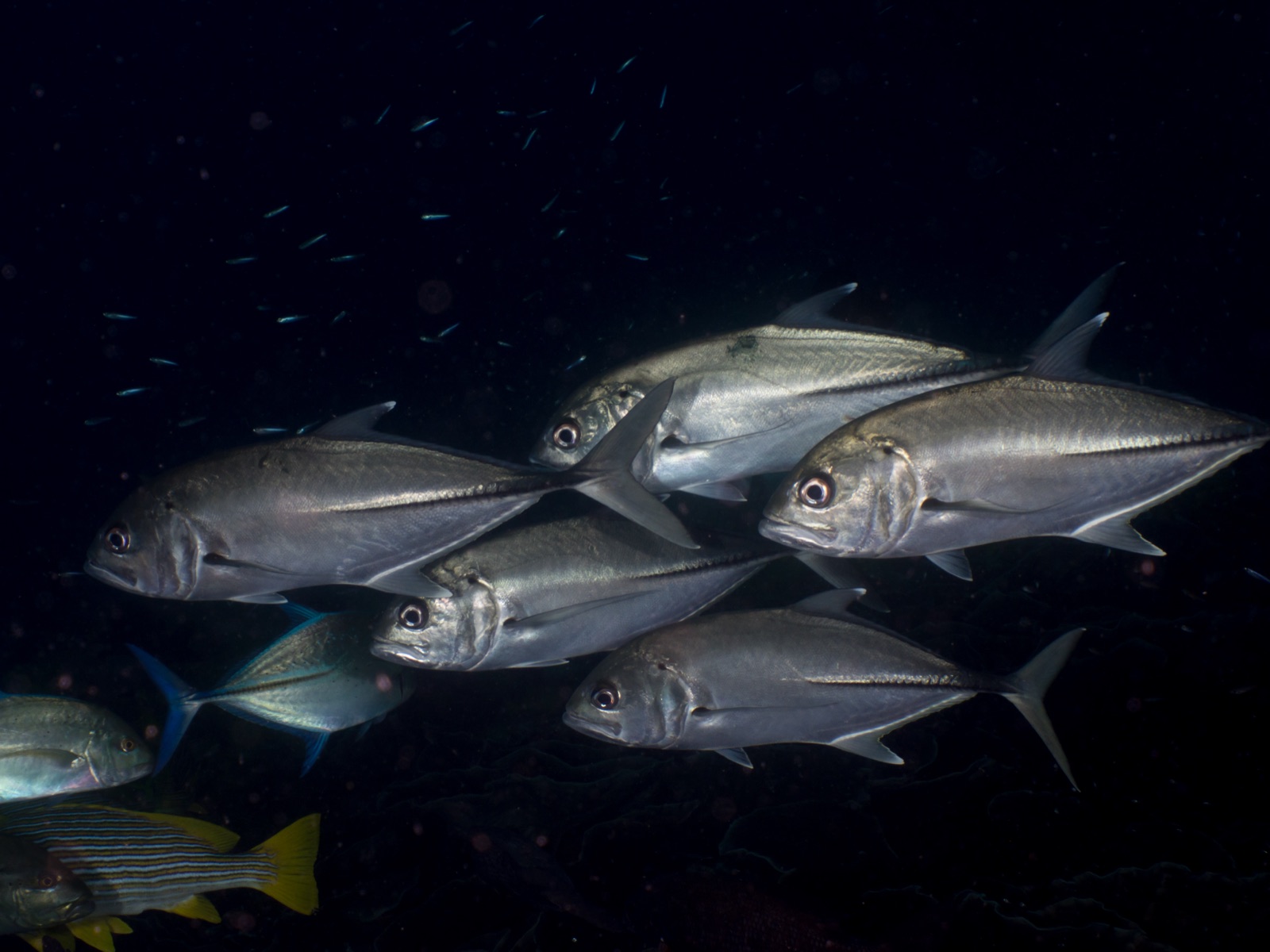
Caranx sexfasciatus reaches 120 cm and 18 kg. Circumtropical jack with silver fusiform body with blue-green-black back, big eyes (hence bigeye trevally). Black spot on operculum, distinctive white spot at tip of upper caudal lobe. Juveniles with 6 dark vertical bands (hence sexfasciatus). Lives in spectacular swirling dense schools (baitball-like schooling) from 0 to 146 m around Indo-Pacific and Eastern Pacific seamounts. Pelagic predator. Mythical encounters at Cabo Pulmo (schools of thousands), Galapagos, Roca Partida Socorro, Sipadan, Palau.
Frequently asked questions
- How big is the Bigeye trevally?
- Bigeye trevally (Caranx sexfasciatus) reaches 40–120 cm in length.
- At what depth can you find the Bigeye trevally?
- Bigeye trevally is found between 0–146 m deep.
- Is the Bigeye trevally dangerous to divers?
- Danger level: Harmless.
- What is the conservation status of the Bigeye trevally?
- IUCN status: Least concern (LC).
- Where can you find the Bigeye trevally?
- Found in: Asian Pacific, Caribbean, Eastern Pacific, Indian Ocean & Red Sea.
Other species in the genus Caranx
- Caranx latus - Horse-eye jack
- Caranx melampygus - Bluefin trevally
- Caranx crysos - Blue runner
- Caranx ruber - Bar jack
- Caranx caninus - Pacific crevalle jack
- Caranx senegallus - Senegal jack
Other species in the family Carangidae
- Seriola dumerili - Greater amberjack
- Trachinotus falcatus - Permit
- Pseudocaranx dentex - White trevally
- Selene peruviana - Pacific moonfish
- Seriola rivoliana - Almaco jack
- Trachinotus goodei - Palometa
Sources
- Taxonomy: WoRMS (AphiaID 218404)
- Photos: iNaturalist (CC BY-NC)
- Distribution: GBIF (taxonKey 2390776)
- Conservation: IUCN Red List
- Encyclopedia: Wikipedia