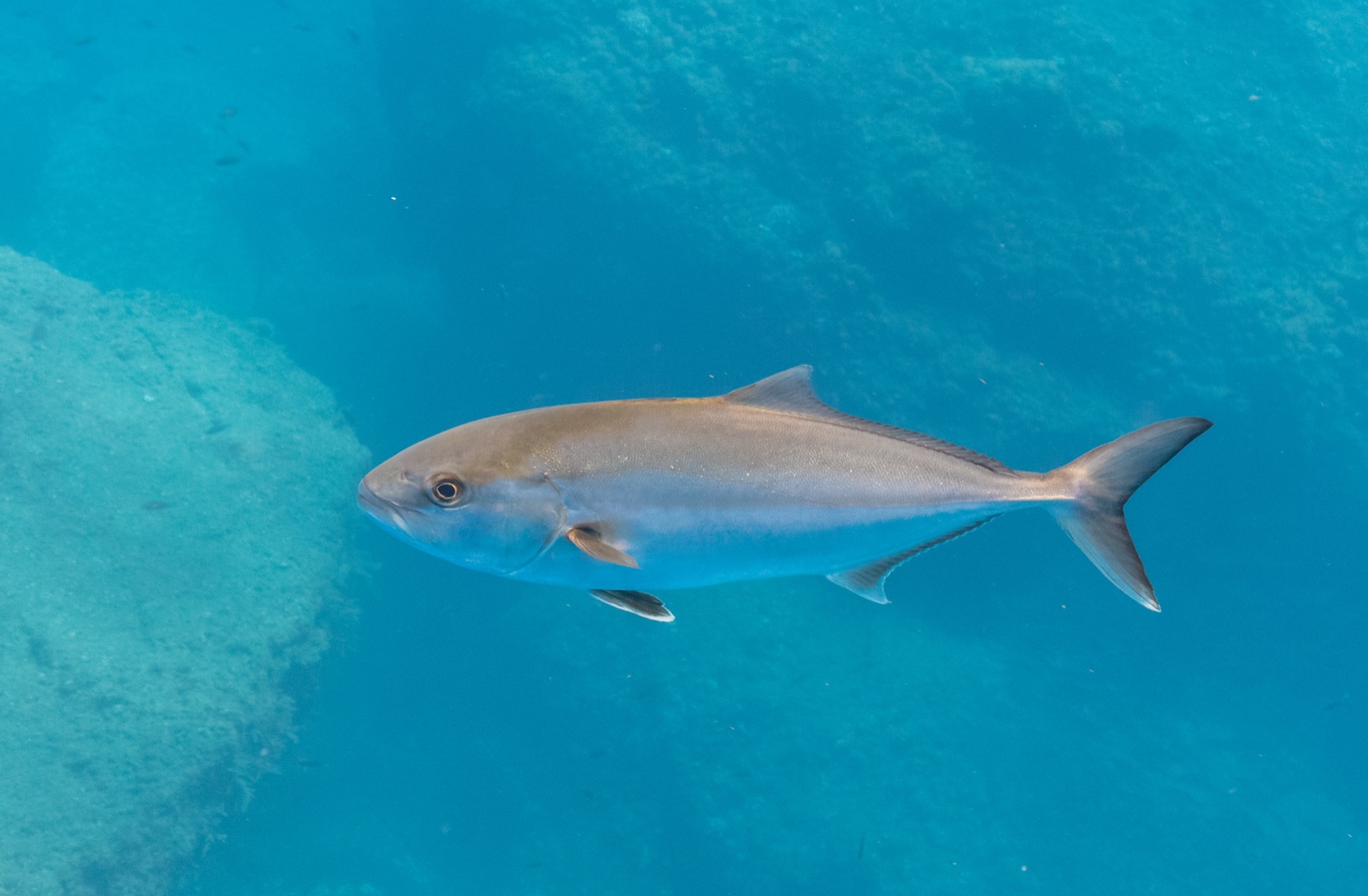
Greater amberjack (Seriola dumerili)
Key facts
- Scientific name
- Seriola dumerili
- Common name
- Greater amberjack
- Category
- Fish
- Family
- Carangidae
- Genus
- Seriola
- Size
- 80–190 cm
- Depth
- 5–360 m
- IUCN status
- Least concern (LC)
- Danger level
- Harmless
- Habitats
- open-water, wreck
- Behaviours
- schooling, fast-moving
- Ocean zones
- East Atlantic, Macaronesia, Mediterranean, Asian Pacific, Caribbean, Indian Ocean & Red Sea, Eastern Pacific
Description
Seriola dumerili reaches 190 cm and 80 kg, the largest amberjack worldwide. Silver-blue with oblique gold band through eye forming a characteristic diadem line. Lives in schools from 5 to 360 m around pinnacles, wrecks and deep rocks of Mediterranean, Atlantic, Pacific. Fast voraciously curious predator. Electric diving encounter, schooling passes on the famous Formigas of Azores. Local overfishing.
Photo of Greater amberjack
Frequently asked questions
- How big is the Greater amberjack?
- Greater amberjack (Seriola dumerili) reaches 80–190 cm in length.
- At what depth can you find the Greater amberjack?
- Greater amberjack is found between 5–360 m deep.
- Is the Greater amberjack dangerous to divers?
- Danger level: Harmless.
- What is the conservation status of the Greater amberjack?
- IUCN status: Least concern (LC).
- Where can you find the Greater amberjack?
- Found in: East Atlantic, Macaronesia, Mediterranean, Asian Pacific, Caribbean, Indian Ocean & Red Sea, Eastern Pacific.
Other species in the genus Seriola
Other species in the family Carangidae
- Caranx latus - Horse-eye jack
- Caranx melampygus - Bluefin trevally
- Caranx crysos - Blue runner
- Caranx ruber - Bar jack
- Trachinotus falcatus - Permit
- Pseudocaranx dentex - White trevally
Sources
- Taxonomy: WoRMS (AphiaID 126816)
- Photos: iNaturalist (CC BY-NC)
- Distribution: GBIF (taxonKey 5961696)
- Conservation: IUCN Red List
- Encyclopedia: Wikipedia