Horse-eye jack (Caranx latus)
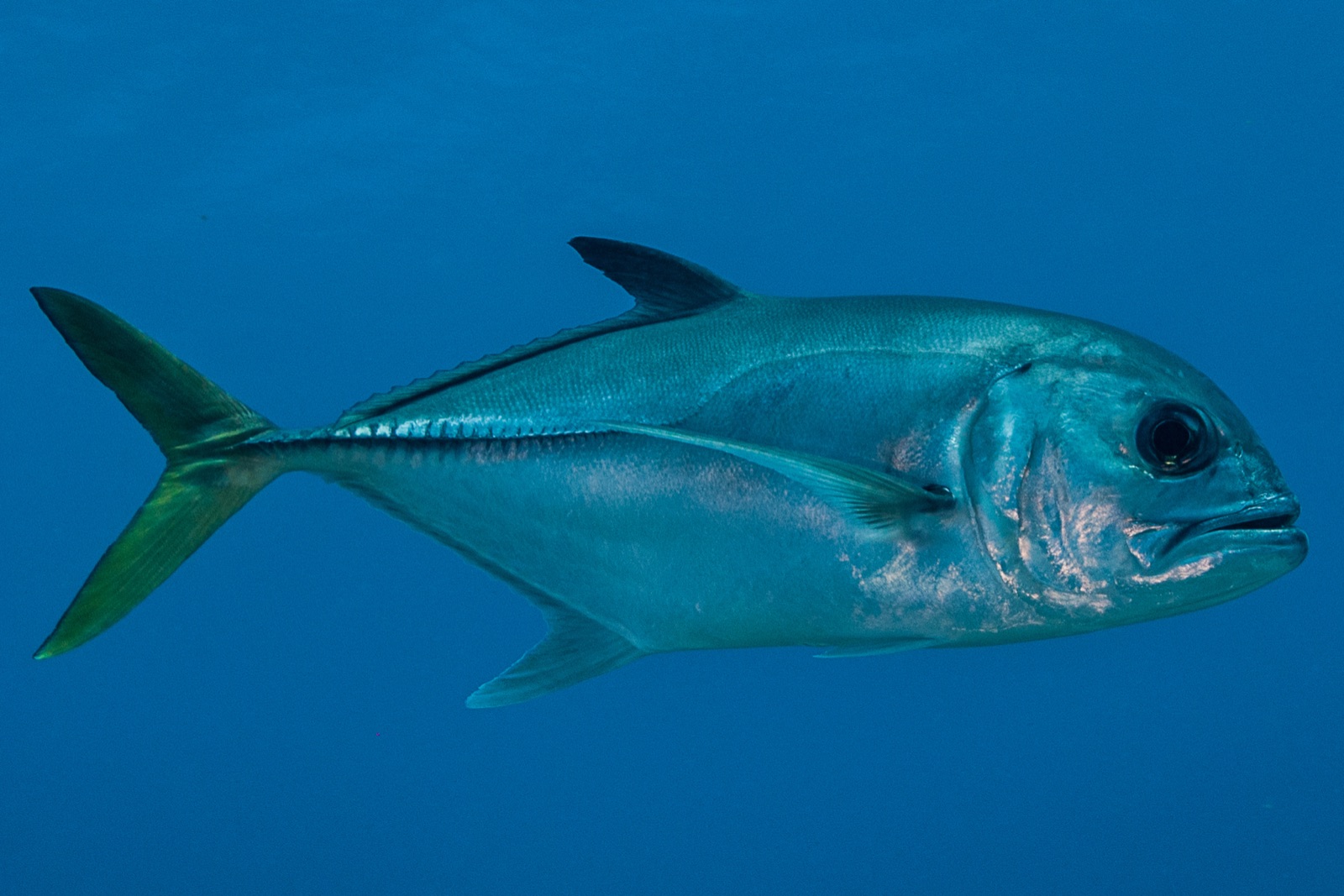
Key facts
- Scientific name
- Caranx latus
- Common name
- Horse-eye jack
- Category
- Fish
- Family
- Carangidae
- Genus
- Caranx
- Size
- 40–100 cm
- Depth
- 0–50 m
- IUCN status
- Least concern (LC)
- Danger level
- Harmless
- Habitats
- coral-reef, open-water
- Behaviours
- solitary, schooling, fast-moving
- Ocean zones
- Caribbean, Macaronesia, Eastern Pacific
Description
Caranx latus reaches 100 cm and 18 kg. Large silver jack with high laterally compressed body with head with convex rounded profile (hence latus, wide), black spot at tip of operculum. Lives in schools or solitary from 0 to 50 m on coral reefs and open water of Caribbean and tropical western Atlantic. Fast pelagic predator. Often in spectacular surface hunts on small pelagics. Prized encounter of Caribbean dives near passes.
Frequently asked questions
- How big is the Horse-eye jack?
- Horse-eye jack (Caranx latus) reaches 40–100 cm in length.
- At what depth can you find the Horse-eye jack?
- Horse-eye jack is found between 0–50 m deep.
- Is the Horse-eye jack dangerous to divers?
- Danger level: Harmless.
- What is the conservation status of the Horse-eye jack?
- IUCN status: Least concern (LC).
- Where can you find the Horse-eye jack?
- Found in: Caribbean, Macaronesia, Eastern Pacific.
Other species in the genus Caranx
- Caranx melampygus - Bluefin trevally
- Caranx crysos - Blue runner
- Caranx ruber - Bar jack
- Caranx caninus - Pacific crevalle jack
- Caranx sexfasciatus - Bigeye trevally
- Caranx senegallus - Senegal jack
Other species in the family Carangidae
- Seriola dumerili - Greater amberjack
- Trachinotus falcatus - Permit
- Pseudocaranx dentex - White trevally
- Selene peruviana - Pacific moonfish
- Seriola rivoliana - Almaco jack
- Trachinotus goodei - Palometa
Sources
- Taxonomy: WoRMS (AphiaID 126804)
- Photos: iNaturalist (CC BY-NC)
- Distribution: GBIF (taxonKey 2390847)
- Conservation: IUCN Red List
- Encyclopedia: Wikipedia