White grunt (Haemulon plumierii)
Key facts
- Scientific name
- Haemulon plumierii
- Common name
- White grunt
- Category
- Fish
- Family
- Haemulidae
- Genus
- Haemulon
- Size
- 20–53 cm
- Depth
- 0–40 m
- IUCN status
- Near threatened (NT)
- Danger level
- Harmless
- Habitats
- coral-reef, sand, seagrass
- Behaviours
- schooling, nocturnal
- Ocean zones
- Caribbean, Eastern Pacific
Description
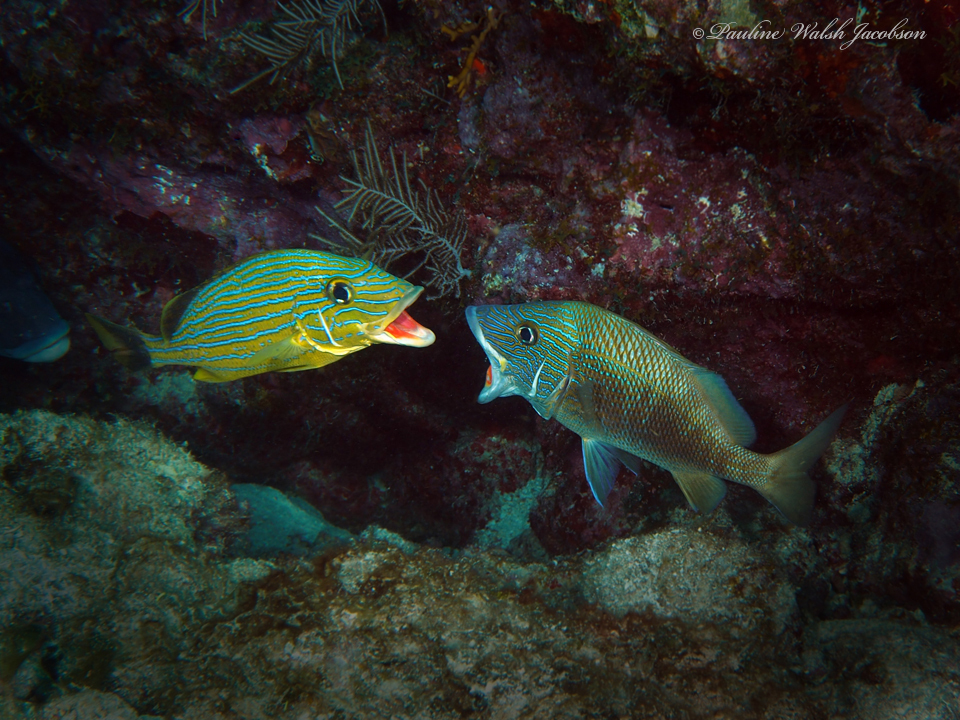
Haemulon plumierii reaches 53 cm, one of the largest Caribbean grunts. Silver body with head with fine blue longitudinal lines on yellow-green background, black-edged scales. Bright red mouth interior. Lives in dense schools from 0 to 40 m on coral reefs, sands and seagrass of Caribbean and tropical western Atlantic (Florida to Brazil). Listed NT by IUCN following overfishing for consumption. Nocturnal, comes out to hunt on sands. Signature photo subject of Caribbean dives.
Frequently asked questions
- How big is the White grunt?
- White grunt (Haemulon plumierii) reaches 20–53 cm in length.
- At what depth can you find the White grunt?
- White grunt is found between 0–40 m deep.
- Is the White grunt dangerous to divers?
- Danger level: Harmless.
- What is the conservation status of the White grunt?
- IUCN status: Near threatened (NT).
- Where can you find the White grunt?
- Found in: Caribbean, Eastern Pacific.
Other species in the genus Haemulon
- Haemulon flavolineatum - French grunt
- Haemulon sciurus - Bluestriped grunt
- Haemulon parra - Sailor's choice
- Haemulon aurolineatum - Tomtate grunt
- Haemulon flaviguttatum - Yellowspot Grunt
- Haemulon sexfasciatum - Sixbar Grunt
Other species in the family Haemulidae
- Plectorhinchus vittatus - Oriental sweetlips
- Plectorhinchus chaetodonoides - Harlequin sweetlips
- Anisotremus virginicus - Porkfish
- Parapristipoma octolineatum - African striped grunt
- Anisotremus surinamensis - Black margate
- Pomadasys incisus - Bastard grunt
Sources
- Taxonomy: WoRMS (AphiaID 158808)
- Photos: iNaturalist (CC BY-NC)
- Distribution: GBIF (taxonKey 2382537)
- Conservation: IUCN Red List
- Encyclopedia: Wikipedia