Striped Sweetlips (Plectorhinchus gaterinus)
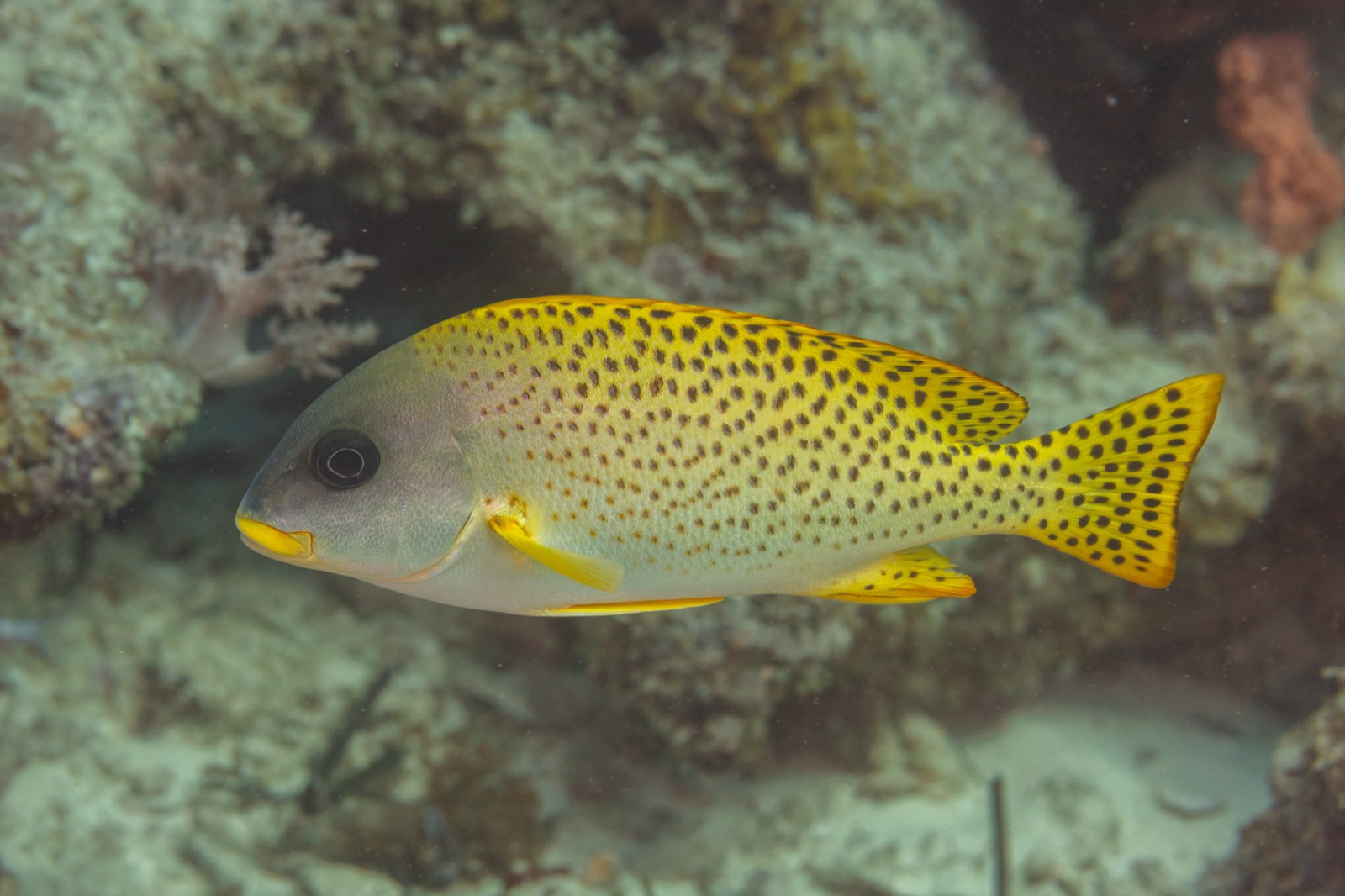
Key facts
- Scientific name
- Plectorhinchus gaterinus
- Common name
- Striped Sweetlips
- Category
- Molluscs
- Family
- Haemulidae
- Genus
- Plectorhinchus
- Size
- 30–50 cm
- Depth
- 5–40 m
- IUCN status
- Least concern (LC)
- Danger level
- Harmless
- Habitats
- coral-reef, rocky-reef
- Behaviours
- benthic, nocturnal, schooling
- Ocean zones
- Asian Pacific, Indian Ocean & Red Sea
Description
Plectorhinchus gaterinus reaches 50 cm. Sweetlips/grunt (Haemulidae) Indo-Pacific. Numerous black-white oblique stripes (30+). Heavy swimmer, sheltered in cave/under ledge by day. Nocturnal, emerges to feed on coral polyps and small invertebrates. Often in loose schools. Reefs 5-40 m. No threats = LC. Hidden by day, visible at night with torch.
Frequently asked questions
- How big is the Striped Sweetlips?
- Striped Sweetlips (Plectorhinchus gaterinus) reaches 30–50 cm in length.
- At what depth can you find the Striped Sweetlips?
- Striped Sweetlips is found between 5–40 m deep.
- Is the Striped Sweetlips dangerous to divers?
- Danger level: Harmless.
- What is the conservation status of the Striped Sweetlips?
- IUCN status: Least concern (LC).
- Where can you find the Striped Sweetlips?
- Found in: Asian Pacific, Indian Ocean & Red Sea.
Other species in the genus Plectorhinchus
- Plectorhinchus vittatus - Oriental sweetlips
- Plectorhinchus chaetodonoides - Harlequin sweetlips
- Plectorhinchus mediterraneus - Rubberlip grunt
- Plectorhinchus macrolepis - Bigscale grunt
- Plectorhinchus schotaf - Blackspotted Sweetlips
- Plectorhinchus albovittatus - Whiteline Sweetlips
Other species in the family Haemulidae
- Haemulon flavolineatum - French grunt
- Haemulon sciurus - Bluestriped grunt
- Haemulon parra - Sailor's choice
- Anisotremus virginicus - Porkfish
- Parapristipoma octolineatum - African striped grunt
- Anisotremus surinamensis - Black margate
Sources
- Taxonomy: WoRMS (AphiaID 218552)
- Photos: iNaturalist (CC BY-NC)
- Distribution: GBIF (taxonKey 2382665)
- Conservation: IUCN Red List
- Encyclopedia: Wikipedia