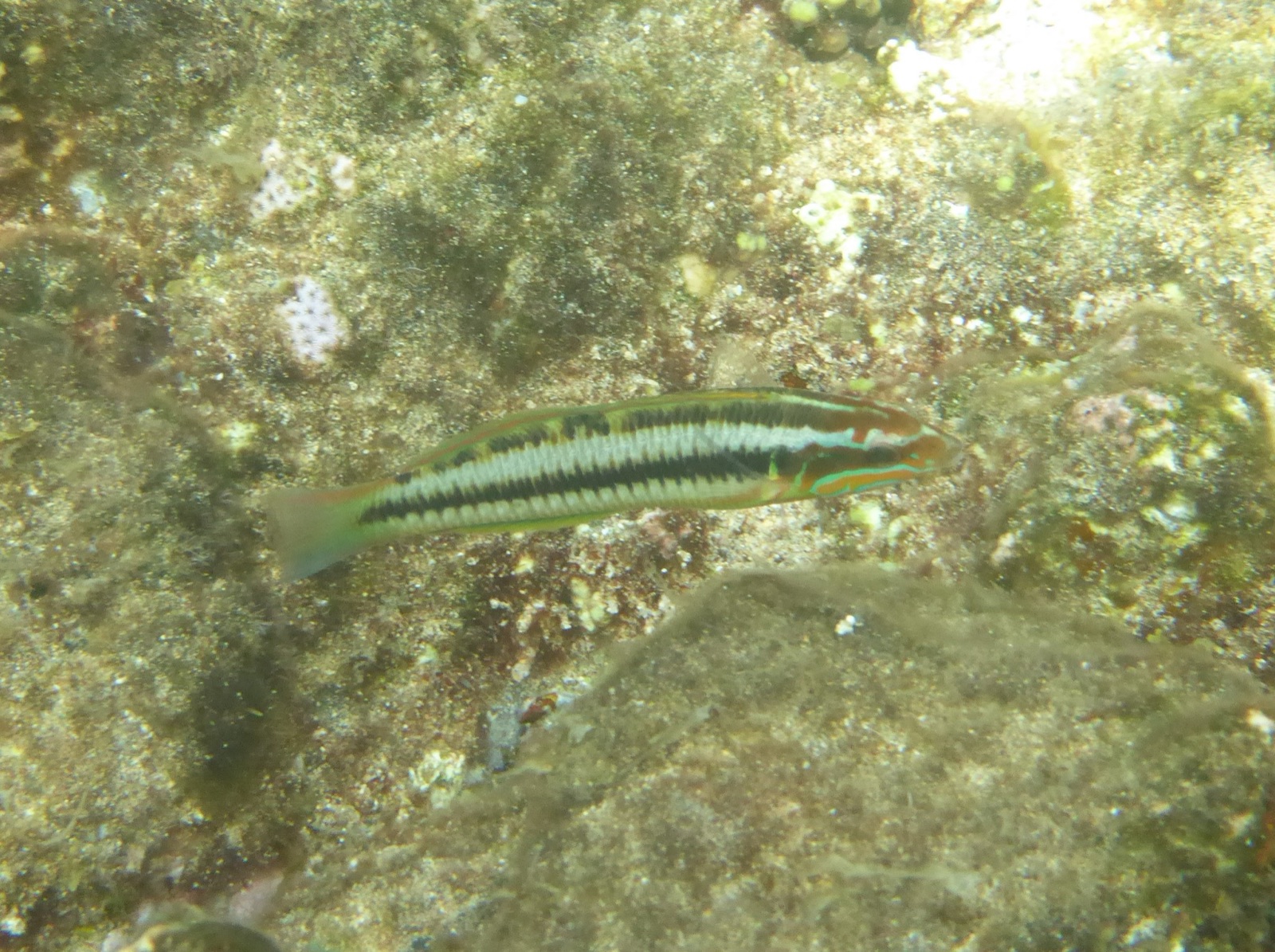
Newton's wrasse (Thalassoma newtoni)
Key facts
- Scientific name
- Thalassoma newtoni
- Common name
- Newton's wrasse
- Category
- Fish
- Family
- Labridae
- Genus
- Thalassoma
- Size
- 15–25 cm
- Depth
- 2–50 m
- IUCN status
- Least concern (LC)
- Danger level
- Harmless
- Habitats
- rocky-reef
- Behaviours
- schooling
- Ocean zones
- East Atlantic, Macaronesia, Mediterranean
Description
Thalassoma newtoni reaches 25 cm. Cape Verde and tropical East Atlantic endemic wrasse (Guinea, occasional Senegal). Terminal males with bright blue-green body with pink-purple head and irregular pink-orange bands on flanks, geographically isolated cousin of Indo-Pacific Thalassoma (T. lunare batch 11). Protogynous hermaphrodite. Lives in active schools from 2 to 50 m on Cape Verde rocky reefs. Named after Francisco Newton, Portuguese naturalist. Iconic photo subject of Cape Verde dives, colorful endemic.
Frequently asked questions
- How big is the Newton's wrasse?
- Newton's wrasse (Thalassoma newtoni) reaches 15–25 cm in length.
- At what depth can you find the Newton's wrasse?
- Newton's wrasse is found between 2–50 m deep.
- Is the Newton's wrasse dangerous to divers?
- Danger level: Harmless.
- What is the conservation status of the Newton's wrasse?
- IUCN status: Least concern (LC).
- Where can you find the Newton's wrasse?
- Found in: East Atlantic, Macaronesia, Mediterranean.
Other species in the genus Thalassoma
- Thalassoma pavo - Ornate wrasse
- Thalassoma bifasciatum - Bluehead wrasse
- Thalassoma lunare - Moon wrasse
- Thalassoma lucasanum - Cortez rainbow wrasse
- Thalassoma lutescens - Rainbow Wrasse
- Thalassoma grammaticum - Bluehead Wrasse
Other species in the family Labridae
- Cheilinus undulatus - Humphead wrasse
- Labrus bergylta - Ballan Wrasse
- Sparisoma cretense - Mediterranean parrotfish
- Symphodus mediterraneus - Axillary wrasse
- Symphodus rostratus - Pointed-snout wrasse
- Symphodus ocellatus - Ocellated wrasse
Sources
- Taxonomy: WoRMS (AphiaID 273586)
- Photos: iNaturalist (CC BY-NC)
- Distribution: GBIF (taxonKey 2384490)
- Conservation: IUCN Red List
- Encyclopedia: Wikipedia