Humphead wrasse (Cheilinus undulatus)
Key facts
- Scientific name
- Cheilinus undulatus
- Common name
- Humphead wrasse
- Category
- Fish
- Family
- Labridae
- Genus
- Cheilinus
- Size
- 100–230 cm
- Depth
- 1–100 m
- IUCN status
- Endangered (EN)
- Danger level
- Harmless
- Habitats
- coral-reef
- Behaviours
- solitary, slow-mover
- Ocean zones
- Indian Ocean & Red Sea, Asian Pacific
Description
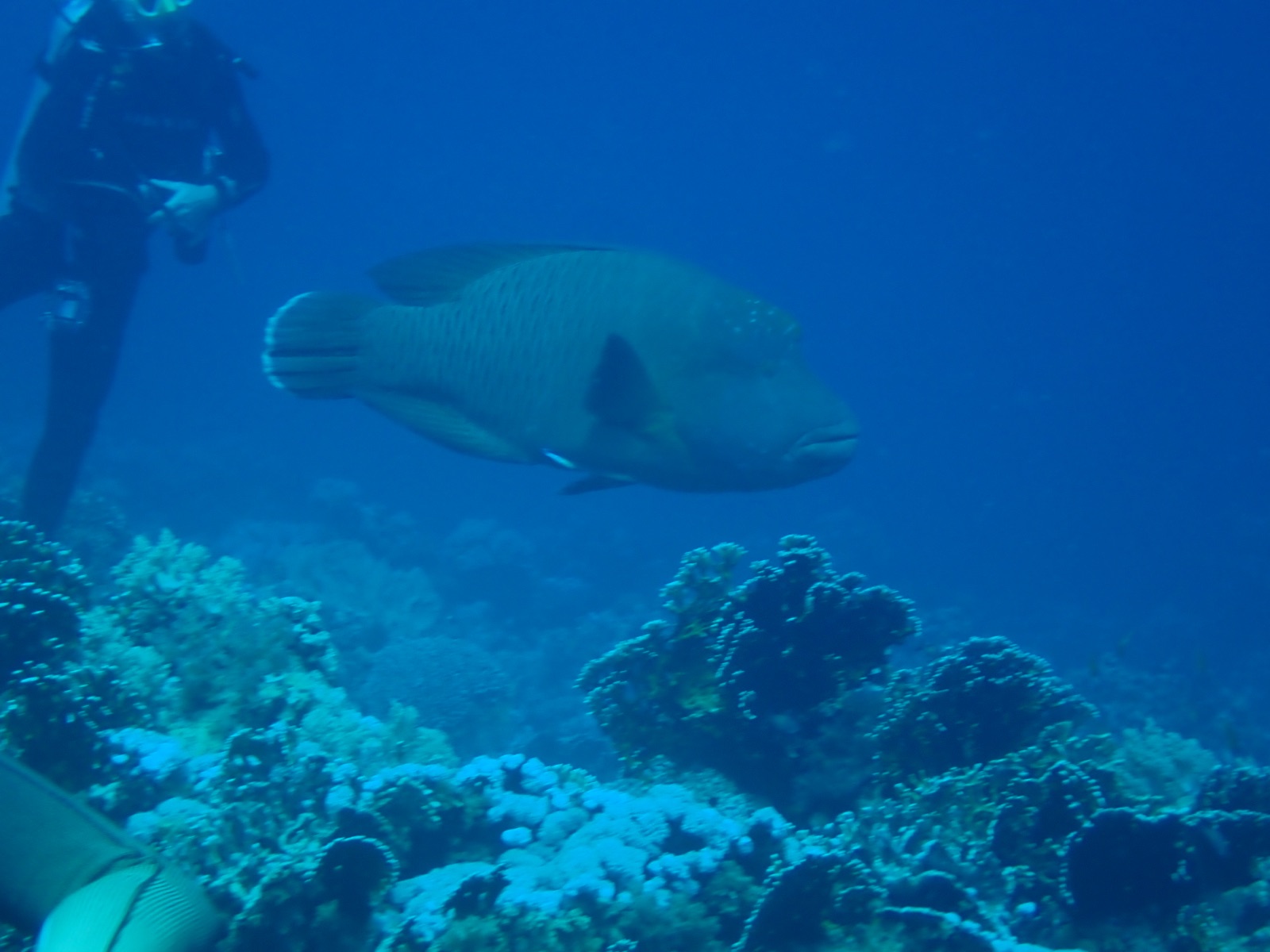
Cheilinus undulatus reaches 2.3 m and 190 kg, the largest wrasse worldwide. Massive green-blue to dark blue body with fine wavy patterns and two black lines from eye. Adult males with characteristic impressive forehead hump (melon). Protogynous hermaphrodite: all born female, dominant become male at 6 years. Lives from 1 to 100 m on coral reefs of Indo-Pacific. Listed EN by IUCN after intense overfishing (Hong Kong luxury restaurants). Iconic encounters Red Sea (Ras Mohamed), Maldives, Great Barrier.
Frequently asked questions
- How big is the Humphead wrasse?
- Humphead wrasse (Cheilinus undulatus) reaches 100–230 cm in length.
- At what depth can you find the Humphead wrasse?
- Humphead wrasse is found between 1–100 m deep.
- Is the Humphead wrasse dangerous to divers?
- Danger level: Harmless.
- What is the conservation status of the Humphead wrasse?
- IUCN status: Endangered (EN).
- Where can you find the Humphead wrasse?
- Found in: Indian Ocean & Red Sea, Asian Pacific.
Other species in the genus Cheilinus
- Cheilinus trilobatus - Tripletail wrasse
- Cheilinus chlorourus - Green-spotted Wrasse
- Cheilinus fasciatus - Redbreasted Wrasse
Other species in the family Labridae
- Labrus bergylta - Ballan Wrasse
- Sparisoma cretense - Mediterranean parrotfish
- Symphodus mediterraneus - Axillary wrasse
- Symphodus rostratus - Pointed-snout wrasse
- Symphodus ocellatus - Ocellated wrasse
- Coris julis - Mediterranean rainbow wrasse
Sources
- Taxonomy: WoRMS (AphiaID 218945)
- Photos: iNaturalist (CC BY-NC)
- Distribution: GBIF (taxonKey 2383313)
- Conservation: IUCN Red List
- Encyclopedia: Wikipedia