Corkwing wrasse (Symphodus melops)
Key facts
- Scientific name
- Symphodus melops
- Common name
- Corkwing wrasse
- Category
- Fish
- Family
- Labridae
- Genus
- Symphodus
- Size
- 10–28 cm
- Depth
- 1–30 m
- IUCN status
- Least concern (LC)
- Danger level
- Harmless
- Habitats
- rocky, kelp
- Behaviours
- solitary, territorial
- Ocean zones
- East Atlantic, Mediterranean
Description
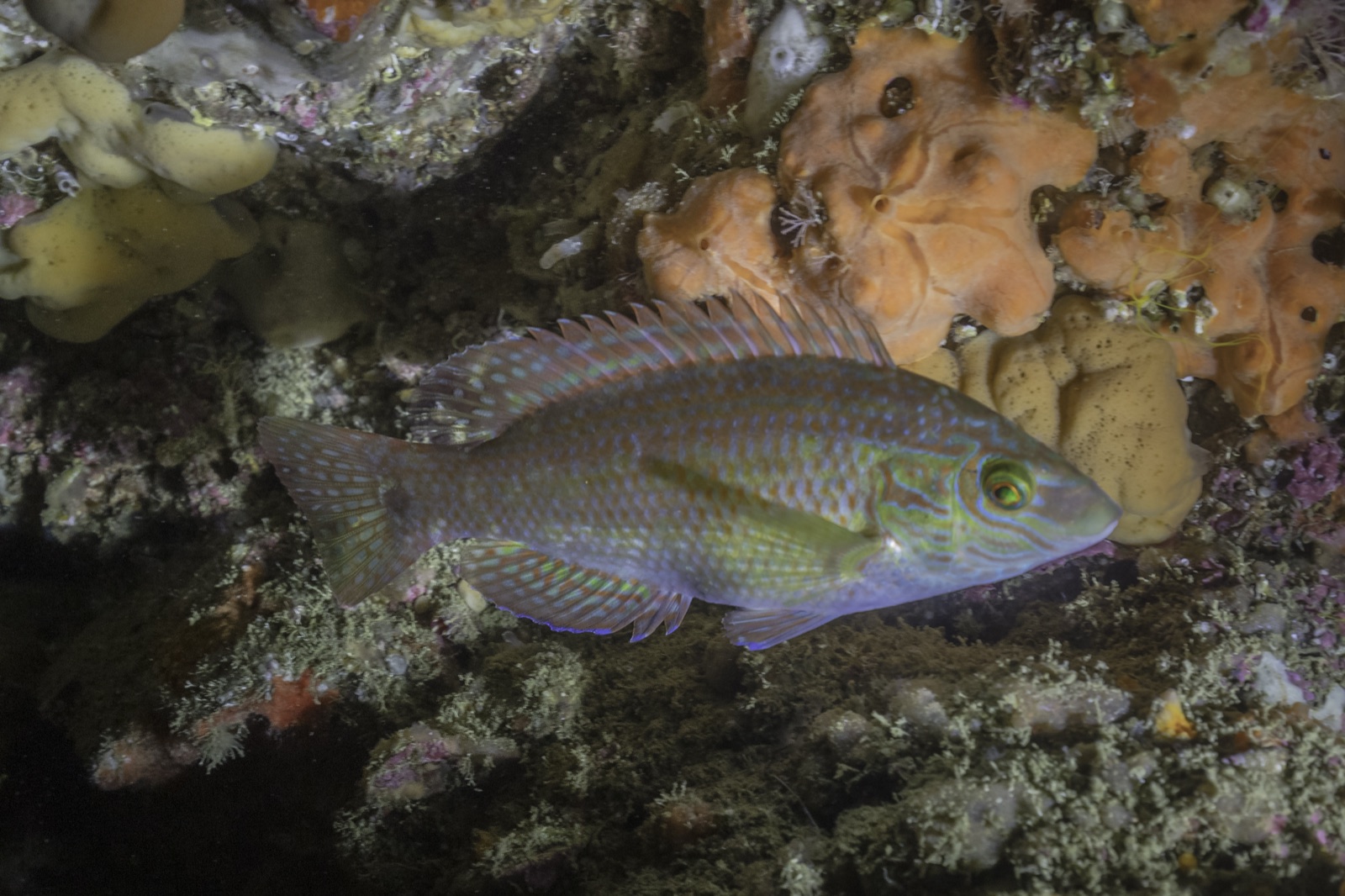
Symphodus melops reaches 28 cm. Stocky oval-bodied wrasse, highly variable color (brown, red, green, blue), always with a characteristic large black spot behind the eye and a yellow-white line below. Protogynous hermaphrodite. Lives on rocks and in kelp forests of the NE Atlantic, from Norway to Portugal, and in the Mediterranean. Builds an algae nest. Used as a cleaner fish in Norwegian aquaculture.
Frequently asked questions
- How big is the Corkwing wrasse?
- Corkwing wrasse (Symphodus melops) reaches 10–28 cm in length.
- At what depth can you find the Corkwing wrasse?
- Corkwing wrasse is found between 1–30 m deep.
- Is the Corkwing wrasse dangerous to divers?
- Danger level: Harmless.
- What is the conservation status of the Corkwing wrasse?
- IUCN status: Least concern (LC).
- Where can you find the Corkwing wrasse?
- Found in: East Atlantic, Mediterranean.
Other species in the genus Symphodus
- Symphodus mediterraneus - Axillary wrasse
- Symphodus rostratus - Pointed-snout wrasse
- Symphodus ocellatus - Ocellated wrasse
- Symphodus tinca - Peacock wrasse
- Symphodus roissali - Five-spotted wrasse
- Symphodus cinereus - Grey wrasse
Other species in the family Labridae
- Cheilinus undulatus - Humphead wrasse
- Labrus bergylta - Ballan Wrasse
- Sparisoma cretense - Mediterranean parrotfish
- Coris julis - Mediterranean rainbow wrasse
- Thalassoma pavo - Ornate wrasse
- Bodianus rufus - Spanish hogfish
Sources
- Taxonomy: WoRMS (AphiaID 273571)
- Photos: iNaturalist (CC BY-NC)
- Distribution: GBIF (taxonKey 2383978)
- Conservation: IUCN Red List
- Encyclopedia: Wikipedia