Spotted hypselodoris (Hypselodoris maculosa)
Key facts
- Scientific name
- Hypselodoris maculosa
- Common name
- Spotted hypselodoris
- Category
- Molluscs
- Family
- Chromodorididae
- Genus
- Hypselodoris
- Size
- 3–6 cm
- Depth
- 5–30 m
- IUCN status
- Least concern (LC)
- Danger level
- Harmless
- Habitats
- coral-reef
- Behaviours
- benthic, slow-mover
- Ocean zones
- Asian Pacific, Indian Ocean & Red Sea
Description
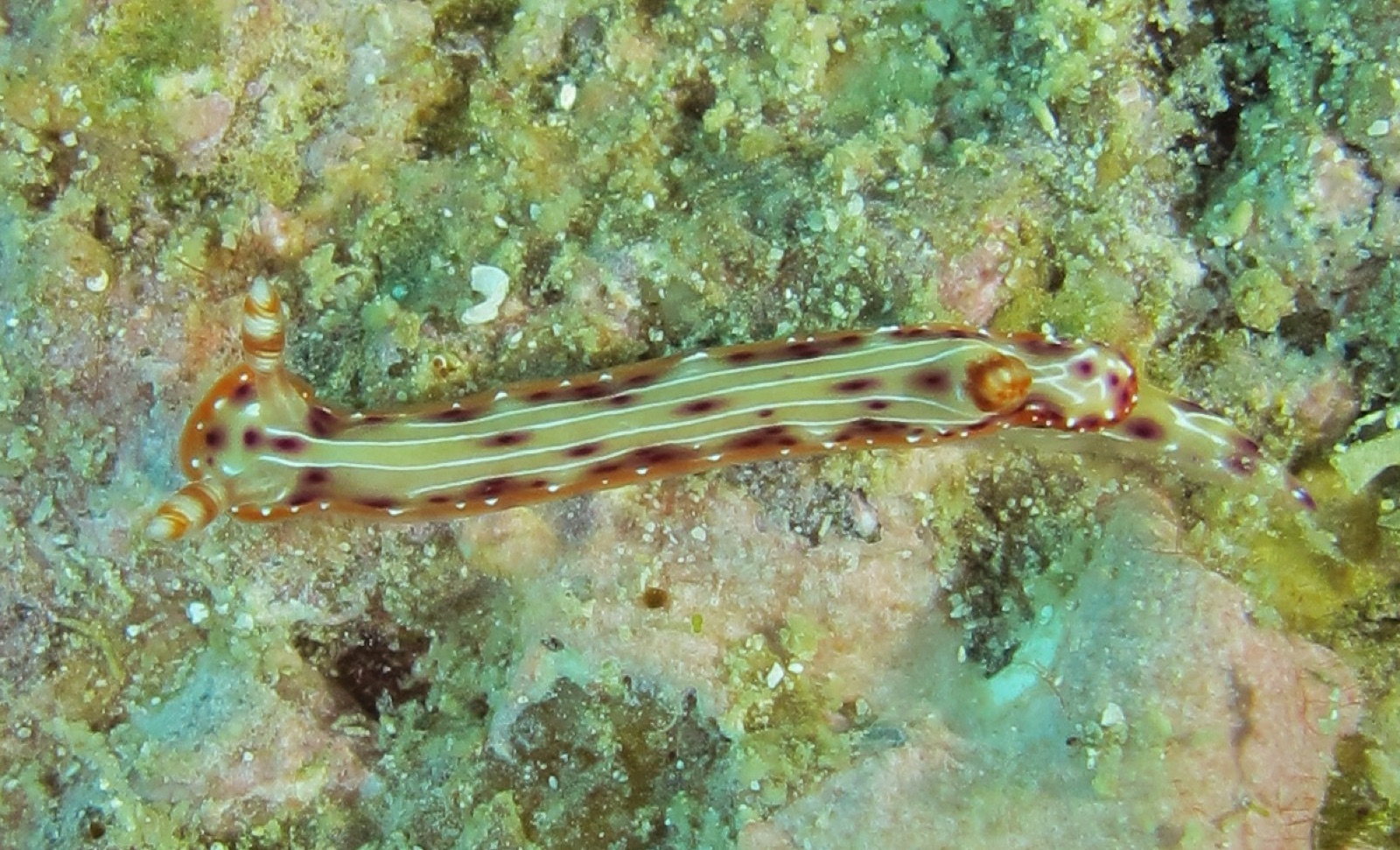
Hypselodoris maculosa reaches 6 cm. Indo-Pacific nudibranch (Chromodorididae) with cream-white mantle covered with distinctive large irregular purple-black spots forming distinct leopard pattern, yellow-purple mantle edge, white to pink gills, purple rhinophores. Lives from 5 to 30 m on coral reefs of central Indo-Pacific. Feeds on sponges. Iconic macro photo subject for its contrasting black-white pattern.
Frequently asked questions
- How big is the Spotted hypselodoris?
- Spotted hypselodoris (Hypselodoris maculosa) reaches 3–6 cm in length.
- At what depth can you find the Spotted hypselodoris?
- Spotted hypselodoris is found between 5–30 m deep.
- Is the Spotted hypselodoris dangerous to divers?
- Danger level: Harmless.
- What is the conservation status of the Spotted hypselodoris?
- IUCN status: Least concern (LC).
- Where can you find the Spotted hypselodoris?
- Found in: Asian Pacific, Indian Ocean & Red Sea.
Other species in the genus Hypselodoris
- Hypselodoris bullockii - Bullock's hypselodoris
- Hypselodoris picta - Painted hypselodoris
- Hypselodoris apolegma - Apolegma chromodoris
- Hypselodoris emma - Emma's hypselodoris
- Hypselodoris infucata - Painted hypselodoris
- Hypselodoris tryoni - Tryon's hypselodoris
Other species in the family Chromodorididae
- Chromodoris magnifica - Magnificent chromodoris
- Felimare tricolor - Tricolor doris
- Chromodoris quadricolor - Pyjama slug
- Felimida luteorosea - Rose-and-gold doris
- Felimida purpurea - Purple doris
- Goniobranchus reticulatus - Reticulated goniobranchus
Sources
- Taxonomy: WoRMS (AphiaID 209597)
- Photos: iNaturalist (CC BY-NC)
- Distribution: GBIF (taxonKey 4360069)
- Conservation: IUCN Red List
- Encyclopedia: Wikipedia