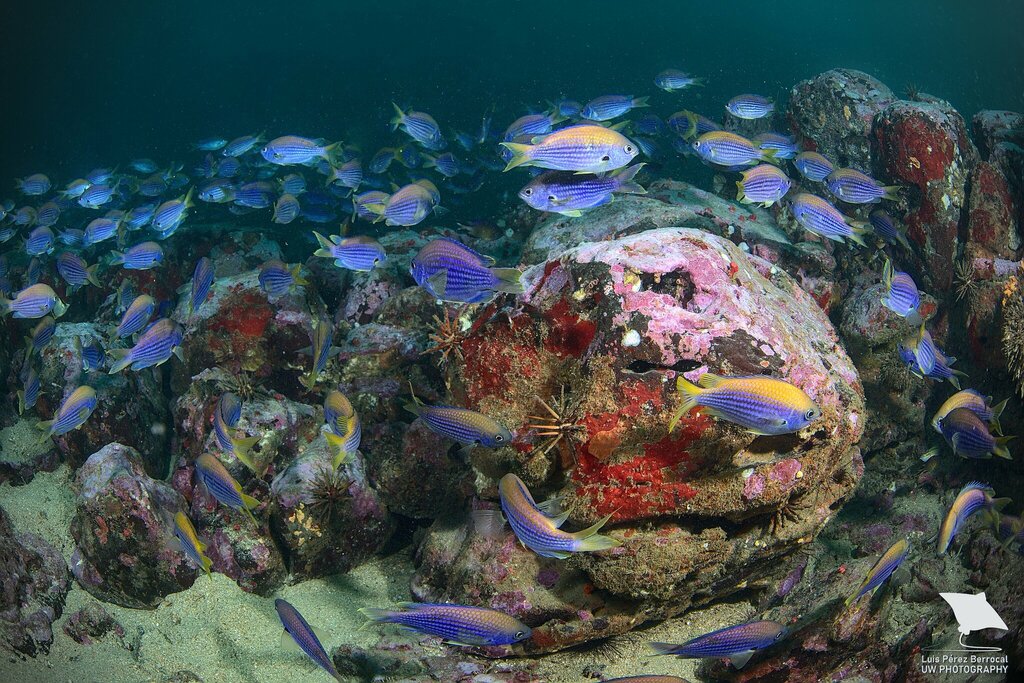
Cadenat's chromis (Chromis cadenati)
Key facts
- Scientific name
- Chromis cadenati
- Common name
- Cadenat's chromis
- Category
- Fish
- Family
- Pomacentridae
- Genus
- Chromis
- Size
- 8–15 cm
- Depth
- 3–40 m
- IUCN status
- Least concern (LC)
- Danger level
- Harmless
- Habitats
- rocky-reef
- Behaviours
- schooling
- Ocean zones
- East Atlantic, Macaronesia
Description
Chromis cadenati reaches 15 cm. Cape Verde endemic damselfish with uniform blue-purple to blue-black body with distinctive bright yellow tail. Lives in dense active schools from 3 to 40 m above rocky drop-offs and coralligenous of Cape Verde. Planktivore. Endemic cousin of East Atlantic damselfish (Chromis limbata Macaronesia batch 10, Chromis chromis Mediterranean batch 3). Name dedicated to Jean Cadenat, French ichthyologist specialist of African Atlantic (IFAN Dakar). Iconic photo subject of Cape Verde dives, easy-to-recognize endemic.
Frequently asked questions
- How big is the Cadenat's chromis?
- Cadenat's chromis (Chromis cadenati) reaches 8–15 cm in length.
- At what depth can you find the Cadenat's chromis?
- Cadenat's chromis is found between 3–40 m deep.
- Is the Cadenat's chromis dangerous to divers?
- Danger level: Harmless.
- What is the conservation status of the Cadenat's chromis?
- IUCN status: Least concern (LC).
- Where can you find the Cadenat's chromis?
- Found in: East Atlantic, Macaronesia.
Other species in the genus Chromis
- Chromis cyanea - Blue chromis
- Chromis viridis - Blue-green chromis
- Chromis multilineata - Brown chromis
- Chromis limbata - Azores chromis
- Chromis atrilobata - Scissortail chromis
- Chromis limbaughi - Limbaugh's Chromis
Other species in the family Pomacentridae
- Amphiprion ocellaris - False clownfish
- Chromis chromis - Mediterranean damselfish
- Amphiprion bicinctus - Two-band anemonefish
- Abudefduf saxatilis - Sergeant major (Atlantic)
- Stegastes partitus - Bicolor damselfish
- Amphiprion akallopisos - Skunk clownfish
Sources
- Taxonomy: WoRMS (AphiaID 273715)
- Photos: iNaturalist (CC BY-NC)
- Distribution: GBIF (taxonKey 5212145)
- Conservation: IUCN Red List
- Encyclopedia: Wikipedia