King angelfish (Holacanthus passer)
Key facts
- Scientific name
- Holacanthus passer
- Common name
- King angelfish
- Category
- Fish
- Family
- Pomacanthidae
- Genus
- Holacanthus
- Size
- 20–36 cm
- Depth
- 4–80 m
- IUCN status
- Least concern (LC)
- Danger level
- Harmless
- Habitats
- coral-reef, rocky-reef
- Behaviours
- solitary, pair
- Ocean zones
- Caribbean, Eastern Pacific
Description
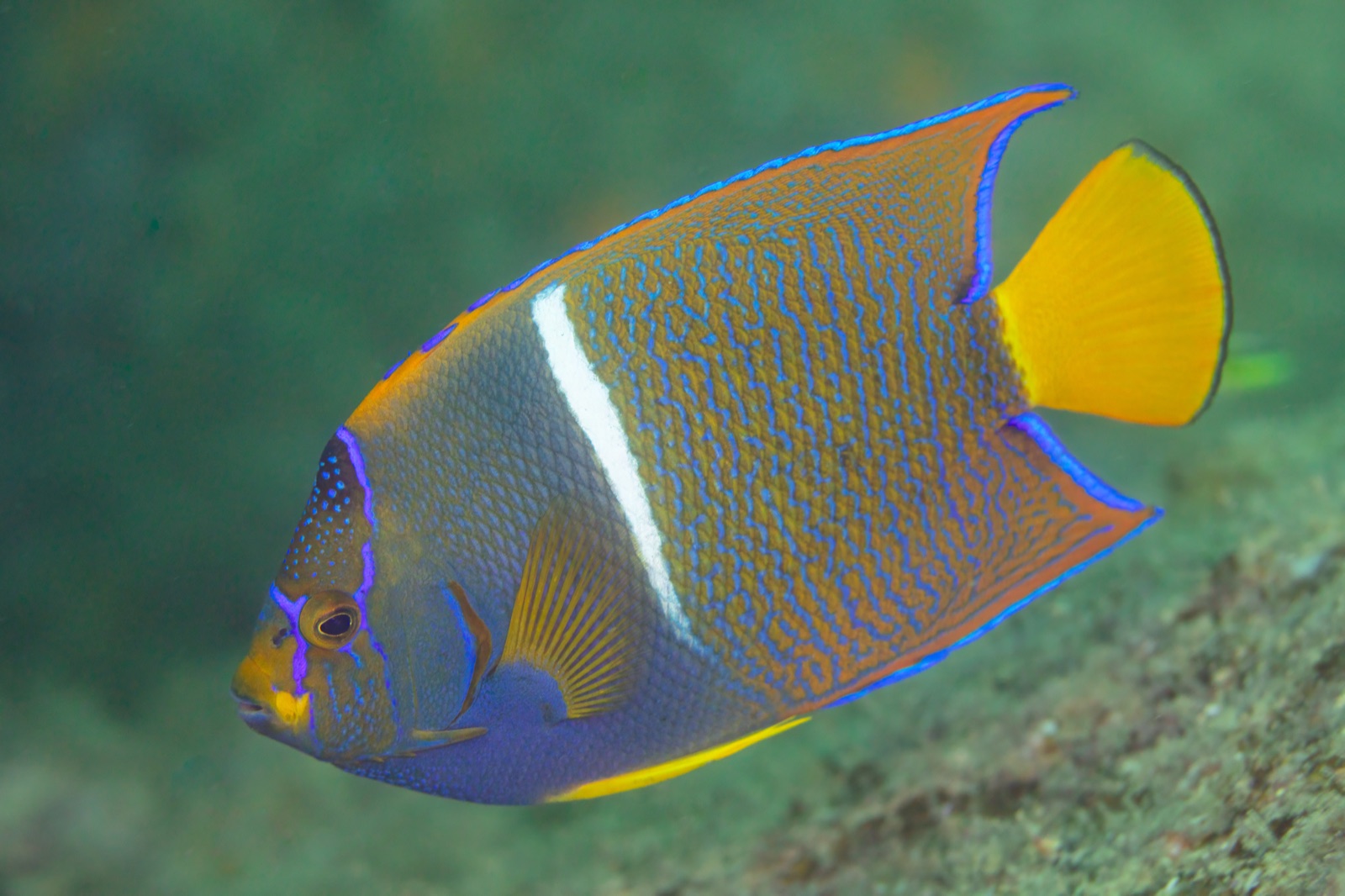
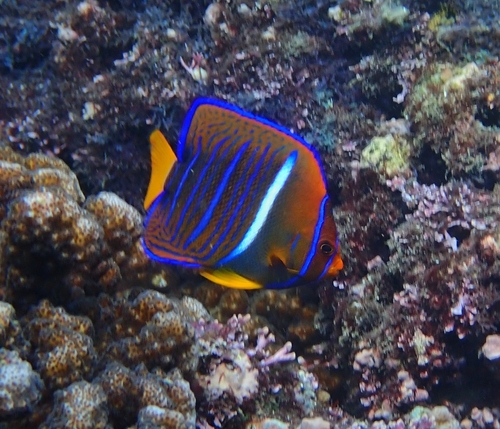
Holacanthus passer reaches 36 cm. Eastern Pacific angelfish with deep blue-black body crossed by very distinctive white vertical bar behind head, yellow tail, anal and dorsal fins edged with yellow lines. Males with white ventral fins, females yellow. Juveniles blue-orange with white bands. Lives from 4 to 80 m on rocky and coral reefs of Eastern Pacific (Gulf of California, Galapagos, Panama). Iconic photo subject, replaces classic tropical Pomacanthus in this zone.
Photo of King angelfish
Frequently asked questions
- How big is the King angelfish?
- King angelfish (Holacanthus passer) reaches 20–36 cm in length.
- At what depth can you find the King angelfish?
- King angelfish is found between 4–80 m deep.
- Is the King angelfish dangerous to divers?
- Danger level: Harmless.
- What is the conservation status of the King angelfish?
- IUCN status: Least concern (LC).
- Where can you find the King angelfish?
- Found in: Caribbean, Eastern Pacific.
Other species in the genus Holacanthus
- Holacanthus ciliaris - Queen angelfish
- Holacanthus tricolor - Rock beauty
- Holacanthus clarionensis - Clarion angelfish
Other species in the family Pomacanthidae
- Pomacanthus paru - French angelfish
- Pomacanthus arcuatus - Gray angelfish
- Pomacanthus maculosus - Yellowbar angelfish
- Pygoplites diacanthus - Regal angelfish
- Pomacanthus imperator - Emperor angelfish
- Centropyge aurantonotus - Flameback angelfish
Sources
- Taxonomy: WoRMS (AphiaID 276016)
- Photos: iNaturalist (CC BY-NC)
- Distribution: GBIF (taxonKey 5211449)
- Conservation: IUCN Red List
- Encyclopedia: Wikipedia