Clown coris (Coris aygula)
Key facts
- Scientific name
- Coris aygula
- Common name
- Clown coris
- Category
- Fish
- Family
- Labridae
- Genus
- Coris
- Size
- 60–120 cm
- Depth
- 2–30 m
- IUCN status
- Least concern (LC)
- Danger level
- Harmless
- Habitats
- coral-reef, sand
- Behaviours
- solitary
- Ocean zones
- Asian Pacific, Indian Ocean & Red Sea
Description
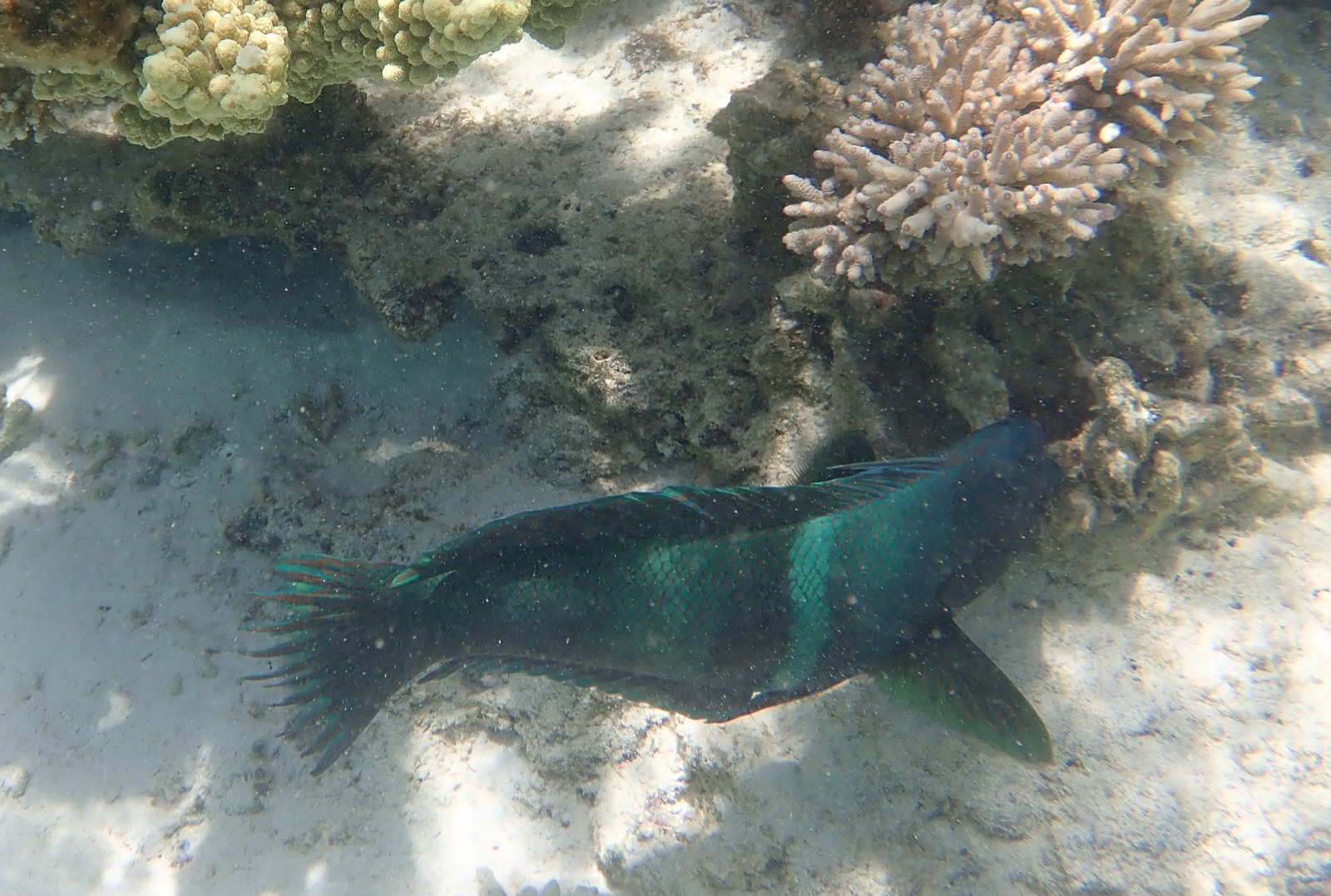
Coris aygula reaches 120 cm. Large wrasse with striking dimorphism. Juveniles white crossed with black spots and bright orange dorsal ocelli (hence clown coris name). Initial females/males green-brown spotted. Terminal males (50 cm+) imposing dark green with massive forehead hump and filamentous pectorals. Lives from 2 to 30 m on reefs and sand of tropical Indo-Pacific. Crushes corals, shells, urchins with powerful teeth. Exceptionally metamorphic photo subject.
Photo of Clown coris
Frequently asked questions
- How big is the Clown coris?
- Clown coris (Coris aygula) reaches 60–120 cm in length.
- At what depth can you find the Clown coris?
- Clown coris is found between 2–30 m deep.
- Is the Clown coris dangerous to divers?
- Danger level: Harmless.
- What is the conservation status of the Clown coris?
- IUCN status: Least concern (LC).
- Where can you find the Clown coris?
- Found in: Asian Pacific, Indian Ocean & Red Sea.
Other species in the genus Coris
- Coris julis - Mediterranean rainbow wrasse
- Coris atlantica - Atlantic rainbow wrasse
- Coris gaimard - Yellowhead Wrasse
- Coris formosa - Elegant Coris Wrasse
- Coris pictoides - Pictured Coris Wrasse
Other species in the family Labridae
- Cheilinus undulatus - Humphead wrasse
- Labrus bergylta - Ballan Wrasse
- Sparisoma cretense - Mediterranean parrotfish
- Symphodus mediterraneus - Axillary wrasse
- Symphodus rostratus - Pointed-snout wrasse
- Symphodus ocellatus - Ocellated wrasse
Sources
- Taxonomy: WoRMS (AphiaID 218957)
- Photos: iNaturalist (CC BY-NC)
- Distribution: GBIF (taxonKey 5209766)
- Conservation: IUCN Red List
- Encyclopedia: Wikipedia