Strawberry anemone (Actinia fragacea)
Key facts
- Scientific name
- Actinia fragacea
- Common name
- Strawberry anemone
- Category
- Cnidarians
- Family
- Actiniidae
- Genus
- Actinia
- Size
- 5–10 cm
- Depth
- 0–20 m
- IUCN status
- Least concern (LC)
- Danger level
- Harmless
- Habitats
- rocky-reef
- Behaviours
- benthic, solitary
- Ocean zones
- East Atlantic, Mediterranean
Description
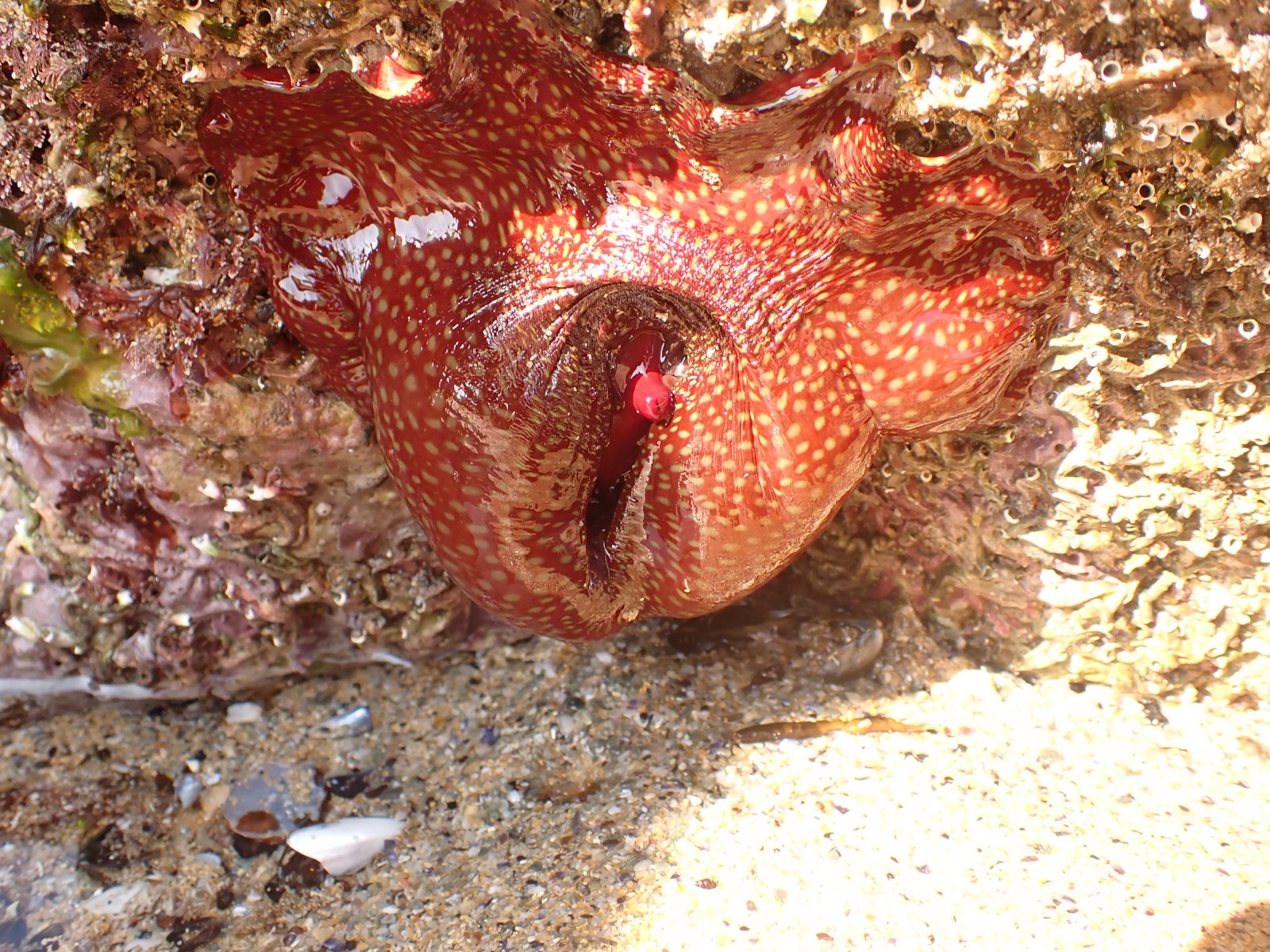
Actinia fragacea reaches 10 cm diameter. Mediterranean and temperate East Atlantic anemone (Actiniidae) with globular body cherry-red to red-brown with distinctive pattern of small yellow-green to light-green spots evoking strawberry achenes (hence fragacea), short retracted tentacles forming visible ball at low tide. Lives from 0 to 20 m on rocky reefs and intertidal zones from Portugal to Mediterranean. Larger and more spotted than A. equina, with which it is often confused. Common East Atlantic rocky coast dive and snorkel photo subject, iconic pattern.
Frequently asked questions
- How big is the Strawberry anemone?
- Strawberry anemone (Actinia fragacea) reaches 5–10 cm in length.
- At what depth can you find the Strawberry anemone?
- Strawberry anemone is found between 0–20 m deep.
- Is the Strawberry anemone dangerous to divers?
- Danger level: Harmless.
- What is the conservation status of the Strawberry anemone?
- IUCN status: Least concern (LC).
- Where can you find the Strawberry anemone?
- Found in: East Atlantic, Mediterranean.
Other species in the genus Actinia
Other species in the family Actiniidae
- Anemonia viridis - Snakelocks anemone
- Bunodactis verrucosa - Gem anemone
- Entacmaea quadricolor - Bubble-tip anemone
- Anthopleura sola - Solitary California anemone
- Condylactis gigantea - Giant Caribbean anemone
- Macrodactyla doreensis - Long tentacle anemone
Sources
- Taxonomy: WoRMS (AphiaID 100805)
- Photos: iNaturalist (CC BY-NC)
- Distribution: GBIF (taxonKey 2256565)
- Conservation: IUCN Red List
- Encyclopedia: Wikipedia