By-the-wind sailor (Velella velella)
Key facts
- Scientific name
- Velella velella
- Common name
- By-the-wind sailor
- Category
- Cnidarians
- Family
- Porpitidae
- Genus
- Velella
- Size
- 4–8 cm
- Depth
- 0–0 m
- IUCN status
- Least concern (LC)
- Danger level
- Harmless
- Habitats
- open-water, pelagic, surface
- Behaviours
- pelagic, colonial
- Ocean zones
- Asian Pacific, Caribbean, East Atlantic, Indian Ocean & Red Sea, Macaronesia, Mediterranean, Eastern Pacific
Description
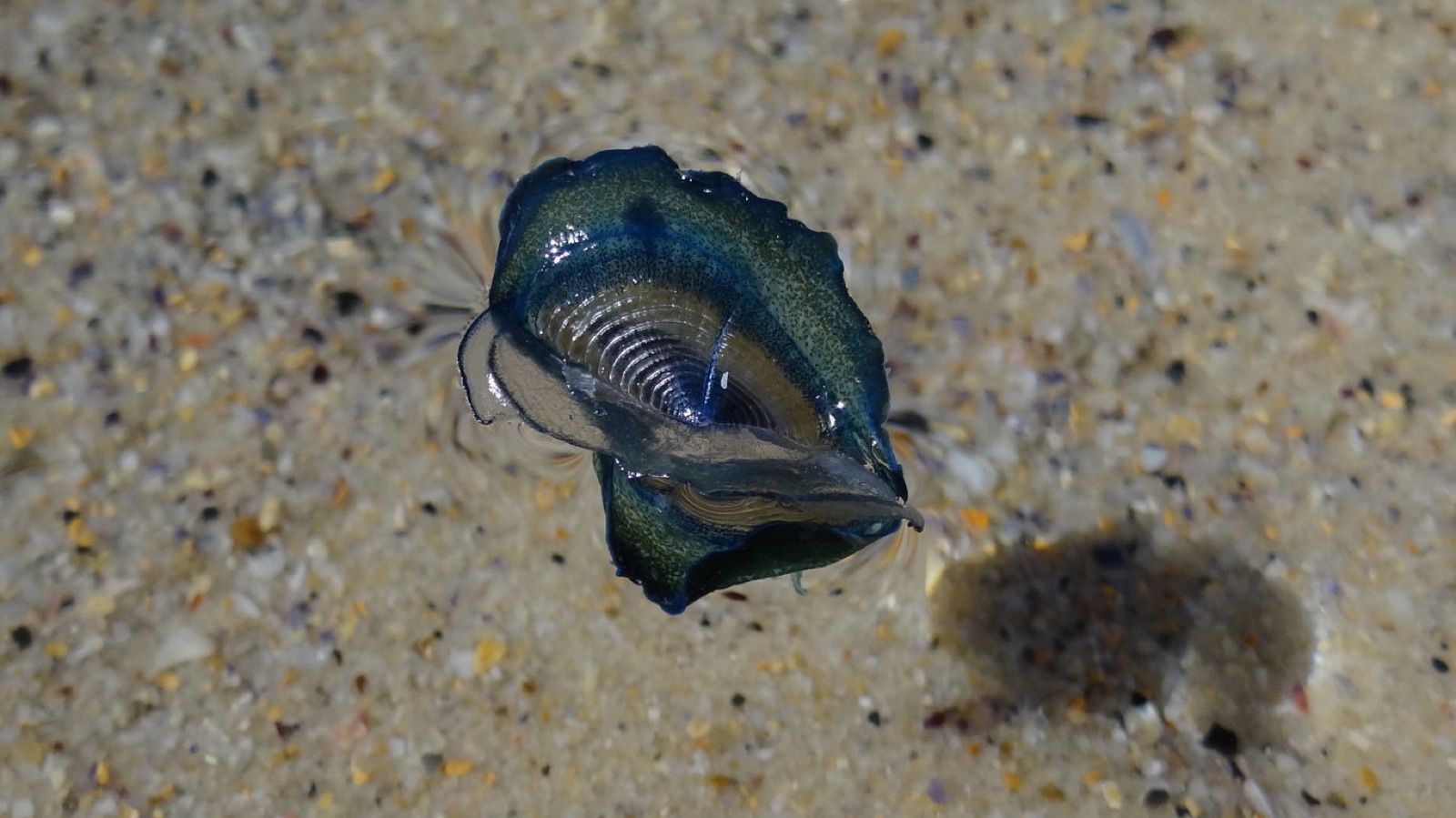
Velella velella, the by-the-wind sailor, is a pelagic colonial hydrozoan of 4 to 8 cm. Vivid-blue oval float topped by a triangular sail set diagonally, causing it to drift either right or left of the wind depending on the individual. Short stinging tentacles, mostly harmless to humans. Mass spring strandings on Atlantic and Mediterranean beaches.
Frequently asked questions
- How big is the By-the-wind sailor?
- By-the-wind sailor (Velella velella) reaches 4–8 cm in length.
- At what depth can you find the By-the-wind sailor?
- By-the-wind sailor is found between 0–0 m deep.
- Is the By-the-wind sailor dangerous to divers?
- Danger level: Harmless.
- What is the conservation status of the By-the-wind sailor?
- IUCN status: Least concern (LC).
- Where can you find the By-the-wind sailor?
- Found in: Asian Pacific, Caribbean, East Atlantic, Indian Ocean & Red Sea, Macaronesia, Mediterranean, Eastern Pacific.
Similar species
- Cotylorhiza tuberculata - Fried egg jellyfish
- Pelagia noctiluca - Mauve stinger
- Rhizostoma pulmo - Barrel jellyfish
- Millepora alcicornis - Branching fire coral
- Cyanea capillata - Lion's mane jellyfish
- Plumularia setacea - Feathery hydroid
Sources
- Taxonomy: WoRMS (AphiaID 117832)
- Photos: iNaturalist (CC BY-NC)
- Distribution: GBIF (taxonKey 2265793)
- Conservation: IUCN Red List
- Encyclopedia: Wikipedia