Blue bell tunicate (Rhopalaea crassa)
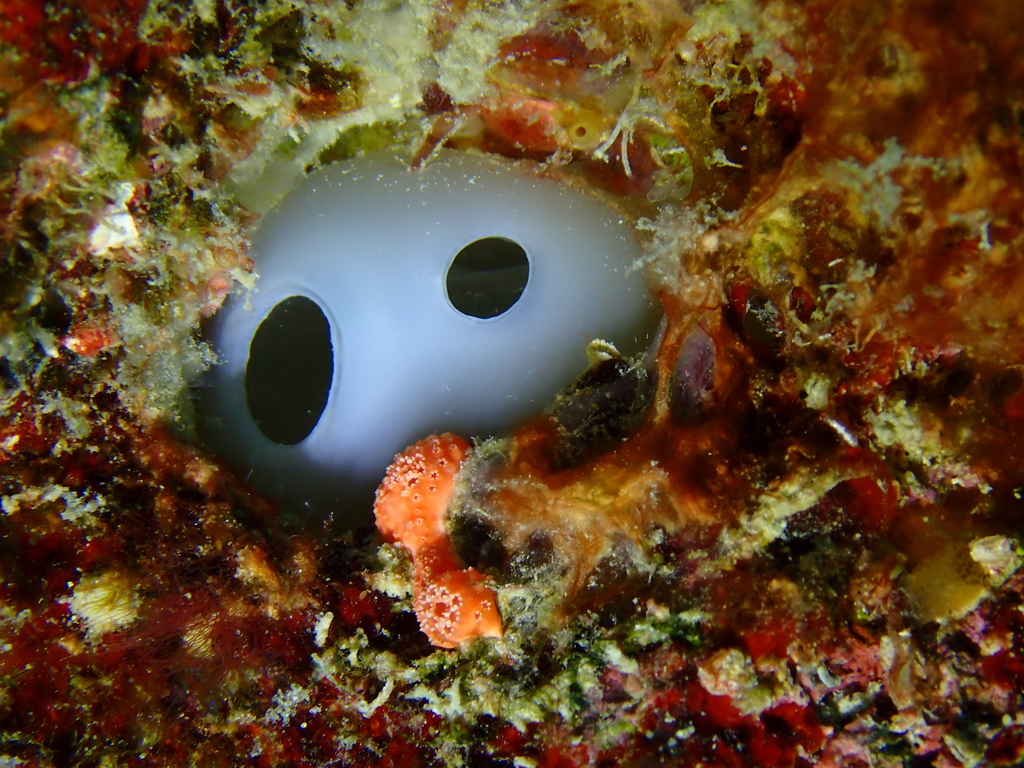
Key facts
- Scientific name
- Rhopalaea crassa
- Common name
- Blue bell tunicate
- Category
- Tunicates
- Family
- Diazonidae
- Genus
- Rhopalaea
- Size
- 5–10 cm
- Depth
- 5–40 m
- IUCN status
- Least concern (LC)
- Danger level
- Harmless
- Habitats
- coral-reef
- Behaviours
- benthic, colonial
- Ocean zones
- Asian Pacific, Indian Ocean & Red Sea, Mediterranean
Description
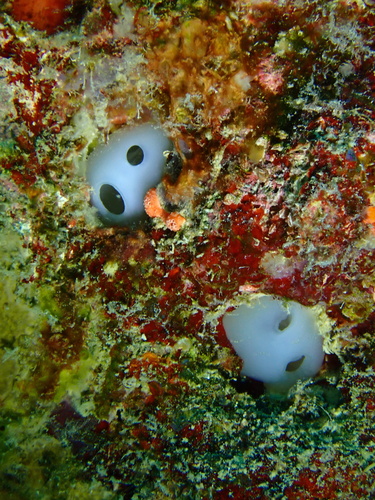
Rhopalaea crassa reaches 10 cm height per tube. Indo-Pacific colonial ascidian (Diazonidae) with individual tubes tightly packed in clusters or bouquets, each in elongated vase shape transparent to blue-purple to fluorescent turquoise, orange or red siphons visible at top. Lives from 5 to 40 m on coral reefs, under overhangs and in shaded recesses. Filter feeder. Classic macro dive photo subject at Lembeh, Anilao, Raja Ampat for its colors and graphic appearance, often photographed in backlight.
Photo of Blue bell tunicate
Frequently asked questions
- How big is the Blue bell tunicate?
- Blue bell tunicate (Rhopalaea crassa) reaches 5–10 cm in length.
- At what depth can you find the Blue bell tunicate?
- Blue bell tunicate is found between 5–40 m deep.
- Is the Blue bell tunicate dangerous to divers?
- Danger level: Harmless.
- What is the conservation status of the Blue bell tunicate?
- IUCN status: Least concern (LC).
- Where can you find the Blue bell tunicate?
- Found in: Asian Pacific, Indian Ocean & Red Sea, Mediterranean.
Similar species
- Polycarpa aurata - Gold-mouth sea squirt
- Polycarpa mytiligera - Mussel-like ascidian
- Didemnum molle - Green barrel tunicate
- Atriolum robustum - Robust atriolum
- Botryllus schlosseri - Star ascidian
- Clavelina lepadiformis - Light-bulb tunicate
Sources
- Taxonomy: WoRMS (AphiaID 251321)
- Photos: iNaturalist (CC BY-NC)
- Distribution: GBIF (taxonKey 2330621)
- Conservation: IUCN Red List
- Encyclopedia: Wikipedia