Sixline wrasse (Pseudocheilinus hexataenia)
Key facts
- Scientific name
- Pseudocheilinus hexataenia
- Common name
- Sixline wrasse
- Category
- Fish
- Family
- Labridae
- Genus
- Pseudocheilinus
- Size
- 5–9 cm
- Depth
- 2–40 m
- IUCN status
- Least concern (LC)
- Danger level
- Harmless
- Habitats
- coral-reef
- Behaviours
- solitary, cryptic
- Ocean zones
- Asian Pacific, Indian Ocean & Red Sea
Description
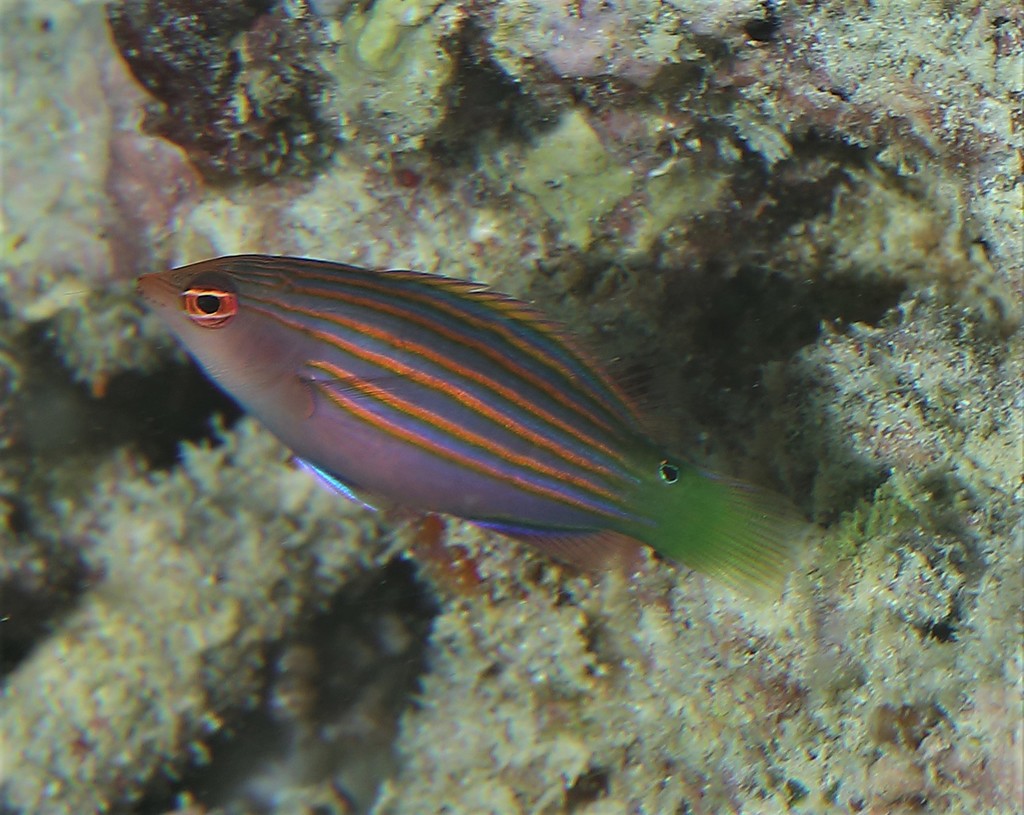
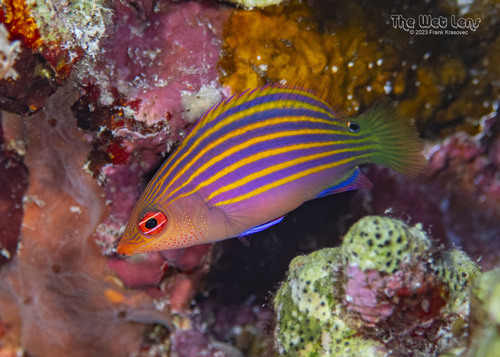
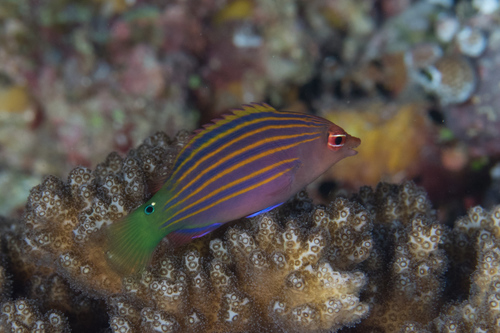
Pseudocheilinus hexataenia reaches 9 cm. Very small wrasse with bright orange to red body crossed by 6 characteristic dark blue to black horizontal bands (hence hexataenia), greenish tail with ocellus, bright yellow eye. Lives from 2 to 40 m hidden in branching hard coral and coralligenous of entire Indo-Pacific. Very territorial and cryptic, cooperates with fish searchers. Highly sought-after macro photo subject by coral reef photographers for its electric colors.
Photo of Sixline wrasse
Frequently asked questions
- How big is the Sixline wrasse?
- Sixline wrasse (Pseudocheilinus hexataenia) reaches 5–9 cm in length.
- At what depth can you find the Sixline wrasse?
- Sixline wrasse is found between 2–40 m deep.
- Is the Sixline wrasse dangerous to divers?
- Danger level: Harmless.
- What is the conservation status of the Sixline wrasse?
- IUCN status: Least concern (LC).
- Where can you find the Sixline wrasse?
- Found in: Asian Pacific, Indian Ocean & Red Sea.
Other species in the genus Pseudocheilinus
Other species in the family Labridae
- Labrus merula - Brown wrasse
- Bodianus rufus - Spanish hogfish
- Bodianus pulchellus - Cuban hogfish
- Halichoeres pictus - Rainbow wrasse
- Halichoeres cyanocephalus - Yellowcheek wrasse
- Sparisoma chrysopterum - Redtail parrotfish
Sources
- Taxonomy: WoRMS (AphiaID 208915)
- Photos: iNaturalist (CC BY-NC)
- Distribution: GBIF (taxonKey 2383693)
- Conservation: IUCN Red List
- Encyclopedia: Wikipedia