Sea goldie (Pseudanthias squamipinnis)
Key facts
- Scientific name
- Pseudanthias squamipinnis
- Common name
- Sea goldie
- Category
- Fish
- Family
- Anthiadidae
- Genus
- Pseudanthias
- Size
- 8–15 cm
- Depth
- 1–55 m
- IUCN status
- Least concern (LC)
- Danger level
- Harmless
- Habitats
- coral-reef
- Behaviours
- schooling
- Ocean zones
- Asian Pacific, Indian Ocean & Red Sea
Description
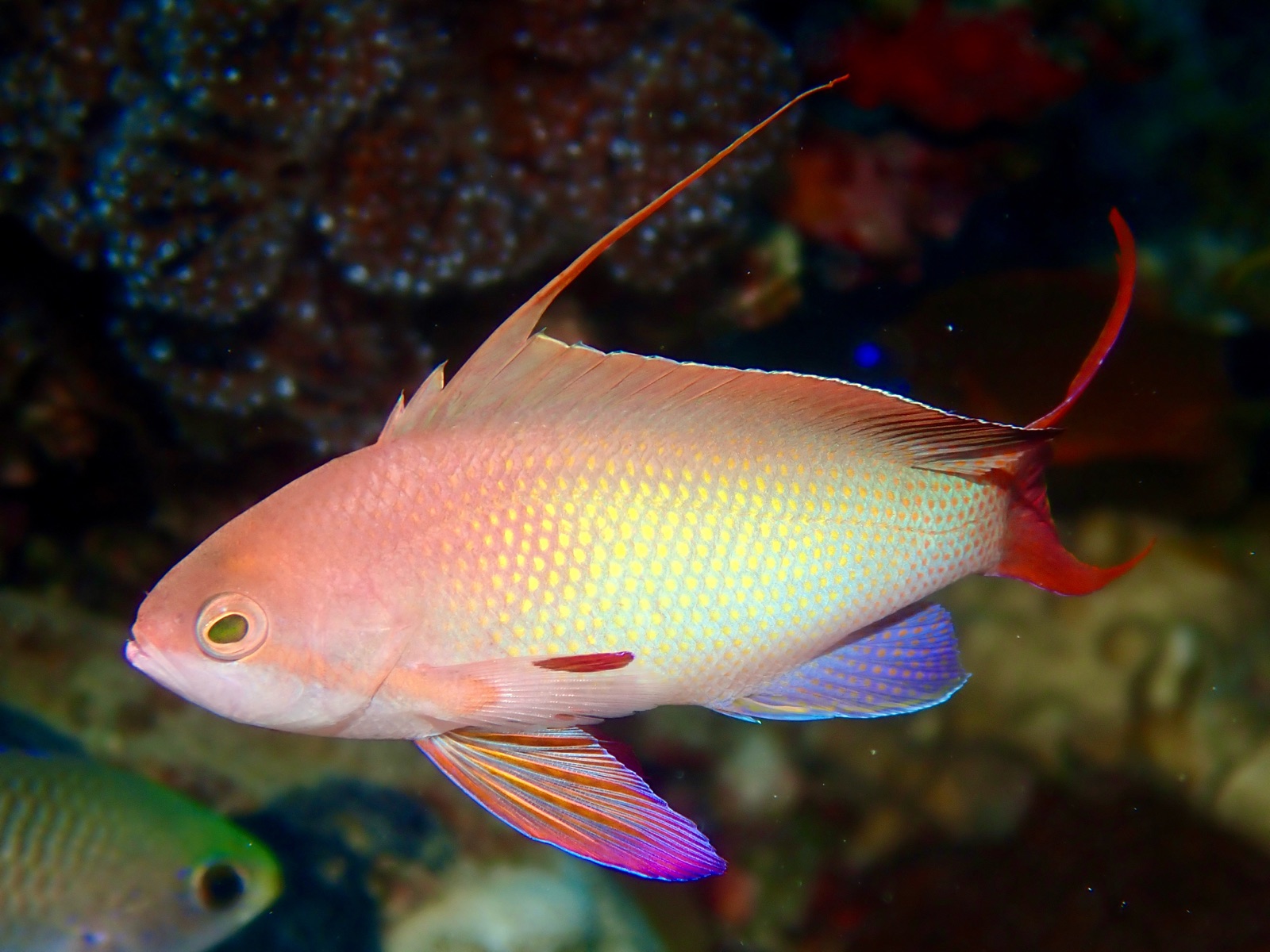
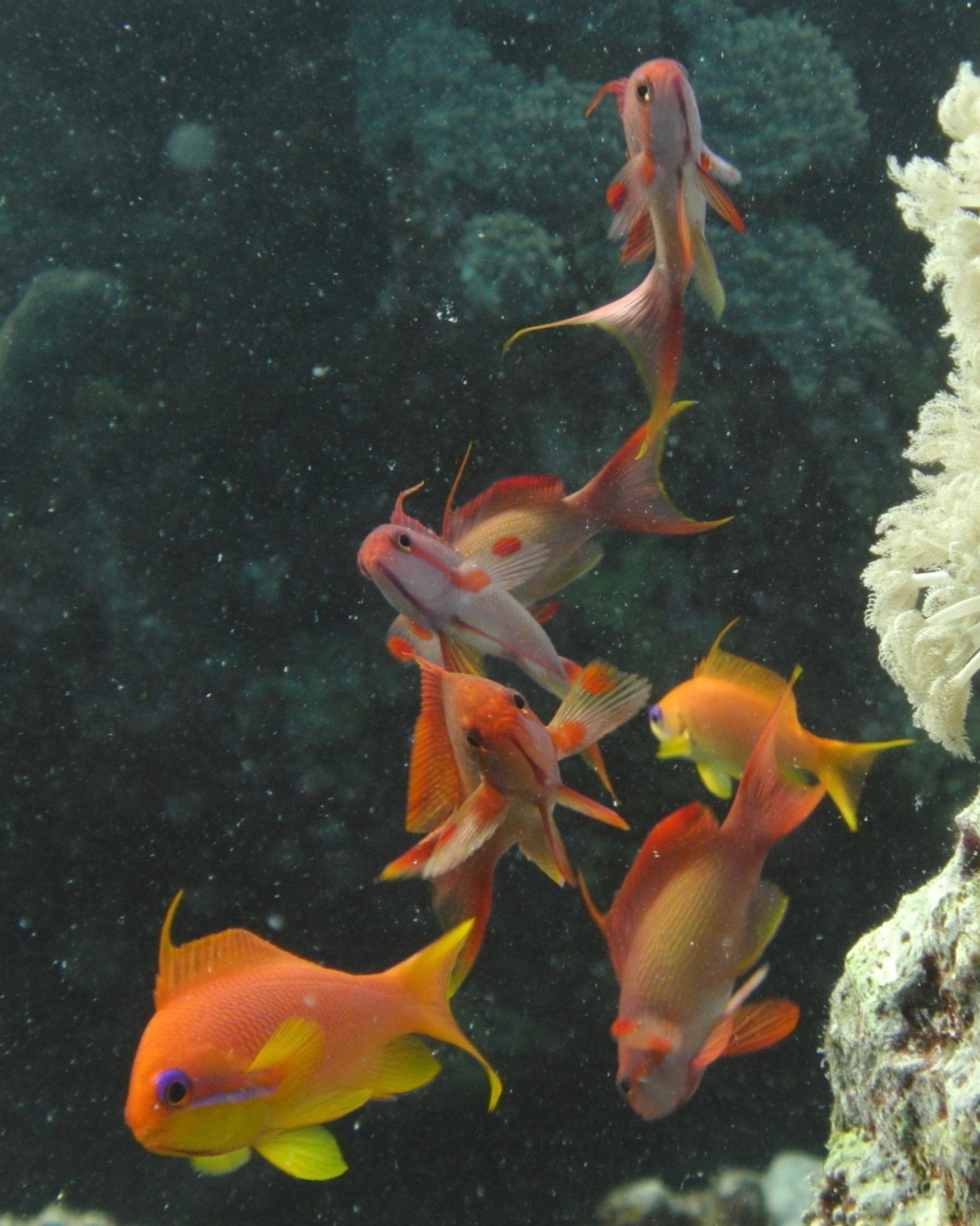
Pseudanthias squamipinnis reaches 15 cm. Best-known and most common Indo-Pacific anthias (Serranidae, Anthiadinae). Marked dimorphism: uniformly orange-pink females, spectacular terminal males purple-violet with elongated filamentous fins and long pink dorsal. Protogynous hermaphrodite. Lives in very dense schools (sometimes hundreds) from 1 to 55 m above corals and drop-offs of Indo-Pacific (Red Sea, Maldives, Indonesia). Planktivore. Signature of Red Sea dives, icon of wide-angle photos in iconic orange swarm.
Photo of Sea goldie
Frequently asked questions
- How big is the Sea goldie?
- Sea goldie (Pseudanthias squamipinnis) reaches 8–15 cm in length.
- At what depth can you find the Sea goldie?
- Sea goldie is found between 1–55 m deep.
- Is the Sea goldie dangerous to divers?
- Danger level: Harmless.
- What is the conservation status of the Sea goldie?
- IUCN status: Least concern (LC).
- Where can you find the Sea goldie?
- Found in: Asian Pacific, Indian Ocean & Red Sea.
Other species in the genus Pseudanthias
- Pseudanthias dispar - Redfin anthias
- Pseudanthias heemstrai - Heemstra's anthias
- Pseudanthias evansi - Evans' anthias
- Pseudanthias bicolor - Bicolor anthias
- Pseudanthias tuka - Purple anthias
- Pseudanthias huchtii - Huchtupp's Anthias
Other species in the family Anthiadidae
- Nemanthias carberryi - Carberry's anthias
- Luzonichthys waitei - Waite's splitfin
- Plectranthias inermis - Unarmed perchlet
- Tosanoides obama - Obama Basslet
Sources
- Taxonomy: WoRMS (AphiaID 218278)
- Photos: iNaturalist (CC BY-NC)
- Distribution: GBIF (taxonKey 2387652)
- Conservation: IUCN Red List
- Encyclopedia: Wikipedia