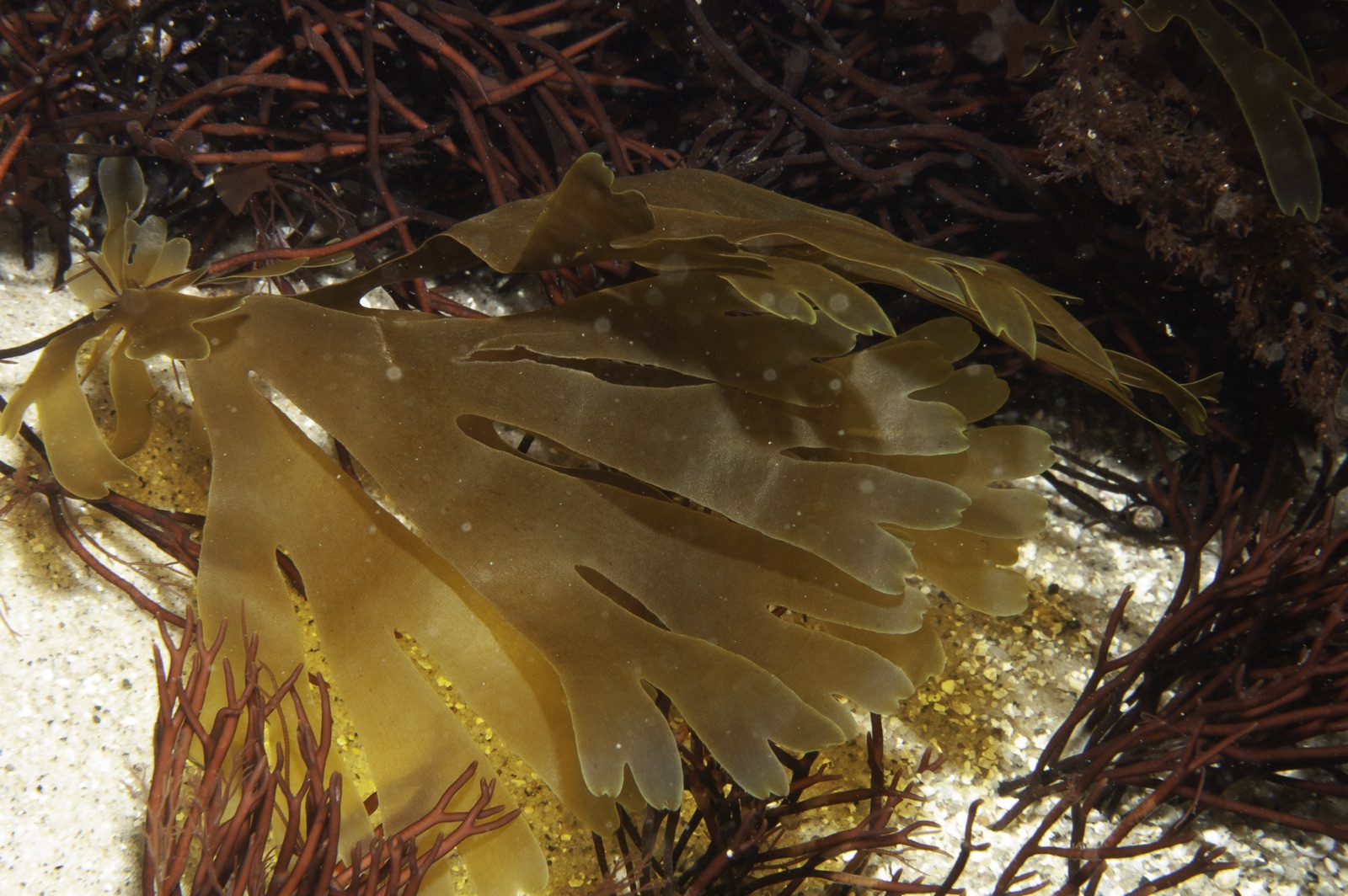
Forkweed (Dictyota dichotoma)
Key facts
- Scientific name
- Dictyota dichotoma
- Common name
- Forkweed
- Category
- Algae
- Family
- Dictyotaceae
- Genus
- Dictyota
- Size
- 5–30 cm
- Depth
- 0–30 m
- IUCN status
- Least concern (LC)
- Danger level
- Harmless
- Habitats
- rocky
- Behaviours
- sessile, photosynthetic
- Ocean zones
- Caribbean, East Atlantic, Macaronesia, Mediterranean
Description
Dictyota dichotoma reaches 30 cm. Brown alga with a ribbon-like thallus divided into regular dichotomous forks. Photogenic feature: iridescent blue-green to purple sheen at certain light angles, due to multilayer optical structures in its cuticle. Very common on rocks and in seagrass down to 30 m. Food for urchins and grazing fish.
Frequently asked questions
- How big is the Forkweed?
- Forkweed (Dictyota dichotoma) reaches 5–30 cm in length.
- At what depth can you find the Forkweed?
- Forkweed is found between 0–30 m deep.
- Is the Forkweed dangerous to divers?
- Danger level: Harmless.
- What is the conservation status of the Forkweed?
- IUCN status: Least concern (LC).
- Where can you find the Forkweed?
- Found in: Caribbean, East Atlantic, Macaronesia, Mediterranean.
Other species in the family Dictyotaceae
- Padina pavonica - Peacock's tail
- Lobophora variegata - Variegated Fan Algae
- Stypopodium zonale - Zoned Stypopodium
Sources
- Taxonomy: WoRMS (AphiaID 145367)
- Photos: iNaturalist (CC BY-NC)
- Distribution: GBIF (taxonKey 5423480)
- Conservation: IUCN Red List
- Encyclopedia: Wikipedia