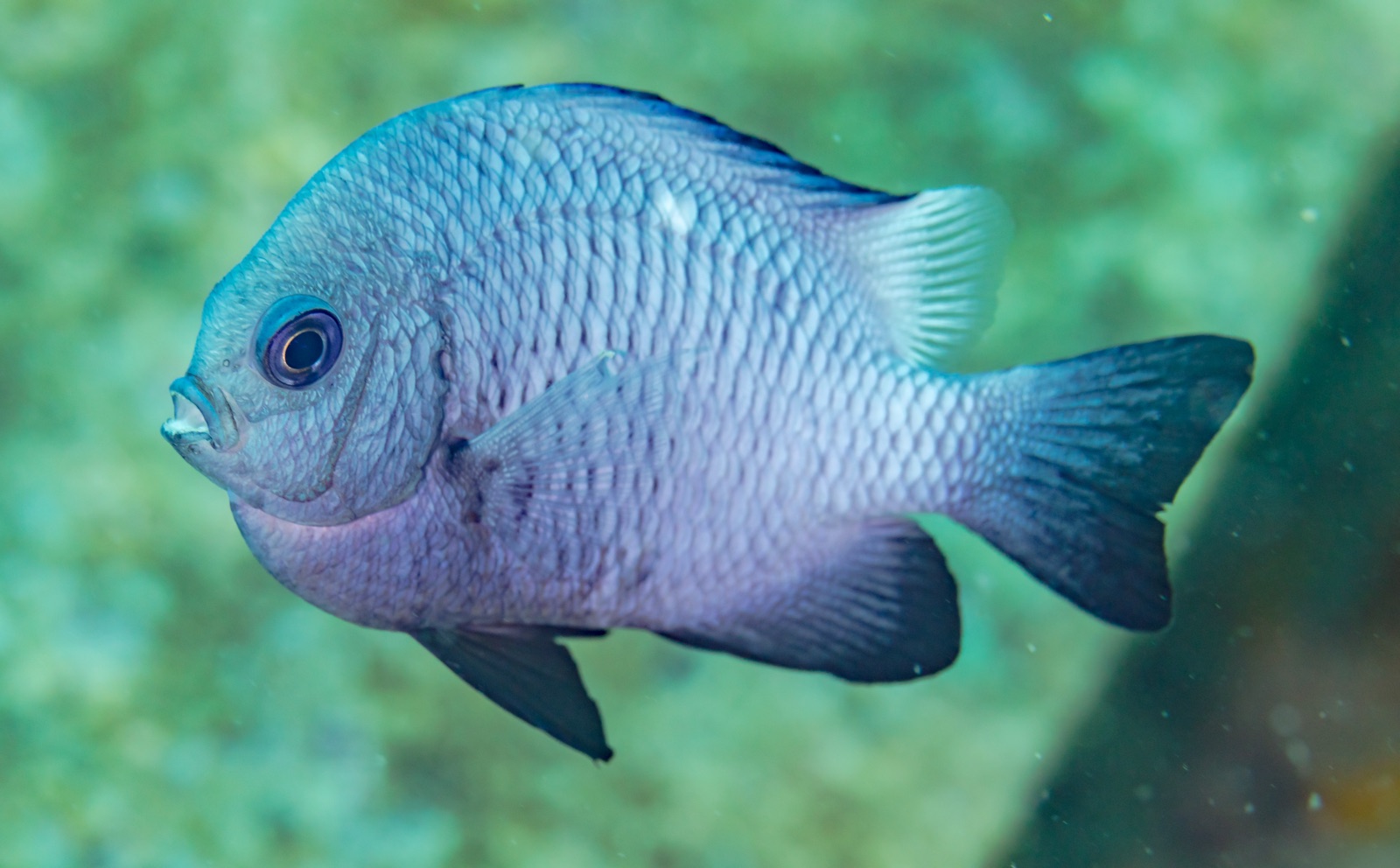
Three-spot damsel (Dascyllus trimaculatus)
Key facts
- Scientific name
- Dascyllus trimaculatus
- Common name
- Three-spot damsel
- Category
- Fish
- Family
- Pomacentridae
- Genus
- Dascyllus
- Size
- 8–14 cm
- Depth
- 1–55 m
- IUCN status
- Least concern (LC)
- Danger level
- Harmless
- Habitats
- coral-reef
- Behaviours
- schooling, territorial
- Ocean zones
- Asian Pacific, Indian Ocean & Red Sea
Description
Dascyllus trimaculatus reaches 14 cm. Damselfish with uniform stocky black body with 3 distinctive white spots: one on forehead and one on each side of flanks (hence trimaculatus), hence sometimes called domino. Juveniles sometimes live symbiotically in anemones like clownfish. Lives in dense schools from 1 to 55 m around table corals (Acropora) and massives of entire Indo-Pacific. Territorial during spawning. Accessible photo subject for beginners, black-white graphic pattern.
Photo of Three-spot damsel
Frequently asked questions
- How big is the Three-spot damsel?
- Three-spot damsel (Dascyllus trimaculatus) reaches 8–14 cm in length.
- At what depth can you find the Three-spot damsel?
- Three-spot damsel is found between 1–55 m deep.
- Is the Three-spot damsel dangerous to divers?
- Danger level: Harmless.
- What is the conservation status of the Three-spot damsel?
- IUCN status: Least concern (LC).
- Where can you find the Three-spot damsel?
- Found in: Asian Pacific, Indian Ocean & Red Sea.
Other species in the genus Dascyllus
- Dascyllus aruanus - Humbug dascyllus
- Dascyllus reticulatus - Reticulated Dascyllus
- Dascyllus melanurus - Blacktail Dascyllus
Other species in the family Pomacentridae
- Amphiprion ocellaris - False clownfish
- Chromis chromis - Mediterranean damselfish
- Amphiprion bicinctus - Two-band anemonefish
- Abudefduf saxatilis - Sergeant major (Atlantic)
- Chromis cyanea - Blue chromis
- Stegastes partitus - Bicolor damselfish
Sources
- Taxonomy: WoRMS (AphiaID 212846)
- Photos: iNaturalist (CC BY-NC)
- Distribution: GBIF (taxonKey 5212031)
- Conservation: IUCN Red List
- Encyclopedia: Wikipedia