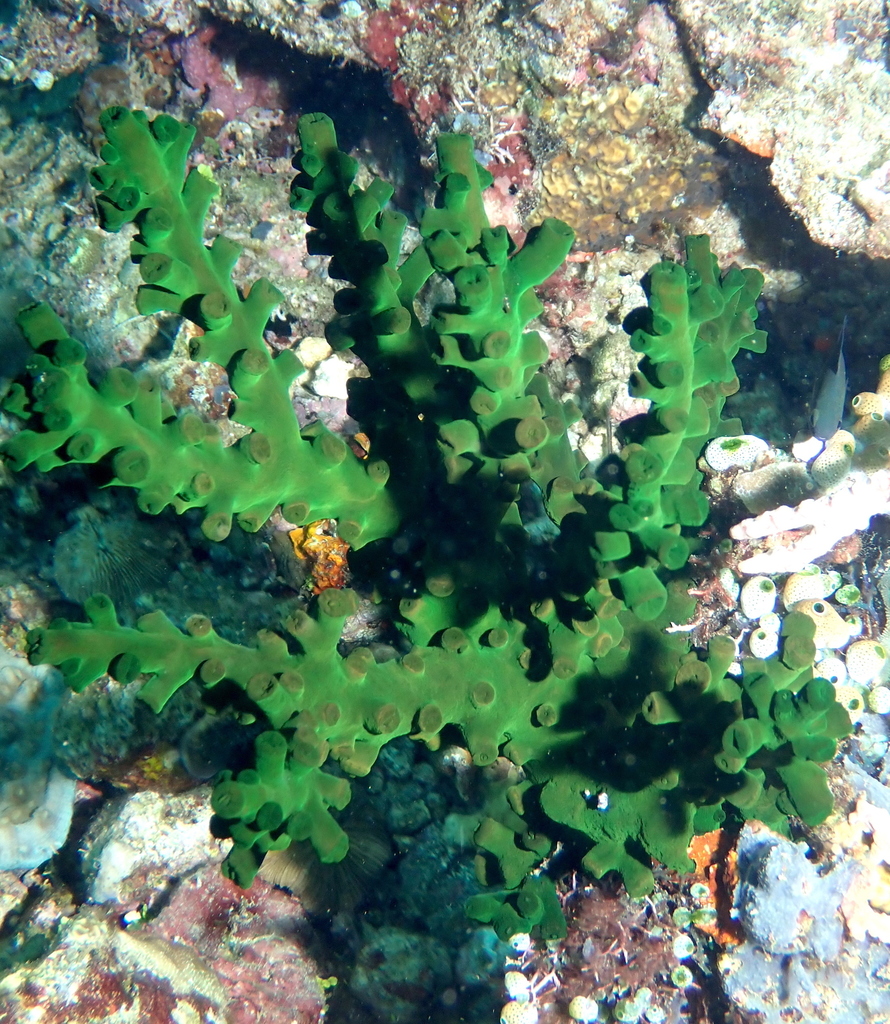
Branching cup coral (Tubastraea micranthus)
Key facts
- Scientific name
- Tubastraea micranthus
- Common name
- Branching cup coral
- Category
- Corals
- Family
- Dendrophylliidae
- Genus
- Tubastraea
- Size
- 30–100 cm
- Depth
- 5–50 m
- IUCN status
- Least concern (LC)
- Danger level
- Harmless
- Habitats
- coral-reef, wreck
- Behaviours
- sessile, colonial, filter-feeder
- Ocean zones
- Asian Pacific, Indian Ocean & Red Sea
Description
Tubastraea micranthus reaches 1 m colonies. Hard coral (Scleractinia) in branching black bush with very developed bright fluorescent orange-yellow polyps open all day long (rare in hard corals). Without symbiotic zooxanthellae (azooxanthellate), feeds exclusively by filtering zooplankton, hence vivid non-photosymbiotic colors. Lives from 5 to 50 m on drop-offs, overhangs and wrecks of Indo-Pacific. Listed LC. Iconic wide-angle photo subject for orange colors open on contrasting black background.
Frequently asked questions
- How big is the Branching cup coral?
- Branching cup coral (Tubastraea micranthus) reaches 30–100 cm in length.
- At what depth can you find the Branching cup coral?
- Branching cup coral is found between 5–50 m deep.
- Is the Branching cup coral dangerous to divers?
- Danger level: Harmless.
- What is the conservation status of the Branching cup coral?
- IUCN status: Least concern (LC).
- Where can you find the Branching cup coral?
- Found in: Asian Pacific, Indian Ocean & Red Sea.
Other species in the family Dendrophylliidae
- Turbinaria mesenterina - Lesser valley coral
- Turbinaria reniformis - Yellow scroll coral
- Astroides calycularis - Mediterranean orange coral
- Leptopsammia pruvoti - Yellow solitary coral
Sources
- Taxonomy: WoRMS (AphiaID 291255)
- Photos: iNaturalist (CC BY-NC)
- Distribution: GBIF (taxonKey 2259550)
- Conservation: IUCN Red List
- Encyclopedia: Wikipedia