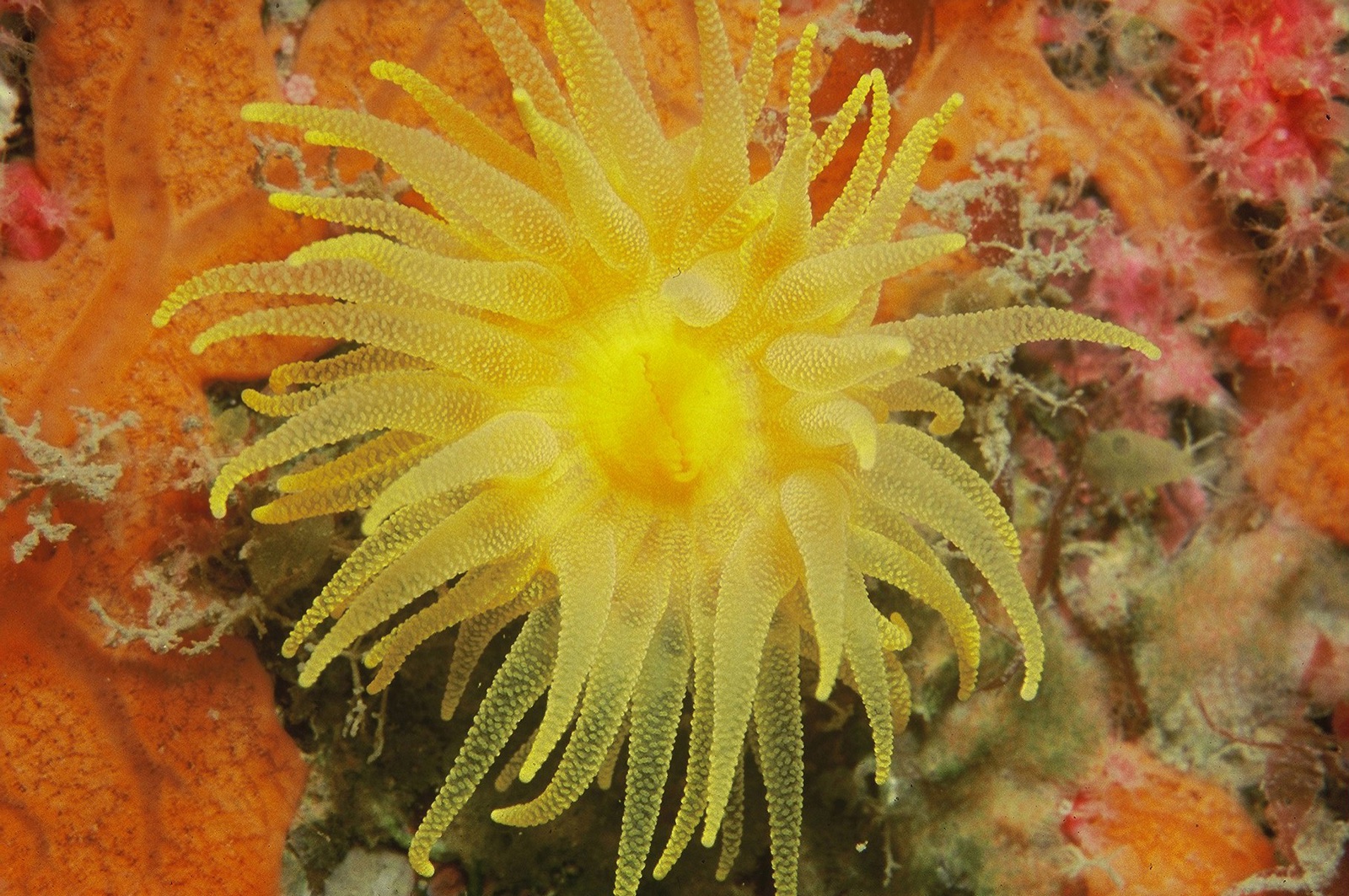
Yellow solitary coral (Leptopsammia pruvoti)
Key facts
- Scientific name
- Leptopsammia pruvoti
- Common name
- Yellow solitary coral
- Category
- Corals
- Family
- Dendrophylliidae
- Genus
- Leptopsammia
- Size
- 1–3 cm
- Depth
- 3–80 m
- IUCN status
- Least concern (LC)
- Danger level
- Harmless
- Habitats
- rocky-reef, cave
- Behaviours
- sessile, filter-feeder
- Ocean zones
- East Atlantic, Macaronesia, Mediterranean
Description
Leptopsammia pruvoti reaches 3 cm per individual, dense aggregations up to square meter. Small solitary hard coral (Scleractinia, Dendrophylliidae) endemic Mediterranean with distinctive bright yellow-orange calcareous coralligenous with single polyp with yellow tentacles. Lives from 3 to 80 m on rocky walls, overhangs and sciaphilic caves, often forming spectacular dense aggregations of hundreds to thousands of neighboring individuals (but not colonial, remaining solitary). Thrives in dark well-circulated zones. Iconic wide-angle photo subject of Med coralligenous dives, the yellow walls of caves.
Photo of Yellow solitary coral
Frequently asked questions
- How big is the Yellow solitary coral?
- Yellow solitary coral (Leptopsammia pruvoti) reaches 1–3 cm in length.
- At what depth can you find the Yellow solitary coral?
- Yellow solitary coral is found between 3–80 m deep.
- Is the Yellow solitary coral dangerous to divers?
- Danger level: Harmless.
- What is the conservation status of the Yellow solitary coral?
- IUCN status: Least concern (LC).
- Where can you find the Yellow solitary coral?
- Found in: East Atlantic, Macaronesia, Mediterranean.
Other species in the family Dendrophylliidae
- Turbinaria mesenterina - Lesser valley coral
- Turbinaria reniformis - Yellow scroll coral
- Tubastraea micranthus - Branching cup coral
- Astroides calycularis - Mediterranean orange coral
Sources
- Taxonomy: WoRMS (AphiaID 135193)
- Photos: iNaturalist (CC BY-NC)
- Distribution: GBIF (taxonKey 2259576)
- Conservation: IUCN Red List
- Encyclopedia: Wikipedia