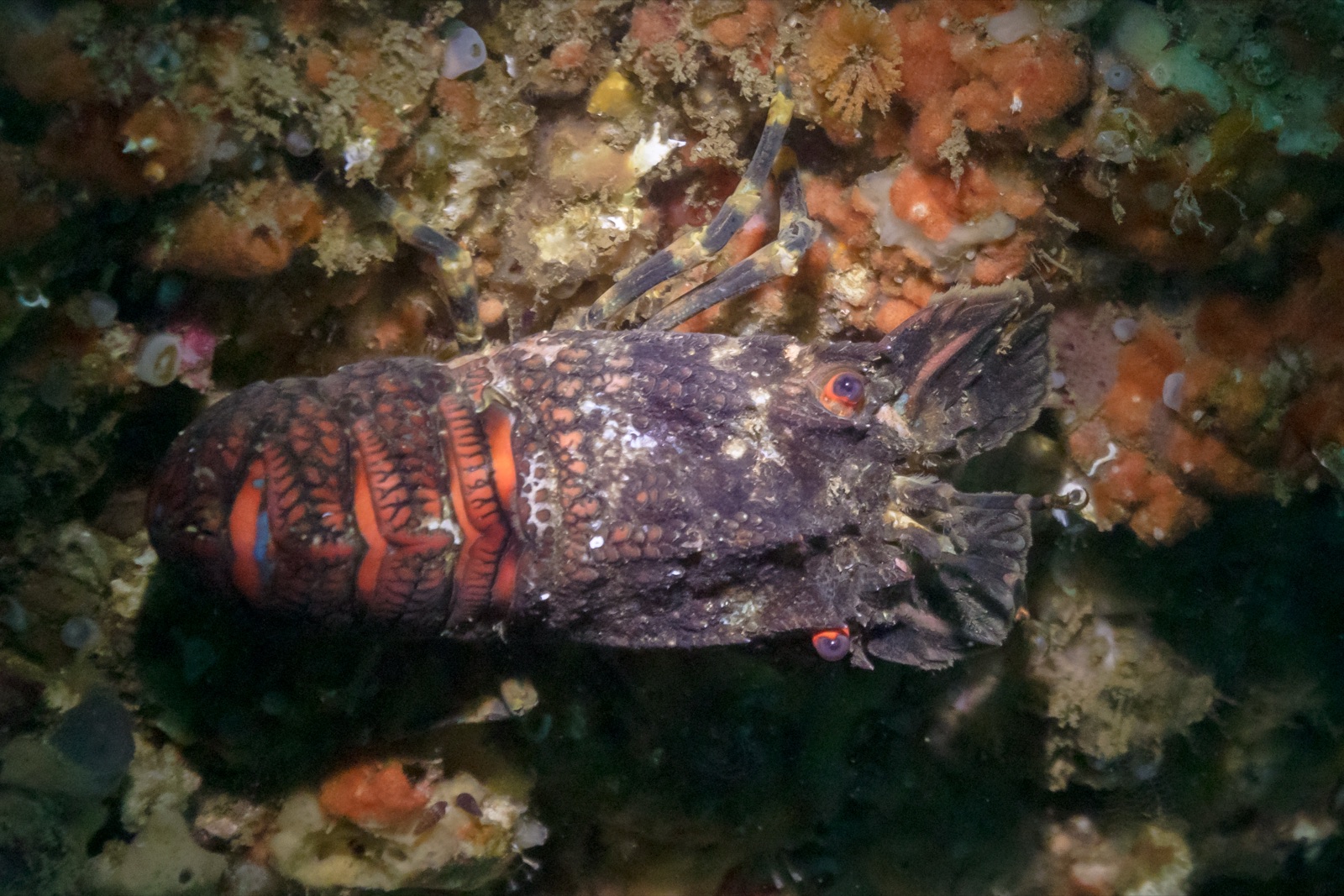
Lesser slipper lobster (Scyllarus arctus)
Key facts
- Scientific name
- Scyllarus arctus
- Common name
- Lesser slipper lobster
- Category
- Crustaceans
- Family
- Scyllaridae
- Genus
- Scyllarus
- Size
- 8–12 cm
- Depth
- 4–50 m
- IUCN status
- Data deficient (DD)
- Danger level
- Harmless
- Habitats
- rocky-reef, cave
- Behaviours
- solitary, nocturnal
- Ocean zones
- East Atlantic, Macaronesia, Mediterranean
Description
Scyllarus arctus reaches 12 cm. Small slipper lobster (Scyllaridae) Mediterranean and temperate Atlantic with very flat brown-orange to beige body with hard granular carapace, secondary antennae enlarged in flattened plates very distinctive (characteristic of Scyllaridae, unlike Palinuridae spiny lobsters). Without large claws. Lives from 4 to 50 m in caves, overhangs and rocky crevices of Mediterranean. Nocturnal, comes out to hunt invertebrates at night. Listed DD by IUCN. Commercial and artisanal fishery (highly prized flesh locally). Iconic nocturnal macro photo subject of Med dives.
Frequently asked questions
- How big is the Lesser slipper lobster?
- Lesser slipper lobster (Scyllarus arctus) reaches 8–12 cm in length.
- At what depth can you find the Lesser slipper lobster?
- Lesser slipper lobster is found between 4–50 m deep.
- Is the Lesser slipper lobster dangerous to divers?
- Danger level: Harmless.
- What is the conservation status of the Lesser slipper lobster?
- IUCN status: Data deficient (DD).
- Where can you find the Lesser slipper lobster?
- Found in: East Atlantic, Macaronesia, Mediterranean.
Other species in the family Scyllaridae
- Scyllarides squammosus - Scaly Slipper Lobster
- Scyllarides latus - Mediterranean Slipper Lobster
- Parribacus antarcticus - Antarctic Slipper Lobster
Sources
- Taxonomy: WoRMS (AphiaID 107709)
- Photos: iNaturalist (CC BY-NC)
- Distribution: GBIF (taxonKey 2221691)
- Conservation: IUCN Red List
- Encyclopedia: Wikipedia