Stone triggerfish (Pseudobalistes naufragium)
Key facts
- Scientific name
- Pseudobalistes naufragium
- Common name
- Stone triggerfish
- Category
- Fish
- Family
- Balistidae
- Genus
- Pseudobalistes
- Size
- 50–100 cm
- Depth
- 1–60 m
- IUCN status
- Least concern (LC)
- Danger level
- Harmless
- Habitats
- rocky-reef, coral-reef
- Behaviours
- solitary, diurnal
- Ocean zones
- Caribbean, Eastern Pacific
Description
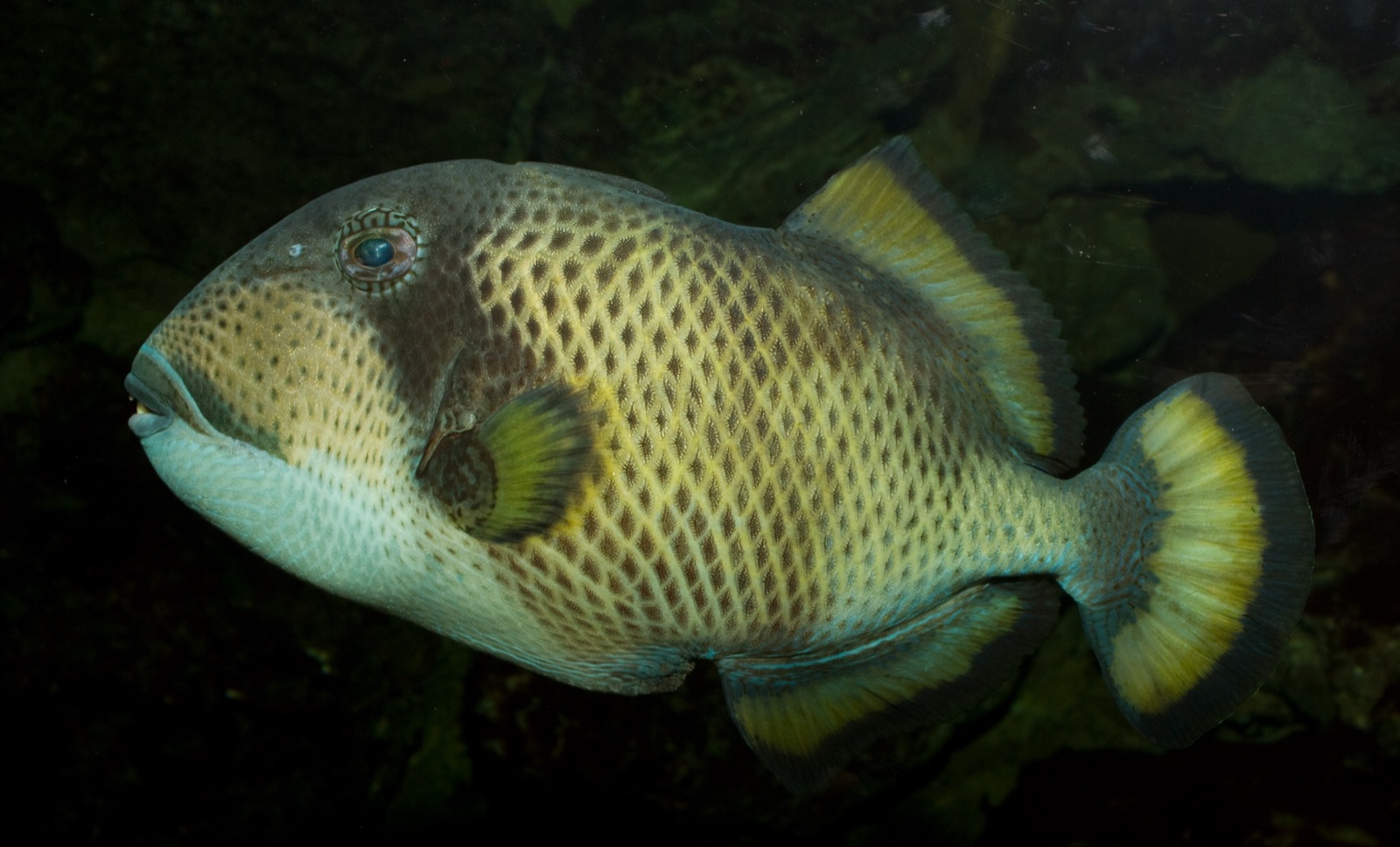
Pseudobalistes naufragium reaches 100 cm and over 15 kg, world's largest triggerfish. Compressed oval body uniformly gray-brown to olive-brown, massive head, powerful teeth, two distinct dorsal fins first one erectile. Lives from 1 to 60 m on rocky and coral reefs of East Pacific, from Gulf of California to Peru, Galapagos and Cocos Island. Territorial especially during nesting when it can charge divers. Omnivore, crushes urchins and shells. Impressive dive photo subject by size, star of Cocos and Galapagos.
Frequently asked questions
- How big is the Stone triggerfish?
- Stone triggerfish (Pseudobalistes naufragium) reaches 50–100 cm in length.
- At what depth can you find the Stone triggerfish?
- Stone triggerfish is found between 1–60 m deep.
- Is the Stone triggerfish dangerous to divers?
- Danger level: Harmless.
- What is the conservation status of the Stone triggerfish?
- IUCN status: Least concern (LC).
- Where can you find the Stone triggerfish?
- Found in: Caribbean, Eastern Pacific.
Other species in the family Balistidae
- Balistes vetula - Queen triggerfish
- Sufflamen bursa - Scythe triggerfish
- Rhinecanthus aculeatus - Picasso triggerfish
- Balistapus undulatus - Orange-lined triggerfish
- Odonus niger - Redtoothed triggerfish
- Canthidermis sufflamen - Ocean triggerfish
Sources
- Taxonomy: WoRMS (AphiaID 279161)
- Photos: iNaturalist (CC BY-NC)
- Distribution: GBIF (taxonKey 2407179)
- Conservation: IUCN Red List
- Encyclopedia: Wikipedia