Scythe triggerfish (Sufflamen bursa)
Key facts
- Scientific name
- Sufflamen bursa
- Common name
- Scythe triggerfish
- Category
- Fish
- Family
- Balistidae
- Genus
- Sufflamen
- Size
- 15–25 cm
- Depth
- 3–90 m
- IUCN status
- Least concern (LC)
- Danger level
- Harmless
- Habitats
- coral-reef, rocky-reef
- Behaviours
- solitary, territorial
- Ocean zones
- Asian Pacific, Indian Ocean & Red Sea
Description
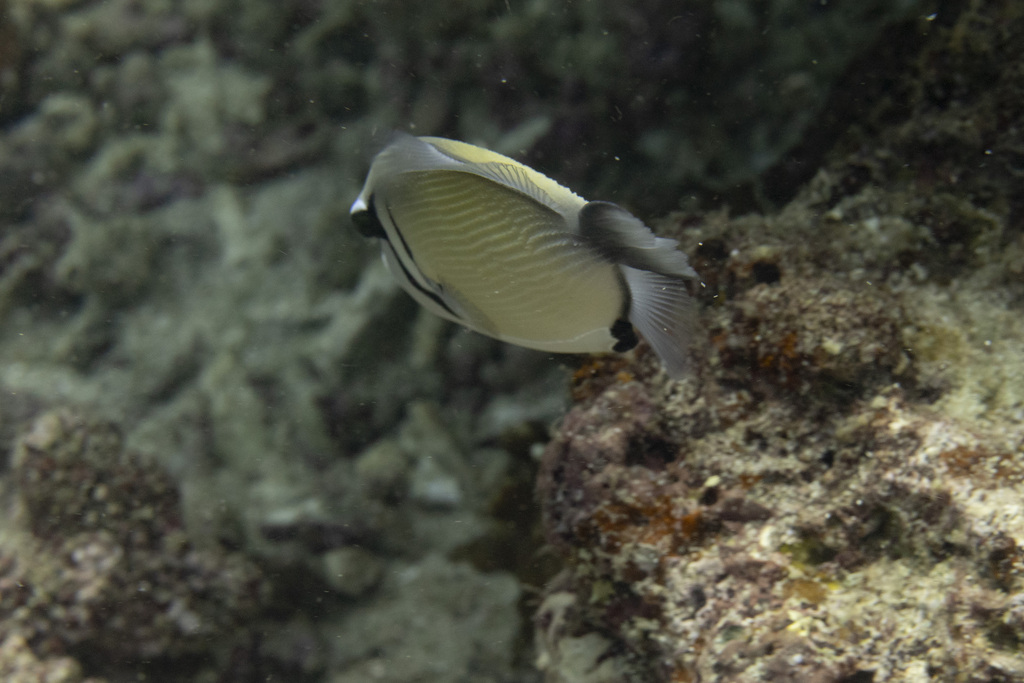
Sufflamen bursa reaches 25 cm. Triggerfish with olive-brown or gray-brown body crossed by two broad yellow-green crescent-shaped bands (hence bursa) starting from top of eye, more saturated in males. Lives from 3 to 90 m on coral and rocky reefs of entire Indo-Pacific (Red Sea to eastern Pacific). Territorial on sands and reefs. Opportunistic predator of urchins, crabs and small fish. Common but characteristic photo subject of coral reefs.
Frequently asked questions
- How big is the Scythe triggerfish?
- Scythe triggerfish (Sufflamen bursa) reaches 15–25 cm in length.
- At what depth can you find the Scythe triggerfish?
- Scythe triggerfish is found between 3–90 m deep.
- Is the Scythe triggerfish dangerous to divers?
- Danger level: Harmless.
- What is the conservation status of the Scythe triggerfish?
- IUCN status: Least concern (LC).
- Where can you find the Scythe triggerfish?
- Found in: Asian Pacific, Indian Ocean & Red Sea.
Other species in the genus Sufflamen
- Sufflamen chrysopterum - Halfmoon triggerfish
- Sufflamen verres - Orange-sided triggerfish
- Sufflamen albicaudatus - Whitecaudal Triggerfish
Other species in the family Balistidae
- Balistes vetula - Queen triggerfish
- Balistoides viridescens - Titan triggerfish
- Rhinecanthus assasi - Red Sea Picasso triggerfish
- Odonus niger - Redtoothed triggerfish
- Balistapus undulatus - Orange-lined triggerfish
- Canthidermis sufflamen - Ocean triggerfish
Sources
- Taxonomy: WoRMS (AphiaID 219894)
- Photos: iNaturalist (CC BY-NC)
- Distribution: GBIF (taxonKey 2407198)
- Conservation: IUCN Red List
- Encyclopedia: Wikipedia