Stone sponge (Petrosia ficiformis)
Key facts
- Scientific name
- Petrosia ficiformis
- Common name
- Stone sponge
- Category
- Sponges
- Family
- Petrosiidae
- Genus
- Petrosia
- Size
- 10–40 cm
- Depth
- 3–50 m
- IUCN status
- Least concern (LC)
- Danger level
- Harmless
- Habitats
- rocky-reef
- Behaviours
- benthic, solitary
- Ocean zones
- East Atlantic, Macaronesia, Mediterranean
Description
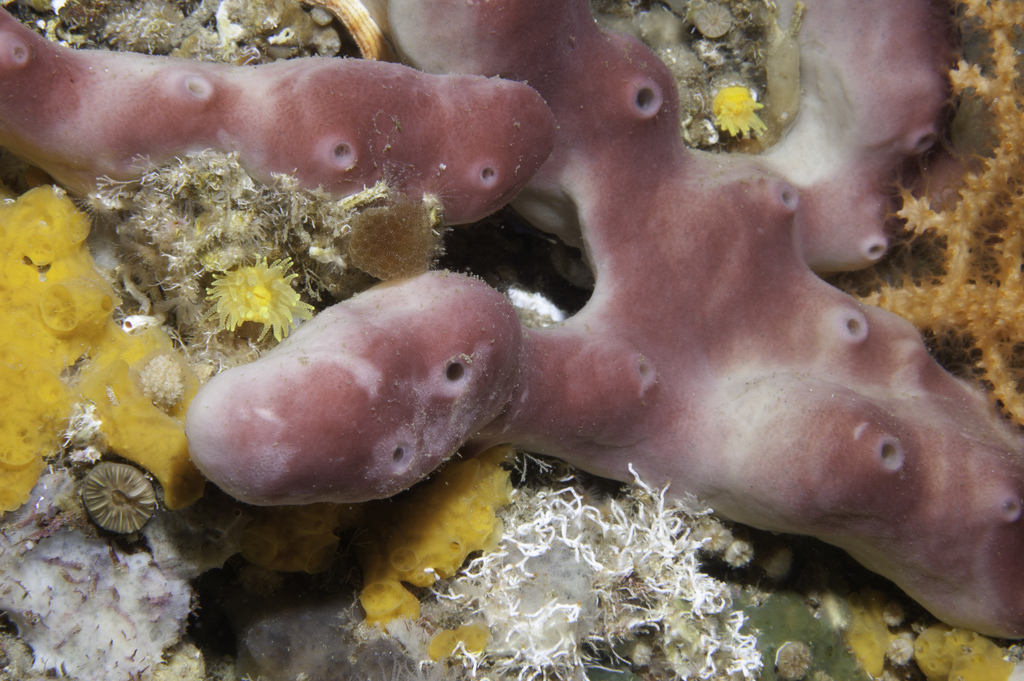
Petrosia ficiformis reaches 40 cm. Sponge (Petrosiidae) Mediterranean and East Atlantic with massive body in highly variable shapes (fig, lobed, encrusting, erect) gray-purple to purple-black to brown-purple, remarkably hard and compact texture (hence petrosia, stone). Lives from 3 to 50 m on rocky reefs at all depths, especially in sciaphilic zones. Filter feeder. Often hosts the dalmatian dorid (Peltodoris atromaculata) which feeds on it. Common Mediterranean dive photo subject, pleasant contrast with more colorful sponges.
Frequently asked questions
- How big is the Stone sponge?
- Stone sponge (Petrosia ficiformis) reaches 10–40 cm in length.
- At what depth can you find the Stone sponge?
- Stone sponge is found between 3–50 m deep.
- Is the Stone sponge dangerous to divers?
- Danger level: Harmless.
- What is the conservation status of the Stone sponge?
- IUCN status: Least concern (LC).
- Where can you find the Stone sponge?
- Found in: East Atlantic, Macaronesia, Mediterranean.
Similar species
- Spongia officinalis - Bath sponge
- Chondrosia reniformis - Kidney sponge
- Crambe crambe - Red encrusting sponge
- Sarcotragus spinosulus - Spiny sponge
- Aplysina aerophoba - Yellow tube sponge
- Aplysina fulva - Yellow-brown rope sponge
Sources
- Taxonomy: WoRMS (AphiaID 132920)
- Photos: iNaturalist (CC BY-NC)
- Distribution: GBIF (taxonKey 2246423)
- Conservation: IUCN Red List
- Encyclopedia: Wikipedia