Bath sponge (Spongia officinalis)
Key facts
- Scientific name
- Spongia officinalis
- Common name
- Bath sponge
- Category
- Sponges
- Family
- Spongiidae
- Genus
- Spongia
- Size
- 10–35 cm
- Depth
- 1–40 m
- IUCN status
- Least concern (LC)
- Danger level
- Harmless
- Habitats
- rocky-reef
- Behaviours
- benthic, solitary
- Ocean zones
- Mediterranean, East Atlantic, Macaronesia
Description
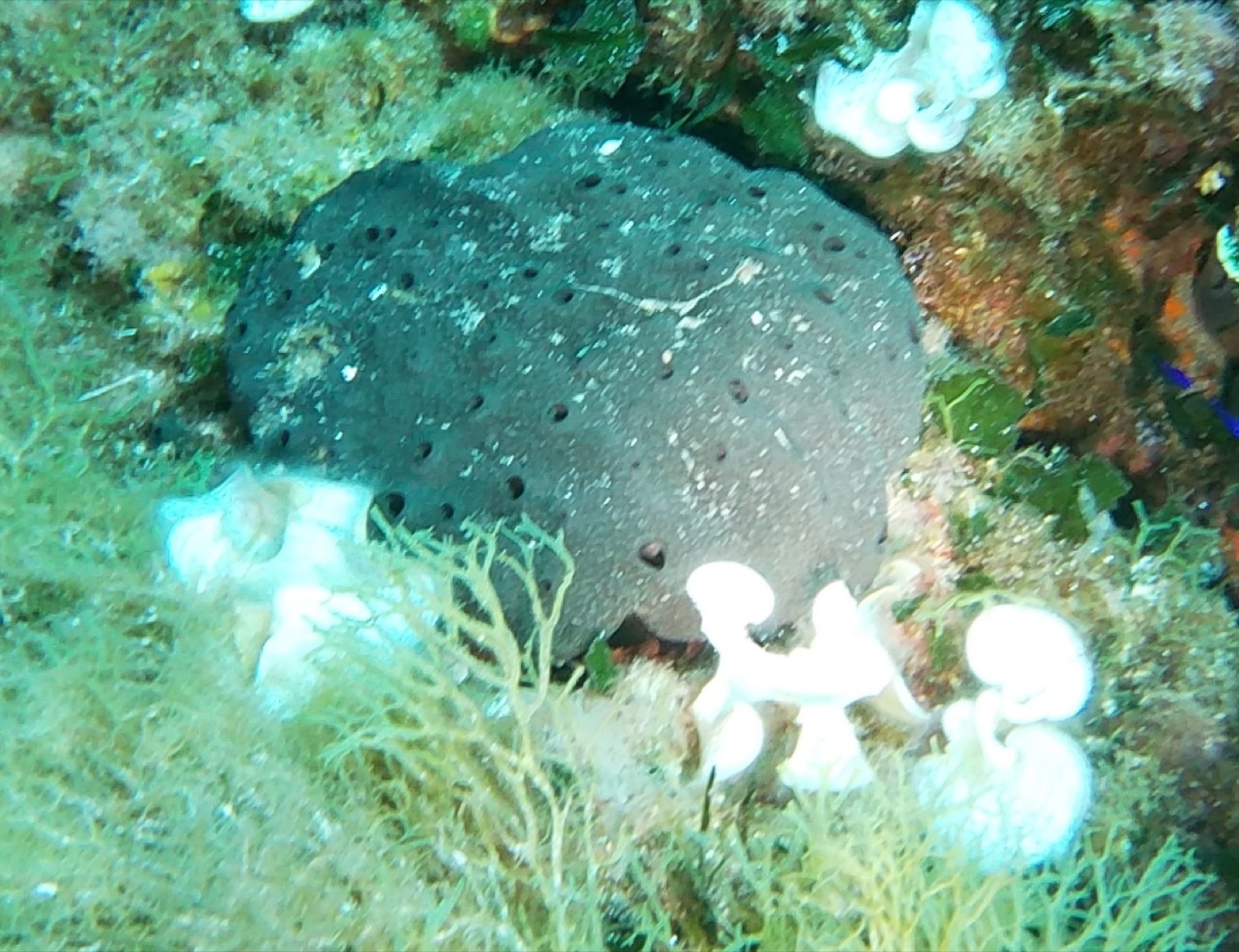
Spongia officinalis reaches 35 cm. Mediterranean and East Atlantic sponge (Spongiidae) with globular or lobed body beige-brown to black-gray, finely perforated surface, without siliceous spicules (skeleton entirely in elastic spongin). Lives from 1 to 40 m on rocky reefs. Exploited since Antiquity as bath sponge (Aegean, Tunisia, Sicily, Dalmatia), traditional fishery in decline today. Classic Mediterranean dive photo subject, symbol of cultural and economic heritage.
Frequently asked questions
- How big is the Bath sponge?
- Bath sponge (Spongia officinalis) reaches 10–35 cm in length.
- At what depth can you find the Bath sponge?
- Bath sponge is found between 1–40 m deep.
- Is the Bath sponge dangerous to divers?
- Danger level: Harmless.
- What is the conservation status of the Bath sponge?
- IUCN status: Least concern (LC).
- Where can you find the Bath sponge?
- Found in: Mediterranean, East Atlantic, Macaronesia.
Similar species
- Chondrosia reniformis - Kidney sponge
- Crambe crambe - Red encrusting sponge
- Sarcotragus spinosulus - Spiny sponge
- Aplysina aerophoba - Yellow tube sponge
- Aplysina fulva - Yellow-brown rope sponge
- Aplysina cauliformis - Row pore rope sponge
Sources
- Taxonomy: WoRMS (AphiaID 132407)
- Photos: iNaturalist (CC BY-NC)
- Distribution: GBIF (taxonKey 8234398)
- Conservation: IUCN Red List
- Encyclopedia: Wikipedia