Spotted spiny lobster (Panulirus guttatus)
Key facts
- Scientific name
- Panulirus guttatus
- Common name
- Spotted spiny lobster
- Category
- Crustaceans
- Family
- Palinuridae
- Genus
- Panulirus
- Size
- 15–30 cm
- Depth
- 1–30 m
- IUCN status
- Data deficient (DD)
- Danger level
- Harmless
- Habitats
- reef, cave
- Behaviours
- nocturnal, solitary
- Ocean zones
- Caribbean, Eastern Pacific
Description
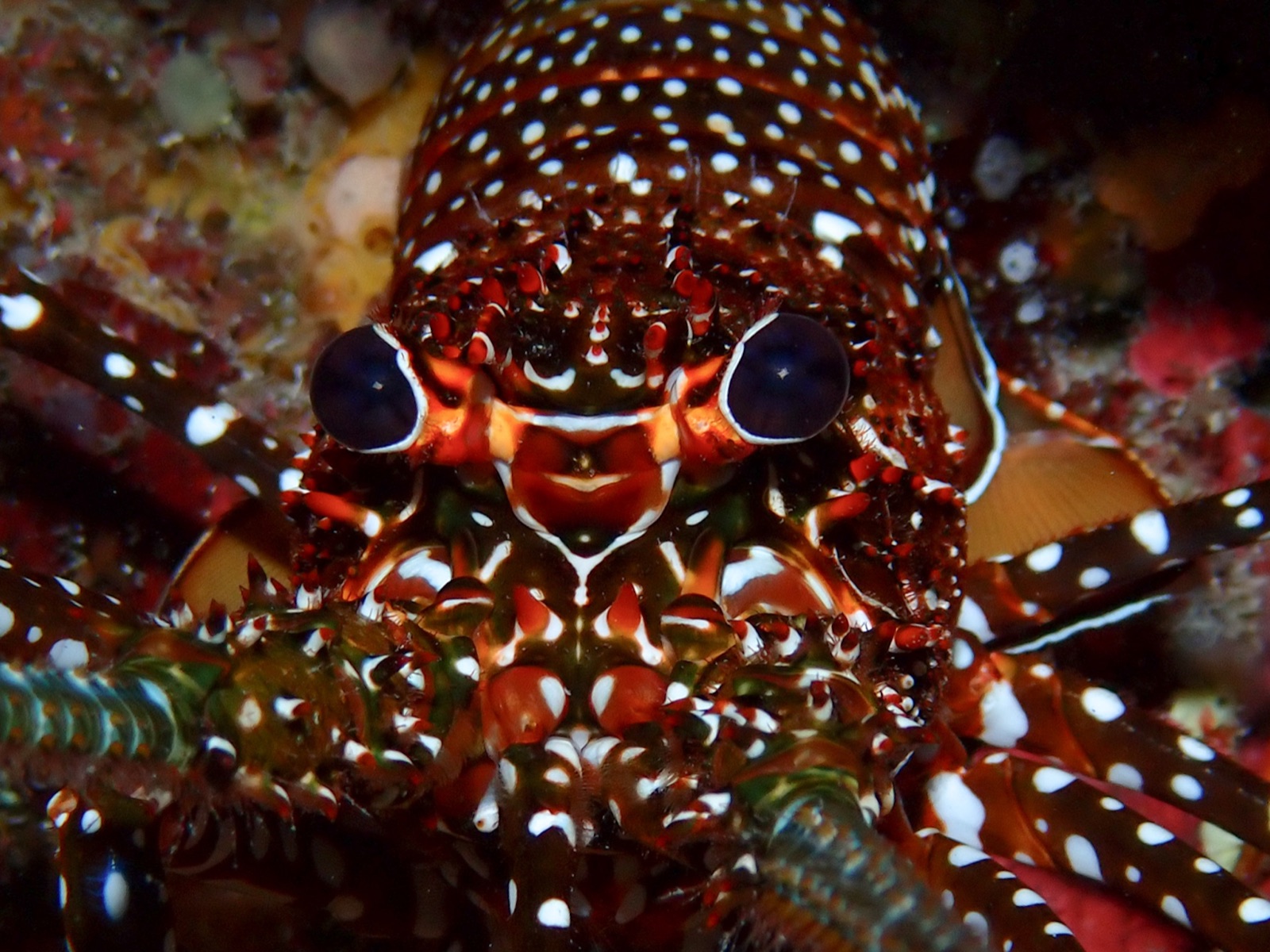
Panulirus guttatus reaches 30 cm. Smaller than the common spiny lobster P. argus, stockier, dark brown-to-red body densely speckled with small regular white spots. Relatively short antennae. Strictly nocturnal, lives hidden in small caves, crevices and shallow Caribbean coral overhangs from 1 to 30 m. More cryptic, less commercially fished but locally harvested. Appreciated sighting on night dives.
Photo of Spotted spiny lobster
Frequently asked questions
- How big is the Spotted spiny lobster?
- Spotted spiny lobster (Panulirus guttatus) reaches 15–30 cm in length.
- At what depth can you find the Spotted spiny lobster?
- Spotted spiny lobster is found between 1–30 m deep.
- Is the Spotted spiny lobster dangerous to divers?
- Danger level: Harmless.
- What is the conservation status of the Spotted spiny lobster?
- IUCN status: Data deficient (DD).
- Where can you find the Spotted spiny lobster?
- Found in: Caribbean, Eastern Pacific.
Other species in the genus Panulirus
- Panulirus argus - Caribbean spiny lobster
- Panulirus interruptus - California Spiny Lobster
- Panulirus penicillatus - Painted Spiny Lobster
- Panulirus versicolor - Painted Spiny Lobster
- Panulirus ornatus - Ornate Spiny Lobster
Other species in the family Palinuridae
Sources
- Taxonomy: WoRMS (AphiaID 382896)
- Photos: iNaturalist (CC BY-NC)
- Distribution: GBIF (taxonKey 2221653)
- Conservation: IUCN Red List
- Encyclopedia: Wikipedia