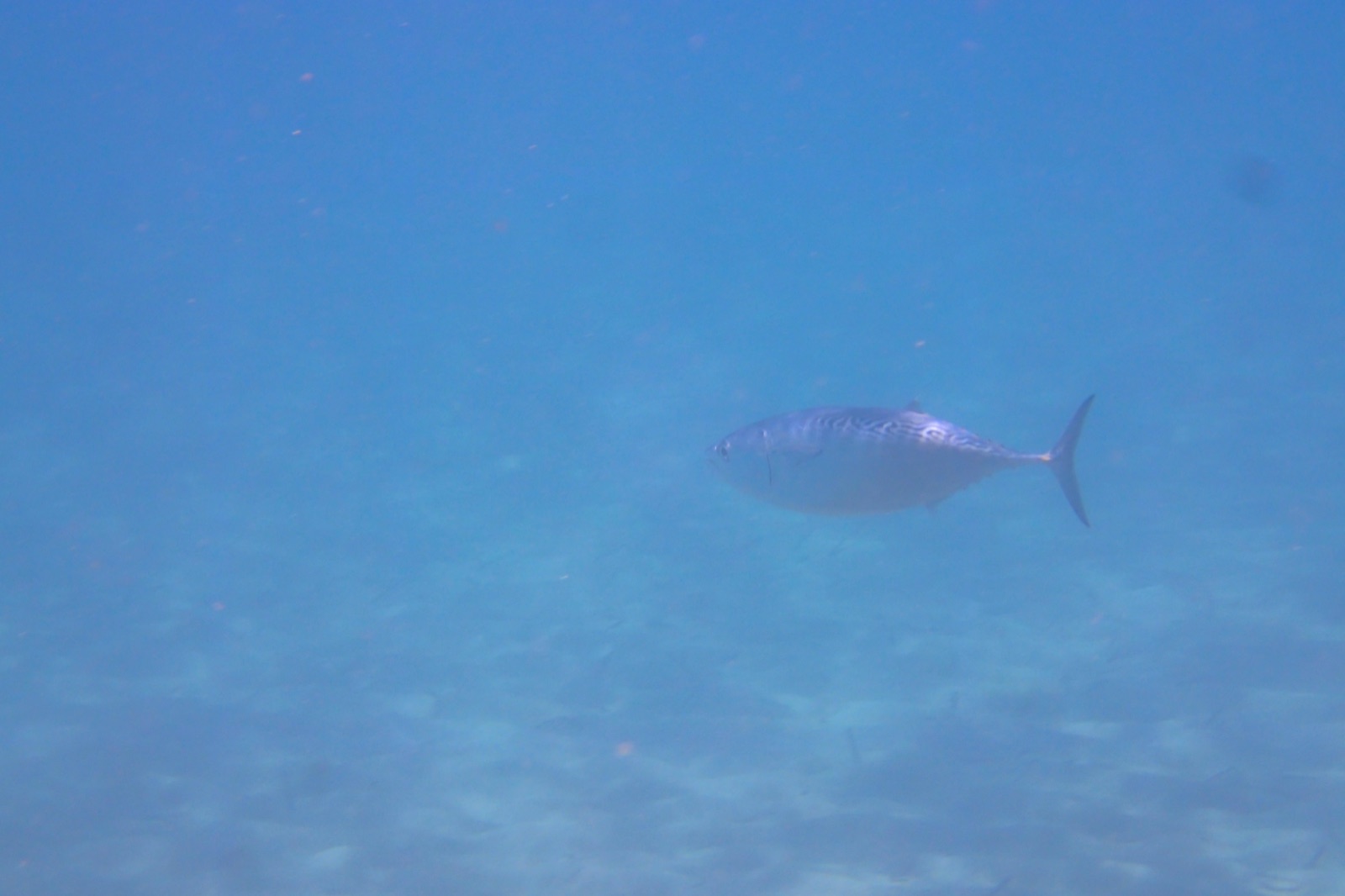
Little tunny (Euthynnus alletteratus)
Key facts
- Scientific name
- Euthynnus alletteratus
- Common name
- Little tunny
- Category
- Fish
- Family
- Scombridae
- Genus
- Euthynnus
- Size
- 40–122 cm
- Depth
- 0–150 m
- IUCN status
- Least concern (LC)
- Danger level
- Harmless
- Habitats
- open-water
- Behaviours
- schooling, fast-moving
- Ocean zones
- Caribbean, East Atlantic, Macaronesia, Mediterranean, Eastern Pacific
Description
Euthynnus alletteratus reaches 122 cm and 16 kg. Pelagic Mediterranean and tropical Atlantic tuna with fusiform silver body on belly, blue-black back with distinctive dark vermicule patterns and 4 well-marked black spots at pectoral base. Lives in schools from 0 to 150 m in coastal open water of Mediterranean and Atlantic tropics. Fast voraciously curious predator. Important commercial and sport fishery. Wide-angle photo subject of pelagic dives. Often encountered in schools with other tuna.
Photo of Little tunny
Frequently asked questions
- How big is the Little tunny?
- Little tunny (Euthynnus alletteratus) reaches 40–122 cm in length.
- At what depth can you find the Little tunny?
- Little tunny is found between 0–150 m deep.
- Is the Little tunny dangerous to divers?
- Danger level: Harmless.
- What is the conservation status of the Little tunny?
- IUCN status: Least concern (LC).
- Where can you find the Little tunny?
- Found in: Caribbean, East Atlantic, Macaronesia, Mediterranean, Eastern Pacific.
Other species in the genus Euthynnus
Other species in the family Scombridae
- Scomber scombrus - Atlantic mackerel
- Thunnus alalunga - Albacore
- Thunnus thynnus - Atlantic bluefin tuna
- Katsuwonus pelamis - Skipjack tuna
- Sarda sarda - Atlantic bonito
- Auxis rochei - Bullet tuna
Sources
- Taxonomy: WoRMS (AphiaID 127017)
- Photos: iNaturalist (CC BY-NC)
- Distribution: GBIF (taxonKey 5208565)
- Conservation: IUCN Red List
- Encyclopedia: Wikipedia