Kawakawa (Euthynnus affinis)
Key facts
- Scientific name
- Euthynnus affinis
- Common name
- Kawakawa
- Category
- Fish
- Family
- Scombridae
- Genus
- Euthynnus
- Size
- 40–100 cm
- Depth
- 0–200 m
- IUCN status
- Least concern (LC)
- Danger level
- Harmless
- Habitats
- open-water
- Behaviours
- schooling, fast-moving
- Ocean zones
- Asian Pacific, East Atlantic, Eastern Pacific, Indian Ocean & Red Sea
Description
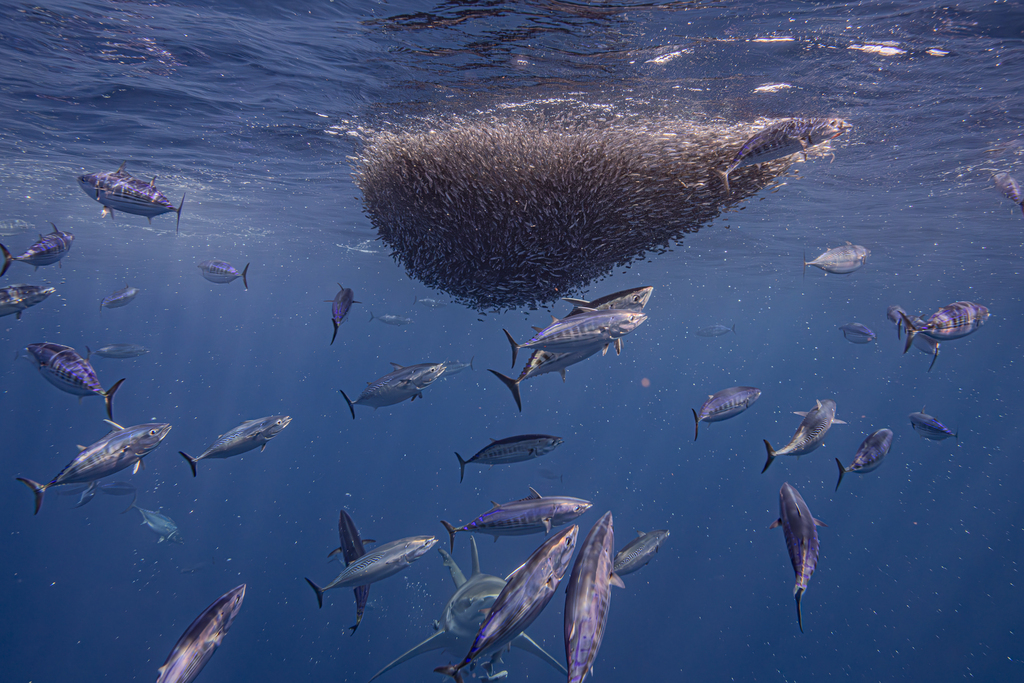
Euthynnus affinis reaches 100 cm and 14 kg. Small Indo-Pacific and tropical Atlantic tuna with fusiform silver body with pearly-white belly and blue-black back covered with distinctive dark wavy patterns (between two dorsals towards tail). Close cousin of E. alletteratus (batch 15 Med) with more discreet black spots at pectoral base. Lives in dense schools from 0 to 200 m in coastal open water and offshore islands. Important local commercial fishery. Rare underwater encounters due to fast speed. Wide-angle photo subject in schools.
Frequently asked questions
- How big is the Kawakawa?
- Kawakawa (Euthynnus affinis) reaches 40–100 cm in length.
- At what depth can you find the Kawakawa?
- Kawakawa is found between 0–200 m deep.
- Is the Kawakawa dangerous to divers?
- Danger level: Harmless.
- What is the conservation status of the Kawakawa?
- IUCN status: Least concern (LC).
- Where can you find the Kawakawa?
- Found in: Asian Pacific, East Atlantic, Eastern Pacific, Indian Ocean & Red Sea.
Other species in the genus Euthynnus
Other species in the family Scombridae
- Scomber scombrus - Atlantic mackerel
- Thunnus alalunga - Albacore
- Thunnus thynnus - Atlantic bluefin tuna
- Katsuwonus pelamis - Skipjack tuna
- Sarda sarda - Atlantic bonito
- Auxis rochei - Bullet tuna
Sources
- Taxonomy: WoRMS (AphiaID 219708)
- Photos: iNaturalist (CC BY-NC)
- Distribution: GBIF (taxonKey 5208561)
- Conservation: IUCN Red List
- Encyclopedia: Wikipedia