Lettuce sea slug (Elysia crispata)
Key facts
- Scientific name
- Elysia crispata
- Common name
- Lettuce sea slug
- Category
- Molluscs
- Family
- Plakobranchidae
- Genus
- Elysia
- Size
- 3–8 cm
- Depth
- 1–25 m
- IUCN status
- Least concern (LC)
- Danger level
- Harmless
- Habitats
- coral-reef, seagrass
- Behaviours
- benthic, slow-mover
- Ocean zones
- Asian Pacific, Caribbean, Eastern Pacific
Description
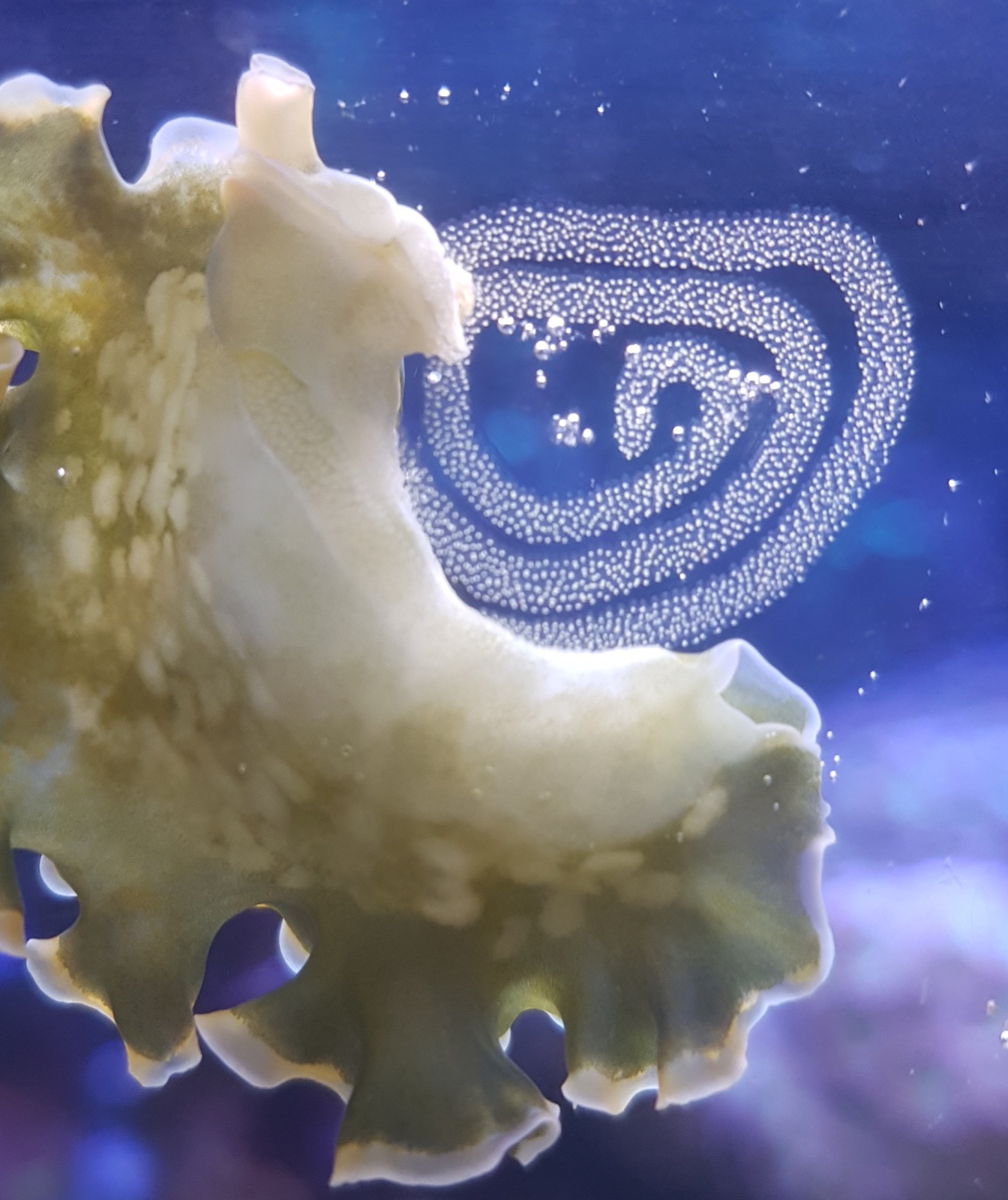
Elysia crispata reaches 8 cm. Large endemic Caribbean sacoglossan (Plakobranchidae) with uniformly vivid green body with extraordinarily wavy and crisp lateral parapodia (hence crispata) resembling very ornamented salad leaves, sometimes yellow or blue margins. Lives from 1 to 25 m on coral reefs and seagrass of Caribbean. Spectacular photosynthesis via kleptoplasty (can survive months without eating thanks to sequestered chloroplasts). Iconic macro photo subject of Caribbean dives (Bonaire, Curaçao, Belize). Popular in aquarium trade.
Photo of Lettuce sea slug
Frequently asked questions
- How big is the Lettuce sea slug?
- Lettuce sea slug (Elysia crispata) reaches 3–8 cm in length.
- At what depth can you find the Lettuce sea slug?
- Lettuce sea slug is found between 1–25 m deep.
- Is the Lettuce sea slug dangerous to divers?
- Danger level: Harmless.
- What is the conservation status of the Lettuce sea slug?
- IUCN status: Least concern (LC).
- Where can you find the Lettuce sea slug?
- Found in: Asian Pacific, Caribbean, Eastern Pacific.
Other species in the genus Elysia
Other species in the family Plakobranchidae
- Thuridilla hopei - Hope's thuridilla
- Thuridilla gracilis - Graceful thuridilla
- Plakobranchus ocellatus - Ocellated plakobranchus
- Thuridilla lineolata - Lineolate thuridilla
- Thuridilla bayeri - Bayer's thuridilla
Sources
- Taxonomy: WoRMS (AphiaID 420572)
- Photos: iNaturalist (CC BY-NC)
- Distribution: GBIF (taxonKey 5192081)
- Conservation: IUCN Red List
- Encyclopedia: Wikipedia