Poulpe à anneaux bleus (Hapalochlaena maculosa)
Caractéristiques
- Nom scientifique
- Hapalochlaena maculosa
- Nom commun
- Poulpe à anneaux bleus
- Catégorie
- Mollusques
- Famille
- Octopodidae
- Genre
- Hapalochlaena
- Taille
- 5–8 cm
- Profondeur
- 1–30 m
- Statut UICN
- Préoccupation mineure (LC)
- Niveau de danger
- Inoffensif
- Habitats
- rocky-reef, coral-reef
- Comportements
- benthic, solitary, nocturnal
- Zones océaniques
- Océan Indien & Mer Rouge
Description
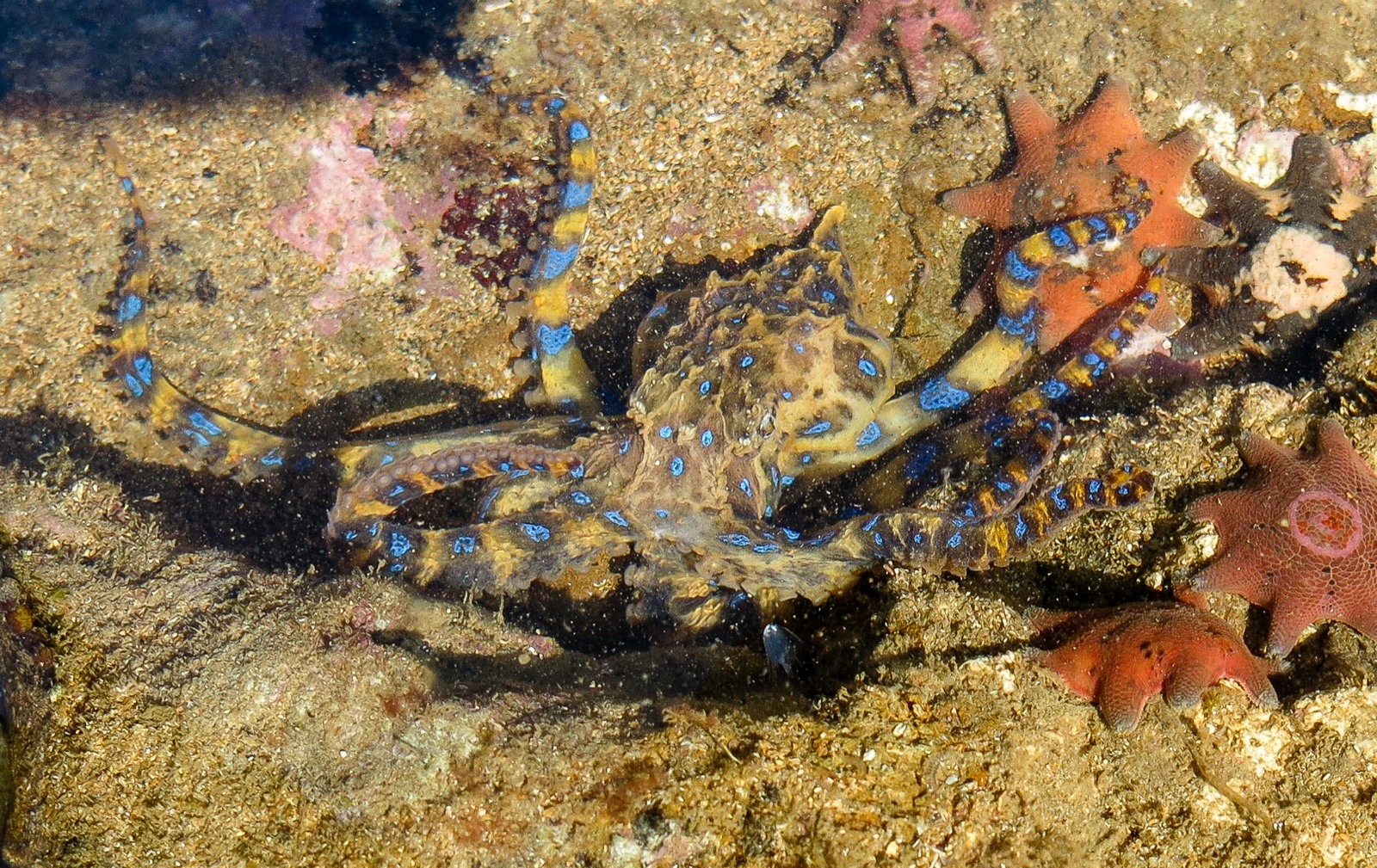
Hapalochlaena maculosa atteint 8 cm. Poulpe à anneaux bleus (Cephalopoda). Minuscule (5-8 cm) mais EXTREMEMENT VENIMEUX, neurotoxine 1000x strychnine. Anneaux bleus iridescents visibles sous stress/excitation. Benthique solitaire, caché roches côtières peu profondes. Très rare observé, nocturne. Prédateur crustacé-poisson larve. EXTREME danger aux plongeurs même contacte accidentel = LC MAIS DANGER MORTEL. Très étudié toxicologie.
Photo de Poulpe à anneaux bleus
Questions fréquentes
- Quelle est la taille de Poulpe à anneaux bleus ?
- Poulpe à anneaux bleus (Hapalochlaena maculosa) mesure entre 5–8 cm.
- À quelle profondeur trouve-t-on Poulpe à anneaux bleus ?
- On rencontre Poulpe à anneaux bleus entre 1–30 m de profondeur.
- Poulpe à anneaux bleus est-il dangereux pour les plongeurs ?
- Niveau de danger : Inoffensif.
- Quel est le statut de conservation de Poulpe à anneaux bleus ?
- Statut UICN : Préoccupation mineure (LC).
- Où trouver Poulpe à anneaux bleus ?
- Présent en: Océan Indien & Mer Rouge.
Autres espèces du genre Hapalochlaena
Autres espèces de la famille Octopodidae
- Octopus vulgaris - Pieuvre commune
- Octopus briareus - Pieuvre de récif caribéenne
- Octopus cyanea - Pieuvre diurne
- Octopus macropus - Pieuvre rouge a longues bras
- Thaumoctopus mimicus - Pieuvre mimique
- Abdopus aculeatus - Pieuvre algue
Sources
- Taxonomie: WoRMS (AphiaID 342334)
- Photos: iNaturalist (CC BY-NC)
- Distribution: GBIF (taxonKey 2289331)
- Conservation: IUCN Red List
- Encyclopédie: Wikipedia