West Indian sea egg (Tripneustes ventricosus)
Key facts
- Scientific name
- Tripneustes ventricosus
- Common name
- West Indian sea egg
- Category
- Echinoderms
- Family
- Toxopneustidae
- Genus
- Tripneustes
- Size
- 10–15 cm
- Depth
- 1–45 m
- IUCN status
- Least concern (LC)
- Danger level
- Harmless
- Habitats
- seagrass, reef
- Behaviours
- herbivorous
- Ocean zones
- Caribbean, Eastern Pacific
Description
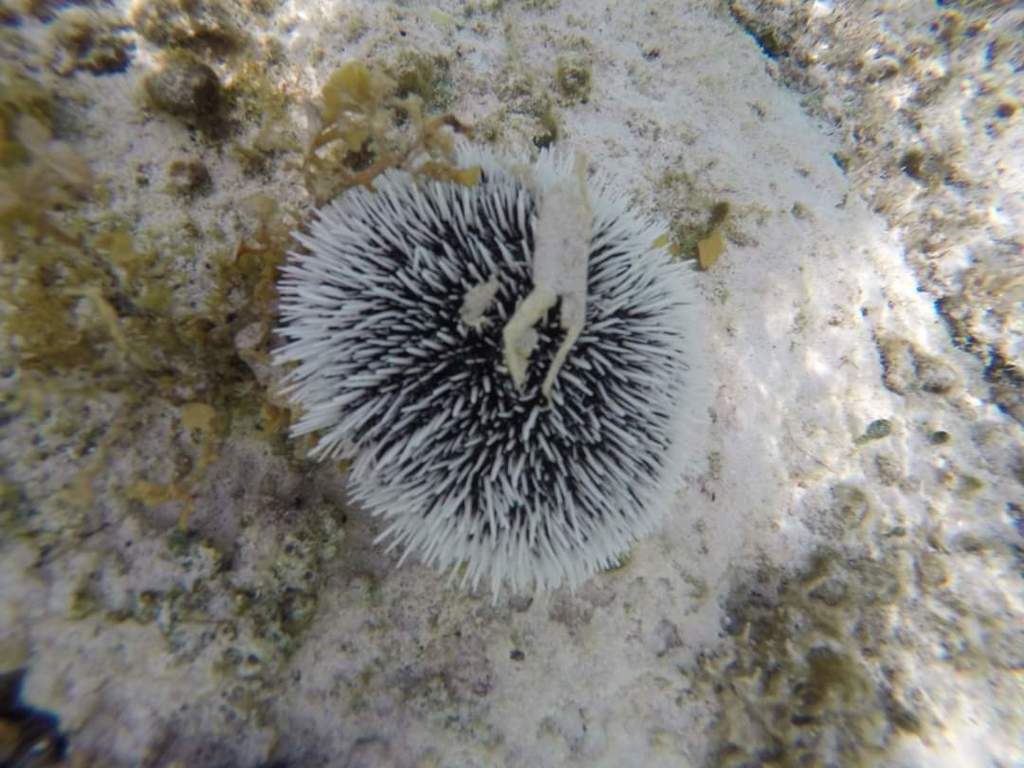
Tripneustes ventricosus reaches 15 cm. Large globular urchin with black-purple test and short white spines in distinct contrast. Frequently covers itself with Thalassia leaf fragments, algae and shells held by its tube feet for camouflage. Intensively grazes Caribbean turtle grass Thalassia testudinum and Syringodium filiforme meadows, regulating their biomass. Gonads consumed in Barbados and southern Caribbean. From 1 to 45 m.
Frequently asked questions
- How big is the West Indian sea egg?
- West Indian sea egg (Tripneustes ventricosus) reaches 10–15 cm in length.
- At what depth can you find the West Indian sea egg?
- West Indian sea egg is found between 1–45 m deep.
- Is the West Indian sea egg dangerous to divers?
- Danger level: Harmless.
- What is the conservation status of the West Indian sea egg?
- IUCN status: Least concern (LC).
- Where can you find the West Indian sea egg?
- Found in: Caribbean, Eastern Pacific.
Other species in the genus Tripneustes
Other species in the family Toxopneustidae
- Sphaerechinus granularis - Violet sea urchin
- Toxopneustes pileolus - Flower urchin
- Lytechinus variegatus - Green Sea Urchin
Sources
- Taxonomy: WoRMS (AphiaID 422490)
- Photos: iNaturalist (CC BY-NC)
- Distribution: GBIF (taxonKey 2278879)
- Conservation: IUCN Red List
- Encyclopedia: Wikipedia