Collector urchin (Tripneustes gratilla)
Key facts
- Scientific name
- Tripneustes gratilla
- Common name
- Collector urchin
- Category
- Echinoderms
- Family
- Toxopneustidae
- Genus
- Tripneustes
- Size
- 10–15 cm
- Depth
- 0–75 m
- IUCN status
- Least concern (LC)
- Danger level
- Harmless
- Habitats
- seagrass, coral-reef
- Behaviours
- benthic
- Ocean zones
- Asian Pacific, Indian Ocean & Red Sea
Description
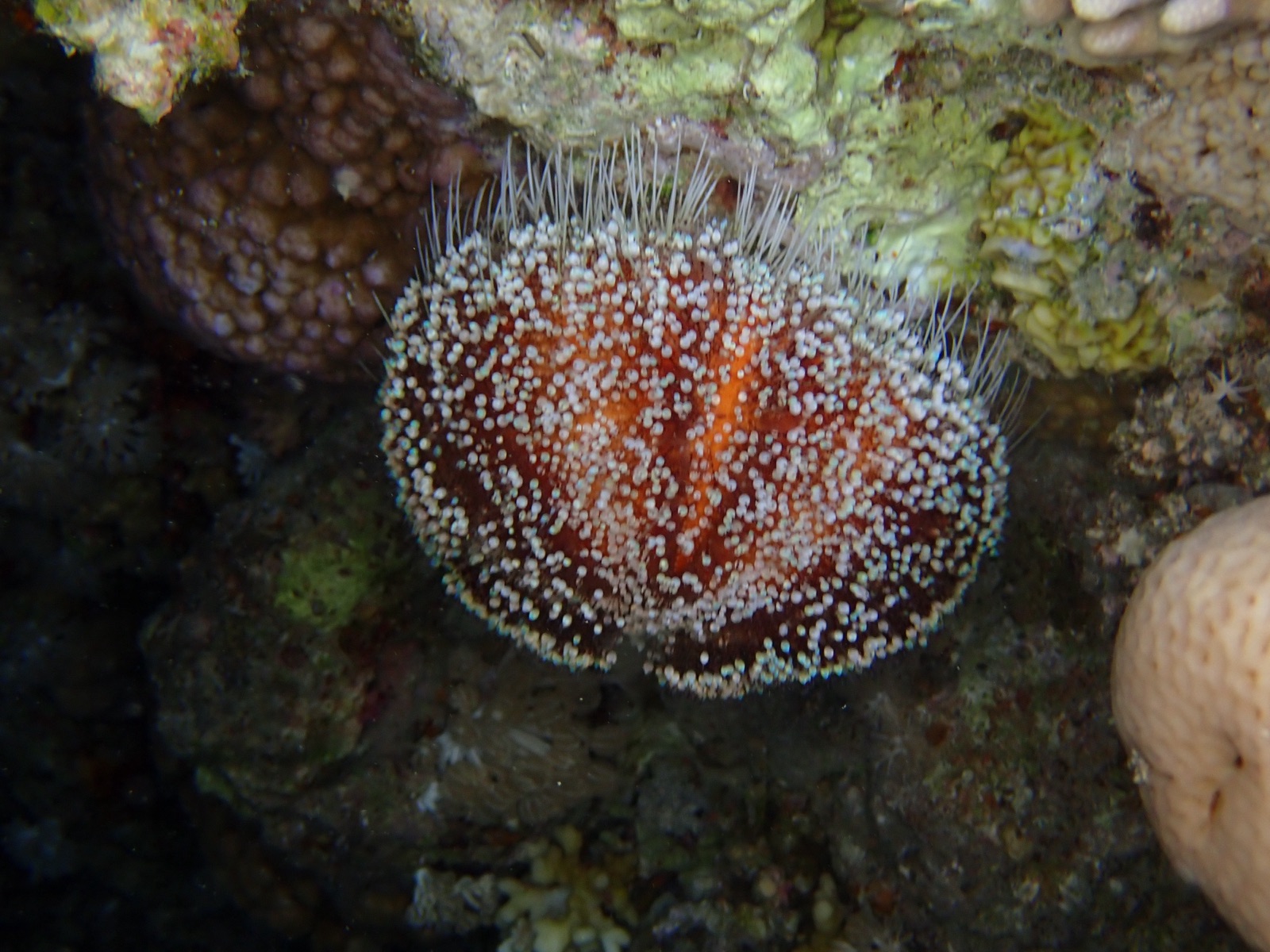
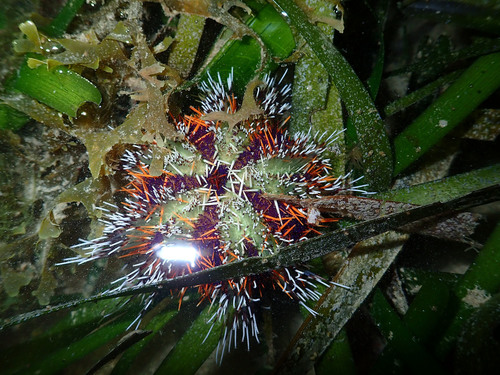
Tripneustes gratilla reaches 15 cm. Common urchin with rounded white to pink test covered with often red-orange-purple short spines, used to camouflaging by sticking to its test algae pieces, shells, coral debris and even plastic pieces (hence collector). Lives from 0 to 75 m on seagrass, coral reefs and rocky bottoms of entire tropical Indo-Pacific. Listed LC. Key herbivore for seagrass maintenance. Commercial fishery for ovaries (uni).
Photo of Collector urchin
Frequently asked questions
- How big is the Collector urchin?
- Collector urchin (Tripneustes gratilla) reaches 10–15 cm in length.
- At what depth can you find the Collector urchin?
- Collector urchin is found between 0–75 m deep.
- Is the Collector urchin dangerous to divers?
- Danger level: Harmless.
- What is the conservation status of the Collector urchin?
- IUCN status: Least concern (LC).
- Where can you find the Collector urchin?
- Found in: Asian Pacific, Indian Ocean & Red Sea.
Other species in the genus Tripneustes
Other species in the family Toxopneustidae
- Sphaerechinus granularis - Violet sea urchin
- Toxopneustes pileolus - Flower urchin
- Lytechinus variegatus - Green Sea Urchin
Sources
- Taxonomy: WoRMS (AphiaID 212453)
- Photos: iNaturalist (CC BY-NC)
- Distribution: GBIF (taxonKey 4341500)
- Conservation: IUCN Red List
- Encyclopedia: Wikipedia