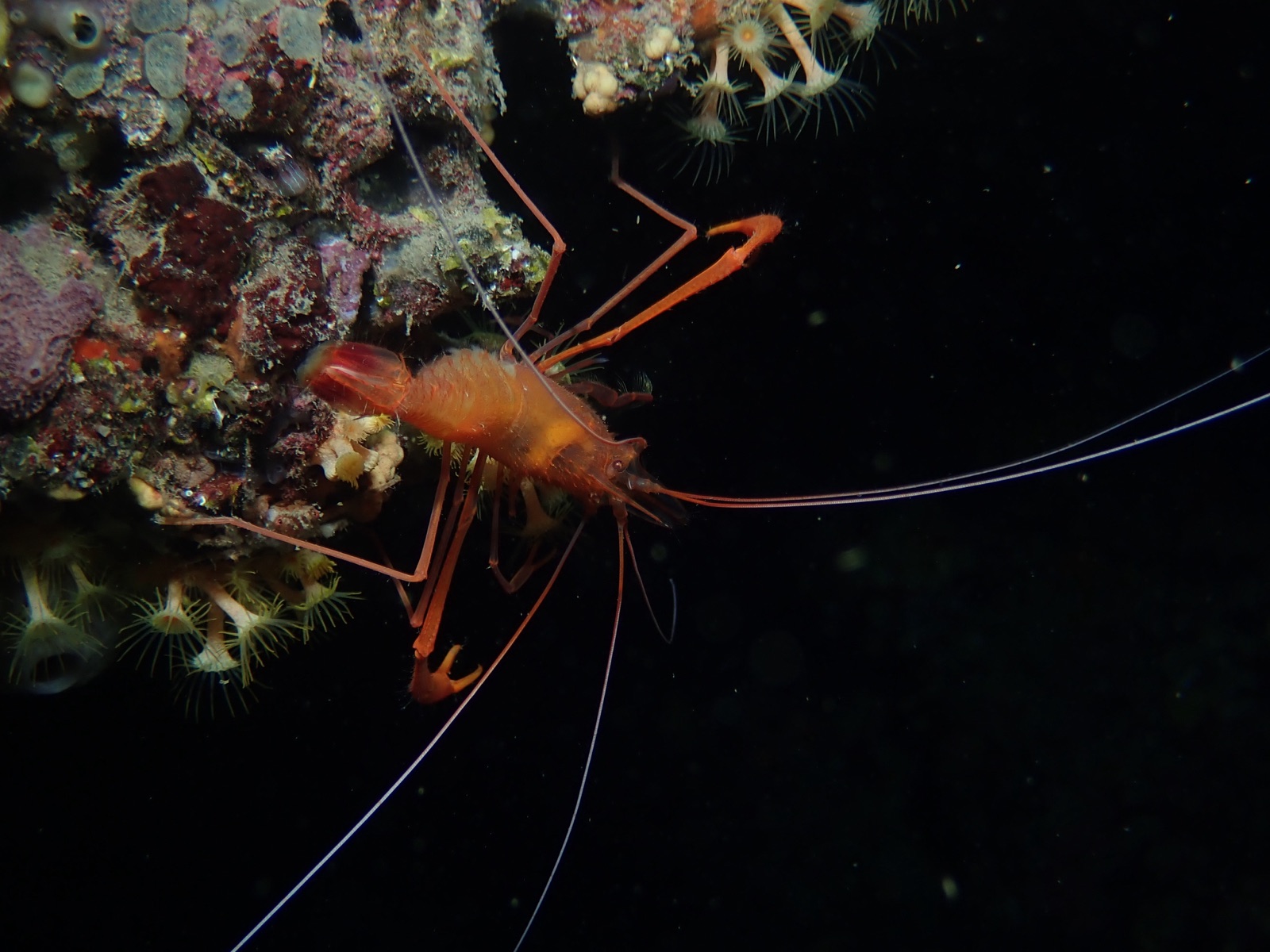
Mediterranean cleaner shrimp (Stenopus spinosus)
Key facts
- Scientific name
- Stenopus spinosus
- Common name
- Mediterranean cleaner shrimp
- Category
- Crustaceans
- Family
- Stenopodidae
- Genus
- Stenopus
- Size
- 4–7 cm
- Depth
- 5–60 m
- IUCN status
- Least concern (LC)
- Danger level
- Harmless
- Habitats
- rocky-reef, cave
- Behaviours
- solitary, pair, cleaner
- Ocean zones
- East Atlantic, Macaronesia, Mediterranean
Description
Stenopus spinosus reaches 7 cm. Cleaner shrimp (Stenopodidae) endemic Mediterranean cousin of Caribbean S. hispidus (batch 4) and Indo-Pacific S. tenuirostris (batch 12). Elongated uniform red-orange body with characteristic long white antennae, third pair of legs in modified boxing claws. Lives in pairs in caves, overhangs and rocky crevices of Mediterranean from 5 to 60 m. Fish cleaner (groupers, congers) which come voluntarily to cleaning stations. Iconic macro photo subject of Med cave dives for vivid colors.
Frequently asked questions
- How big is the Mediterranean cleaner shrimp?
- Mediterranean cleaner shrimp (Stenopus spinosus) reaches 4–7 cm in length.
- At what depth can you find the Mediterranean cleaner shrimp?
- Mediterranean cleaner shrimp is found between 5–60 m deep.
- Is the Mediterranean cleaner shrimp dangerous to divers?
- Danger level: Harmless.
- What is the conservation status of the Mediterranean cleaner shrimp?
- IUCN status: Least concern (LC).
- Where can you find the Mediterranean cleaner shrimp?
- Found in: East Atlantic, Macaronesia, Mediterranean.
Other species in the genus Stenopus
Sources
- Taxonomy: WoRMS (AphiaID 107721)
- Photos: iNaturalist (CC BY-NC)
- Distribution: GBIF (taxonKey 5178718)
- Conservation: IUCN Red List
- Encyclopedia: Wikipedia