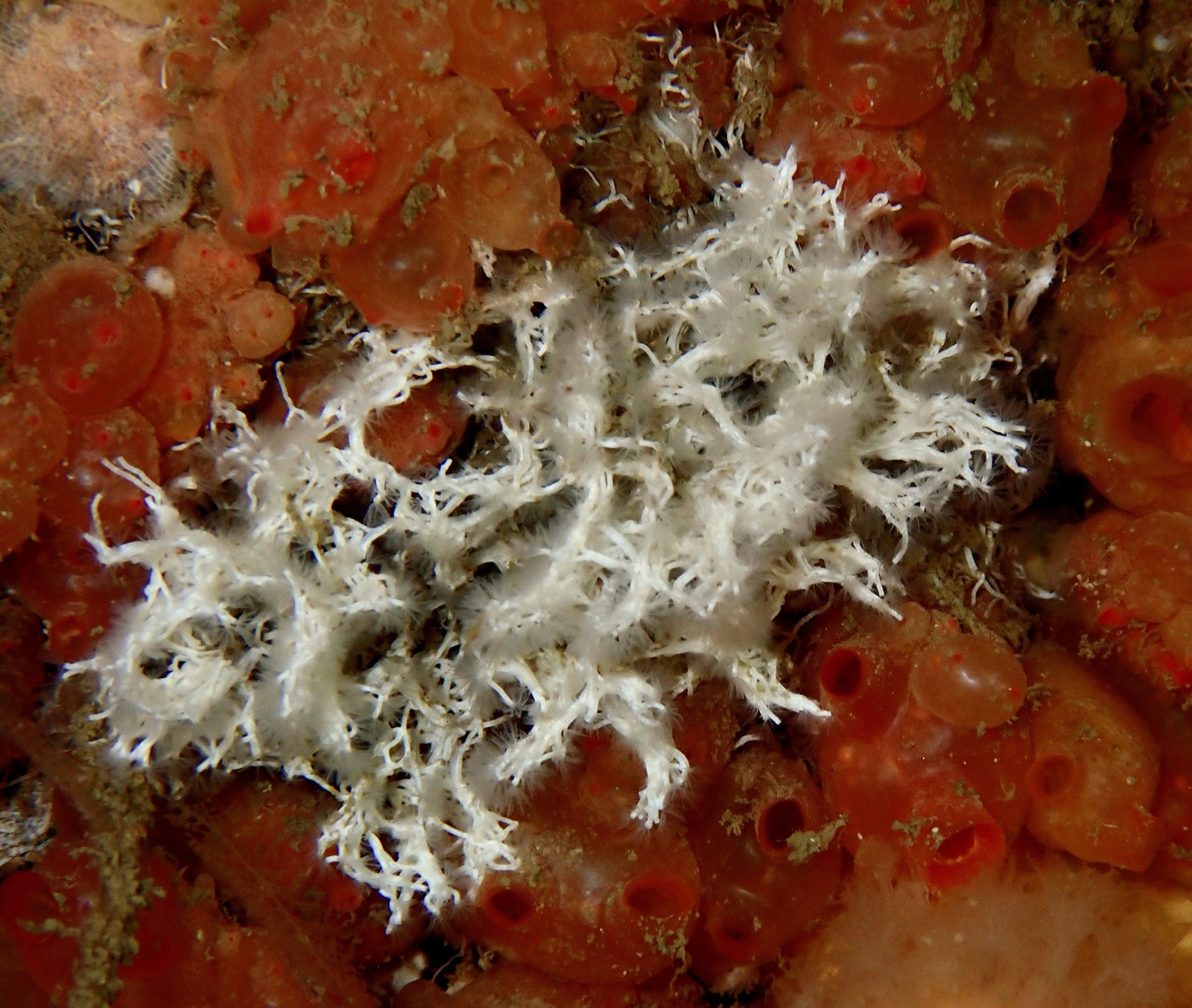
Cluster tubeworm (Salmacina dysteri)
Key facts
- Scientific name
- Salmacina dysteri
- Common name
- Cluster tubeworm
- Category
- Worms
- Family
- Serpulidae
- Genus
- Salmacina
- Size
- 2–8 cm
- Depth
- 5–30 m
- IUCN status
- Least concern (LC)
- Danger level
- Harmless
- Habitats
- rocky-reef, cave
- Behaviours
- sessile, colonial, filter-feeder
- Ocean zones
- Asian Pacific, Caribbean, East Atlantic, Indian Ocean & Red Sea, Mediterranean, Eastern Pacific
Description
Salmacina dysteri reaches 8 cm colonies. Very small tubeworm (Polychaeta, Serpulidae) Mediterranean forming colonies in spongy clusters of extremely thin intertwined cream-white calcareous tubes. Each tiny worm emits translucent white-pink branchial crown. Lives from 5 to 30 m on overhangs, caves and sciaphilic (low-light) hard substrates of Mediterranean. Often in company of Filograna implexa and other colonial serpulids. Discreet macro photo subject for Polychaeta enthusiasts.
Frequently asked questions
- How big is the Cluster tubeworm?
- Cluster tubeworm (Salmacina dysteri) reaches 2–8 cm in length.
- At what depth can you find the Cluster tubeworm?
- Cluster tubeworm is found between 5–30 m deep.
- Is the Cluster tubeworm dangerous to divers?
- Danger level: Harmless.
- What is the conservation status of the Cluster tubeworm?
- IUCN status: Least concern (LC).
- Where can you find the Cluster tubeworm?
- Found in: Asian Pacific, Caribbean, East Atlantic, Indian Ocean & Red Sea, Mediterranean, Eastern Pacific.
Other species in the family Serpulidae
- Protula tubularia - Pink fanworm
- Filograna implexa - Filigree tubeworm
- Spirobranchus triqueter - European fanworm
- Spirobranchus giganteus - Christmas tree worm
- Spirobranchus lamarcki - Lamarck's spirograph
- Serpula vermicularis - Calcareous tubeworm
Sources
- Taxonomy: WoRMS (AphiaID 131038)
- Photos: iNaturalist (CC BY-NC)
- Distribution: GBIF (taxonKey 2326672)
- Conservation: IUCN Red List
- Encyclopedia: Wikipedia