Indo-Pacific feather duster (Sabellastarte spectabilis)
Key facts
- Scientific name
- Sabellastarte spectabilis
- Common name
- Indo-Pacific feather duster
- Category
- Worms
- Family
- Sabellidae
- Genus
- Sabellastarte
- Size
- 10–20 cm
- Depth
- 1–30 m
- IUCN status
- Least concern (LC)
- Danger level
- Harmless
- Habitats
- coral-reef, rocky-reef
- Behaviours
- benthic, solitary
- Ocean zones
- Asian Pacific, Caribbean, Eastern Pacific, Indian Ocean & Red Sea, Macaronesia, Mediterranean
Description
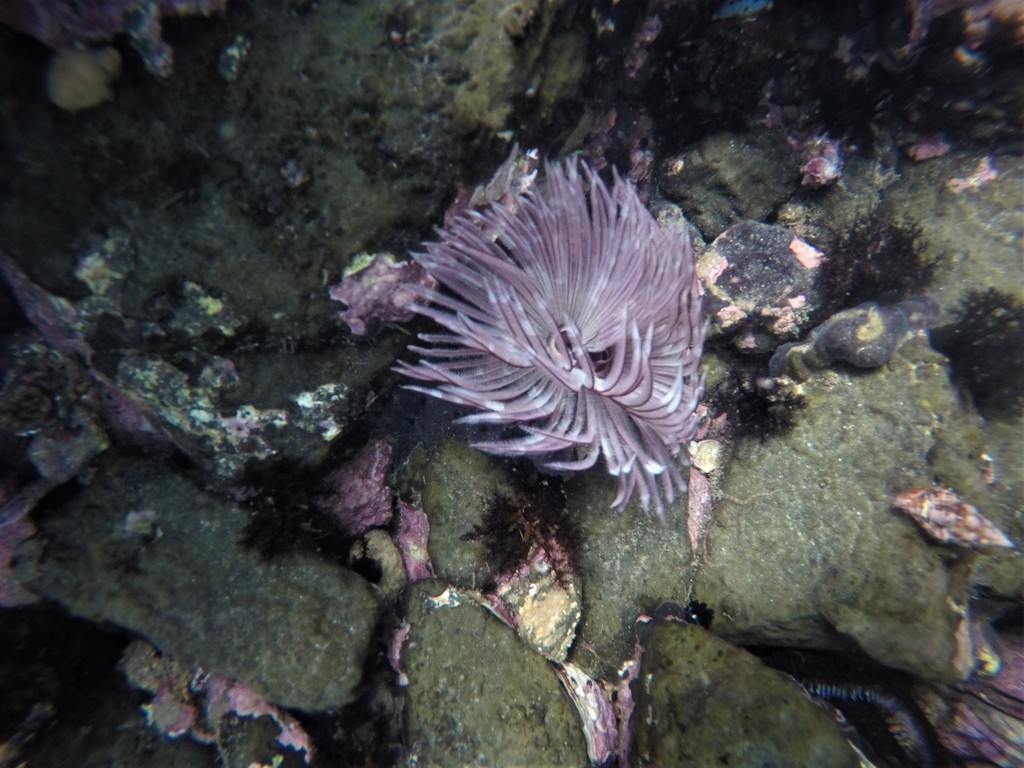
Sabellastarte spectabilis reaches 20 cm with 10 cm diameter crown. Sabellid polychaete worm (Sabellidae) Indo-Pacific with body hidden in membranous tube, projecting outside a bipartite crown of radioles (branchial tentacles) in open wide double spiral, highly variable striped pattern white, brown and red. Lives from 1 to 30 m on coral and rocky reefs, often embedded in corals or crevices. Filter feeder through radioles. Retracts instantly into tube at any disturbance. Classic Indo-Pacific macro dive photo subject, discrete approach challenge.
Frequently asked questions
- How big is the Indo-Pacific feather duster?
- Indo-Pacific feather duster (Sabellastarte spectabilis) reaches 10–20 cm in length.
- At what depth can you find the Indo-Pacific feather duster?
- Indo-Pacific feather duster is found between 1–30 m deep.
- Is the Indo-Pacific feather duster dangerous to divers?
- Danger level: Harmless.
- What is the conservation status of the Indo-Pacific feather duster?
- IUCN status: Least concern (LC).
- Where can you find the Indo-Pacific feather duster?
- Found in: Asian Pacific, Caribbean, Eastern Pacific, Indian Ocean & Red Sea, Macaronesia, Mediterranean.
Other species in the family Sabellidae
- Bispira volutacornis - Twin fanworm
- Sabella spallanzanii - Mediterranean fanworm
- Myxicola infundibulum - Slime tube worm
Sources
- Taxonomy: WoRMS (AphiaID 429077)
- Photos: iNaturalist (CC BY-NC)
- Distribution: GBIF (taxonKey 5200379)
- Conservation: IUCN Red List
- Encyclopedia: Wikipedia