Common seadragon (Phyllopteryx taeniolatus)
Key facts
- Scientific name
- Phyllopteryx taeniolatus
- Common name
- Common seadragon
- Category
- Fish
- Family
- Syngnathidae
- Genus
- Phyllopteryx
- Size
- 25–46 cm
- Depth
- 3–50 m
- IUCN status
- Least concern (LC)
- Danger level
- Harmless
- Habitats
- rocky-reef, seagrass
- Behaviours
- solitary, slow-mover
- Ocean zones
- Asian Pacific
Description
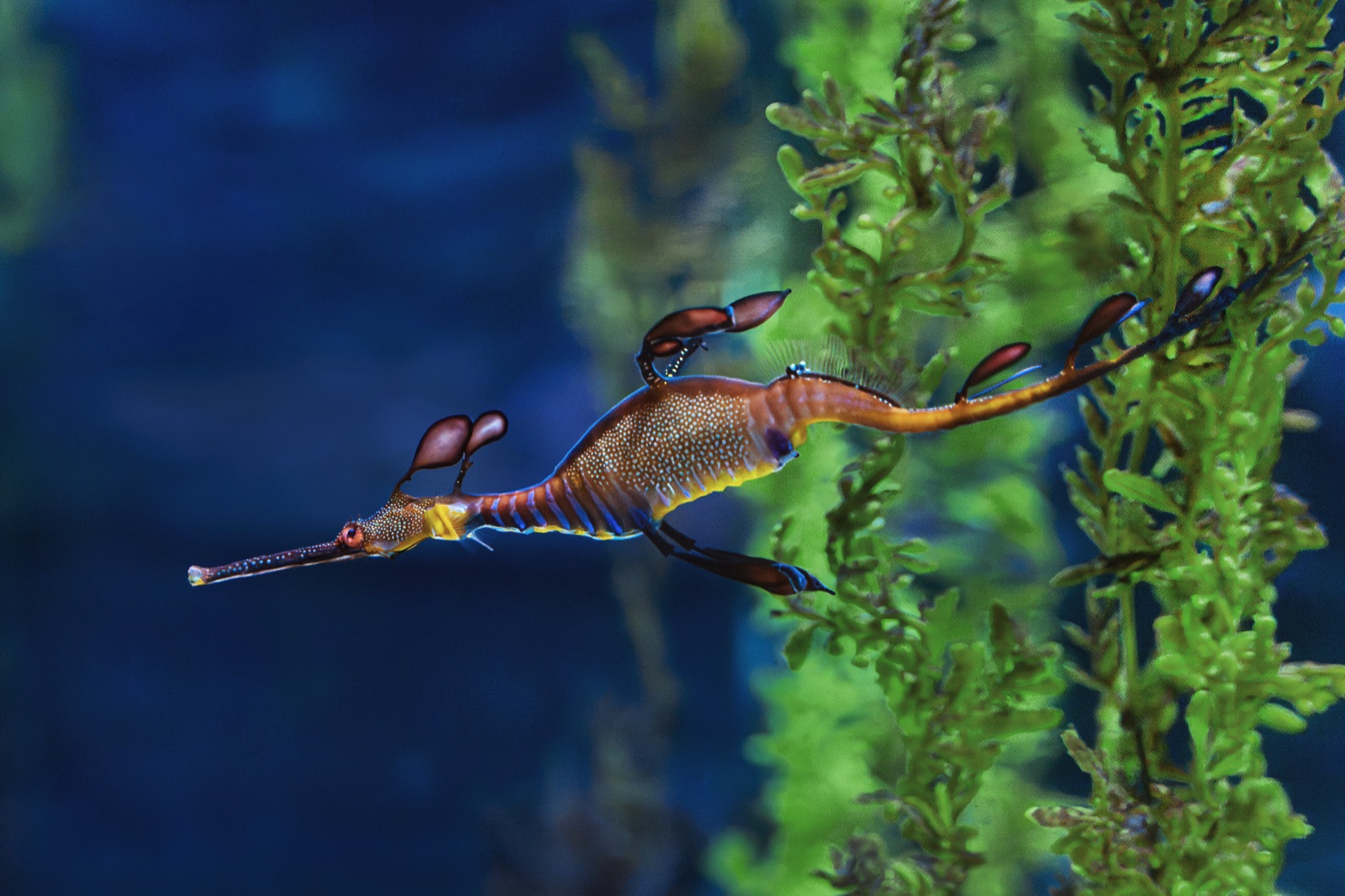
Phyllopteryx taeniolatus reaches 46 cm. Common seadragon (Syngnathidae) endemic to southern Australia (Victoria, Tasmania, New South Wales). Elongated body with less developed thin skin appendages than Phycodurus eques. Spectacular colors: bright yellow-orange and purple-pink longitudinal lines on red-purple back, head and fins with small white spots. Male gestator. Lives from 3 to 50 m on rocks, seagrass and kelp of southern temperate Australia. Less leafy but more colorful cousin than leafy seadragon. Iconic trophy macro photo subject.
Frequently asked questions
- How big is the Common seadragon?
- Common seadragon (Phyllopteryx taeniolatus) reaches 25–46 cm in length.
- At what depth can you find the Common seadragon?
- Common seadragon is found between 3–50 m deep.
- Is the Common seadragon dangerous to divers?
- Danger level: Harmless.
- What is the conservation status of the Common seadragon?
- IUCN status: Least concern (LC).
- Where can you find the Common seadragon?
- Found in: Asian Pacific.
Other species in the family Syngnathidae
- Hippocampus guttulatus - Long-snouted seahorse
- Hippocampus hippocampus - Short-snouted seahorse
- Dunckerocampus dactyliophorus - Banded pipefish
- Hippocampus bargibanti - Bargibant's pygmy seahorse
- Hippocampus denise - Denise's pygmy seahorse
- Hippocampus severnsi - Severns' pygmy seahorse
Sources
- Taxonomy: WoRMS (AphiaID 282254)
- Photos: iNaturalist (CC BY-NC)
- Distribution: GBIF (taxonKey 5200965)
- Conservation: IUCN Red List
- Encyclopedia: Wikipedia