Blue tang (Paracanthurus hepatus)
Key facts
- Scientific name
- Paracanthurus hepatus
- Common name
- Blue tang
- Category
- Fish
- Family
- Acanthuridae
- Genus
- Paracanthurus
- Size
- 15–31 cm
- Depth
- 2–40 m
- IUCN status
- Least concern (LC)
- Danger level
- Harmless
- Habitats
- reef
- Behaviours
- schooling, herbivorous
- Ocean zones
- Asian Pacific, Caribbean, East Atlantic, Indian Ocean & Red Sea, Mediterranean, Eastern Pacific
Description
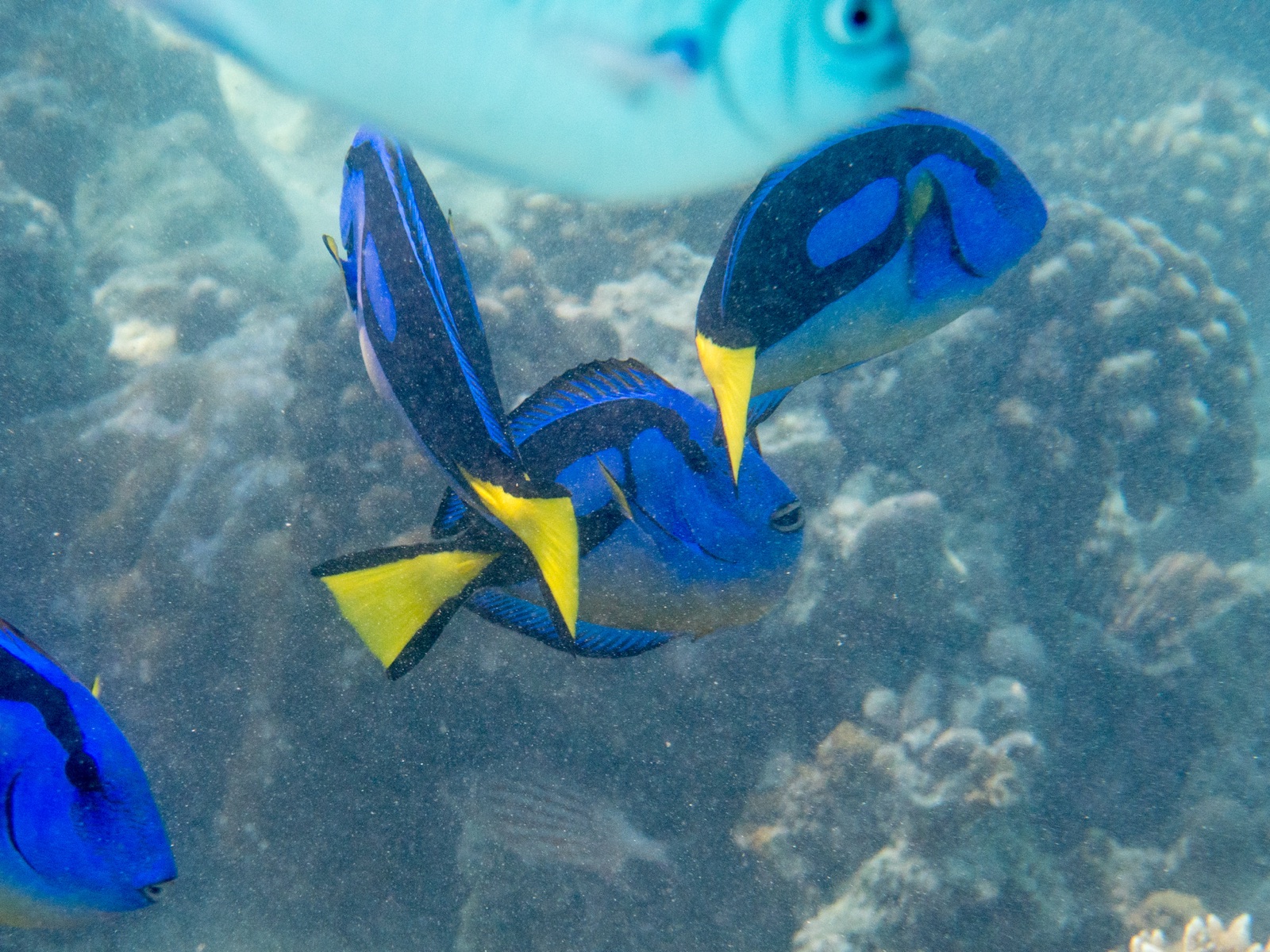
Paracanthurus hepatus, popularized as Dory in Finding Nemo and Finding Dory, reaches 31 cm. Oval deep-royal-blue body with a characteristic black palette-shaped pattern, vivid yellow tail. Sharp retractable lateral blade. Juveniles live alone or in pairs within Pocillopora coral, adults in schools on Indo-Pacific drop-offs. From 2 to 40 m. Populations under pressure from the aquarium trade, sustainable aquaculture developing.
Photo of Blue tang
Frequently asked questions
- How big is the Blue tang?
- Blue tang (Paracanthurus hepatus) reaches 15–31 cm in length.
- At what depth can you find the Blue tang?
- Blue tang is found between 2–40 m deep.
- Is the Blue tang dangerous to divers?
- Danger level: Harmless.
- What is the conservation status of the Blue tang?
- IUCN status: Least concern (LC).
- Where can you find the Blue tang?
- Found in: Asian Pacific, Caribbean, East Atlantic, Indian Ocean & Red Sea, Mediterranean, Eastern Pacific.
Other species in the family Acanthuridae
- Acanthurus coeruleus - Blue tang surgeonfish
- Acanthurus chirurgus - Doctorfish
- Acanthurus tractus - Atlantic blue tang
- Naso lituratus - Orangespine unicornfish
- Zebrasoma xanthurum - Yellowtail tang
- Zebrasoma desjardinii - Sailfin tang
Sources
- Taxonomy: WoRMS (AphiaID 219676)
- Photos: iNaturalist (CC BY-NC)
- Distribution: GBIF (taxonKey 2379534)
- Conservation: IUCN Red List
- Encyclopedia: Wikipedia