Banded sea urchin (Echinothrix calamaris)
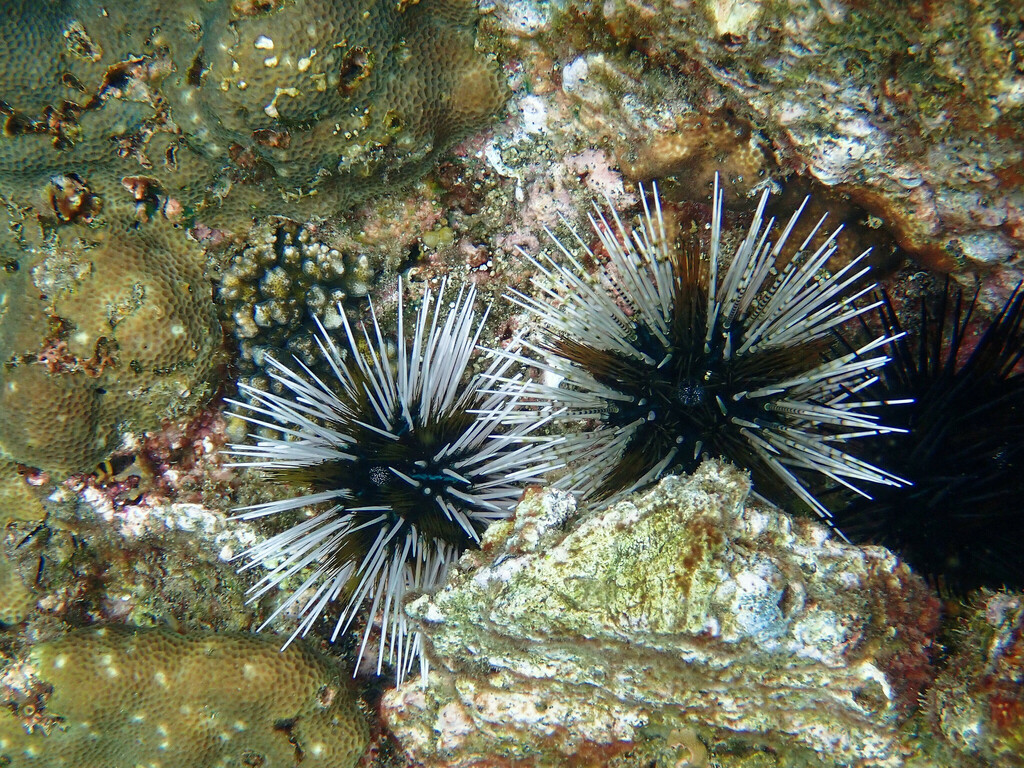
Key facts
- Scientific name
- Echinothrix calamaris
- Common name
- Banded sea urchin
- Category
- Echinoderms
- Family
- Diadematidae
- Genus
- Echinothrix
- Size
- 15–25 cm
- Depth
- 1–70 m
- IUCN status
- Least concern (LC)
- Danger level
- Harmless
- Habitats
- coral-reef, rocky-reef
- Behaviours
- benthic, nocturnal, venomous
- Ocean zones
- Asian Pacific, Indian Ocean & Red Sea
Description
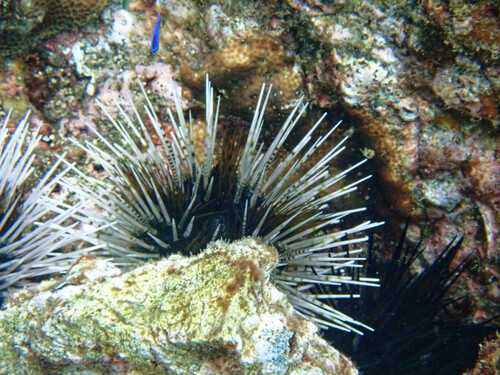
Echinothrix calamaris reaches 25 cm. Characteristic urchin with long needle-like spines (less fine than Diadema) transversally banded brown, white and black, giving zebra appearance, distinctive iridescent blue-purple anal ring on top of test. Brown-beige body. Lives from 1 to 70 m on coral and rocky reefs of entire Indo-Pacific. Listed LC. Nocturnal, hides during day under corals, comes out to hunt algae and detritus at night. Painful but not serious sting. Identifiable and photogenic photo subject.
Photo of Banded sea urchin
Frequently asked questions
- How big is the Banded sea urchin?
- Banded sea urchin (Echinothrix calamaris) reaches 15–25 cm in length.
- At what depth can you find the Banded sea urchin?
- Banded sea urchin is found between 1–70 m deep.
- Is the Banded sea urchin dangerous to divers?
- Danger level: Harmless.
- What is the conservation status of the Banded sea urchin?
- IUCN status: Least concern (LC).
- Where can you find the Banded sea urchin?
- Found in: Asian Pacific, Indian Ocean & Red Sea.
Other species in the family Diadematidae
Sources
- Taxonomy: WoRMS (AphiaID 213377)
- Photos: iNaturalist (CC BY-NC)
- Distribution: GBIF (taxonKey 5721102)
- Conservation: IUCN Red List
- Encyclopedia: Wikipedia