Mediterranean stony coral (Cladocora caespitosa)
Key facts
- Scientific name
- Cladocora caespitosa
- Common name
- Mediterranean stony coral
- Category
- Corals
- Family
- Cladocoridae
- Genus
- Cladocora
- Size
- 10–200 cm
- Depth
- 3–50 m
- IUCN status
- Endangered (EN)
- Danger level
- Harmless
- Habitats
- rocky-reef
- Behaviours
- sessile, colonial, filter-feeder
- Ocean zones
- East Atlantic, Mediterranean
Description
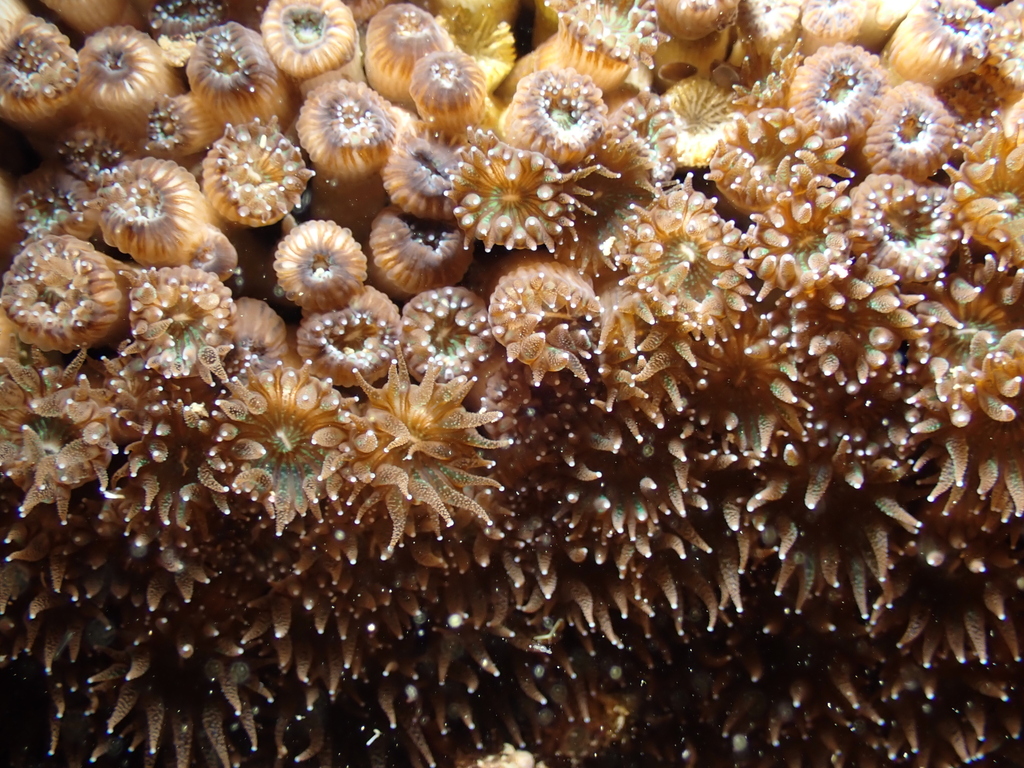
Cladocora caespitosa reaches 2 m colony diameter. Largest reef-building hard coral (Scleractinia) in Mediterranean, one of the only true builders of the zone (with Astroides). Massive cushion or mushroom-shaped colonies yellow-green to brown-orange with small tight coralligenous. Lives from 3 to 50 m on hard substrates of Mediterranean. Listed EN by IUCN following 2003, 2018, 2022 summer heat waves causing massive bleaching and mortality. Witness species of Mediterranean climate change. Iconic but threatened wide-angle photo subject.
Frequently asked questions
- How big is the Mediterranean stony coral?
- Mediterranean stony coral (Cladocora caespitosa) reaches 10–200 cm in length.
- At what depth can you find the Mediterranean stony coral?
- Mediterranean stony coral is found between 3–50 m deep.
- Is the Mediterranean stony coral dangerous to divers?
- Danger level: Harmless.
- What is the conservation status of the Mediterranean stony coral?
- IUCN status: Endangered (EN).
- Where can you find the Mediterranean stony coral?
- Found in: East Atlantic, Mediterranean.
Similar species
- Acropora cervicornis - Staghorn coral
- Corallium rubrum - Red coral
- Gorgonia ventalina - Common sea fan
- Antillogorgia americana - Slimy sea plume
- Montastraea cavernosa - Great star coral
- Orbicella annularis - Boulder star coral
Sources
- Taxonomy: WoRMS (AphiaID 135146)
- Photos: iNaturalist (CC BY-NC)
- Distribution: GBIF (taxonKey 2258965)
- Conservation: IUCN Red List
- Encyclopedia: Wikipedia