Fin whale (Balaenoptera physalus)
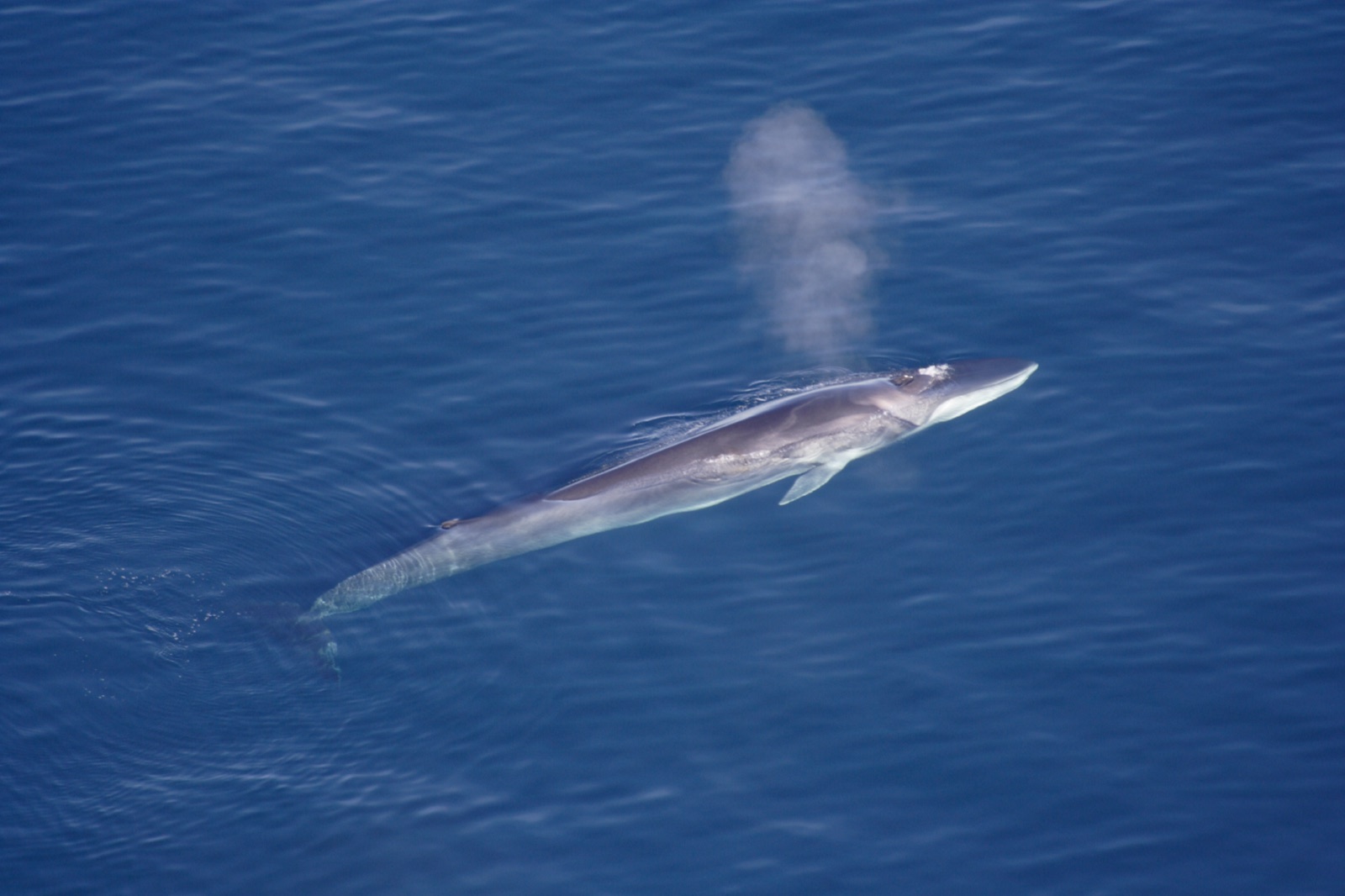
Key facts
- Scientific name
- Balaenoptera physalus
- Common name
- Fin whale
- Category
- Marine mammals
- Family
- Balaenopteridae
- Genus
- Balaenoptera
- Size
- 1800–2700 cm
- Depth
- 0–470 m
- IUCN status
- Vulnerable (VU)
- Danger level
- Harmless
- Habitats
- open-water
- Behaviours
- solitary, schooling, fast-moving
- Ocean zones
- East Atlantic, Macaronesia, Eastern Pacific
Description
Balaenoptera physalus reaches 27 m and 80 tons. Second largest animal in the world after the blue whale. Slender gray-brown silhouette above, white below, unique asymmetry for mammals: white right lower jaw but gray left. Baleen filter. Fastest of the great whales (40 km/h). Seasonal migrations, observed in spring-summer in Azores and Mediterranean (Pelagos sanctuary). Listed VU following whaling. Iconic encounters of Azores whale-watching trips April-June.
Photo of Fin whale
Frequently asked questions
- How big is the Fin whale?
- Fin whale (Balaenoptera physalus) reaches 1800–2700 cm in length.
- At what depth can you find the Fin whale?
- Fin whale is found between 0–470 m deep.
- Is the Fin whale dangerous to divers?
- Danger level: Harmless.
- What is the conservation status of the Fin whale?
- IUCN status: Vulnerable (VU).
- Where can you find the Fin whale?
- Found in: East Atlantic, Macaronesia, Eastern Pacific.
Other species in the genus Balaenoptera
Other species in the family Balaenopteridae
Sources
- Taxonomy: WoRMS (AphiaID 137091)
- Photos: iNaturalist (CC BY-NC)
- Distribution: GBIF (taxonKey 2440718)
- Conservation: IUCN Red List
- Encyclopedia: Wikipedia