Saddle oyster (Anomia ephippium)
Key facts
- Scientific name
- Anomia ephippium
- Common name
- Saddle oyster
- Category
- Molluscs
- Family
- Anomiidae
- Genus
- Anomia
- Size
- 3–6 cm
- Depth
- 0–70 m
- IUCN status
- Least concern (LC)
- Danger level
- Harmless
- Habitats
- rocky
- Behaviours
- sessile, filter-feeder
- Ocean zones
- East Atlantic, Macaronesia, Mediterranean
Description
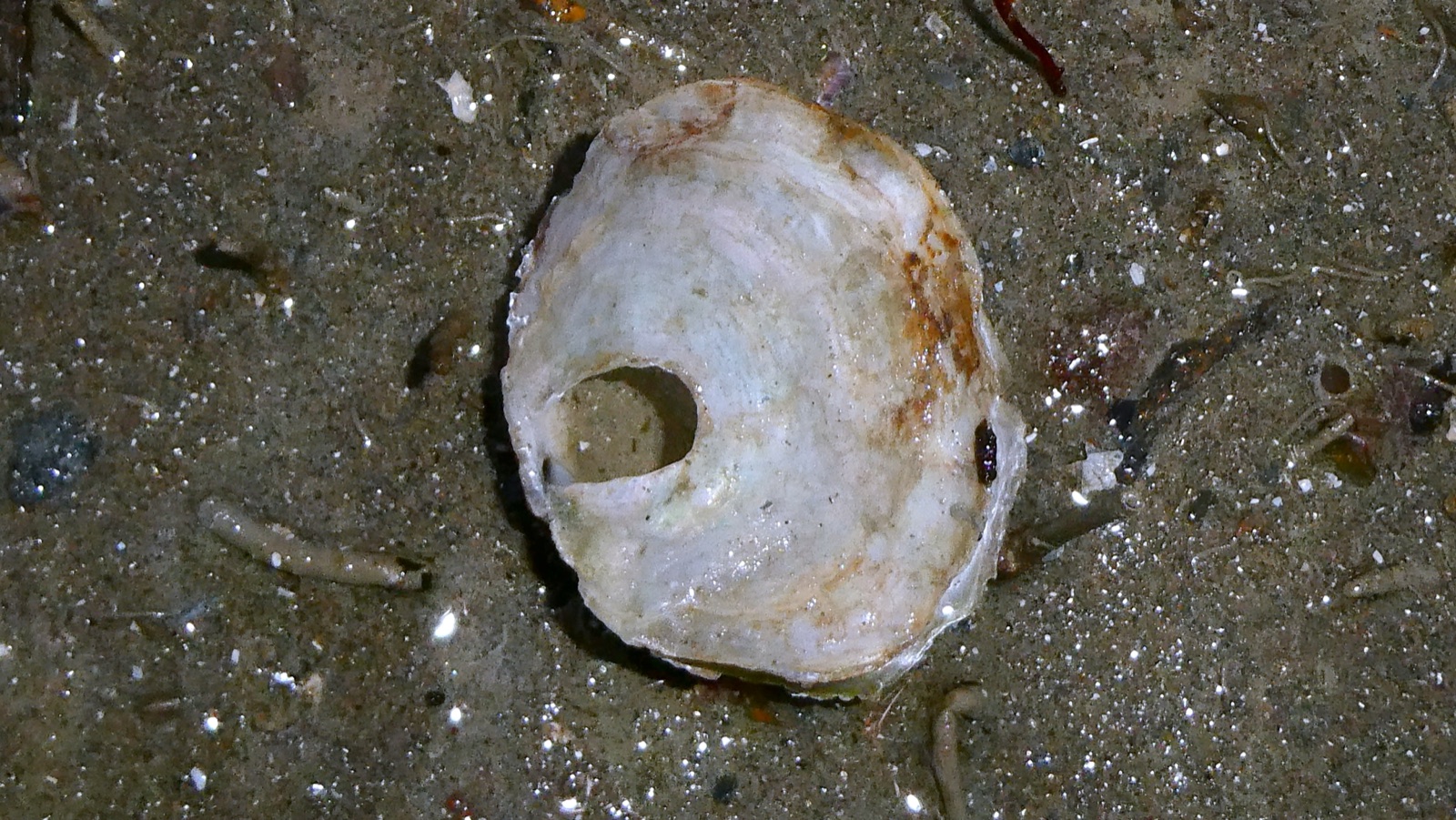
Anomia ephippium is an asymmetric bivalve of 3 to 6 cm, with markedly dissimilar valves: upper one bulging and silvery, lower one flat with a central opening through which passes a calcified byssus anchoring it to the substrate. Literally molds itself to the shape of the host rock. Very common on rocks, shells and wrecks from 0 to 70 m. Plankton filter feeder. Iridescent shell prized for decoration.
Photo of Saddle oyster
Frequently asked questions
- How big is the Saddle oyster?
- Saddle oyster (Anomia ephippium) reaches 3–6 cm in length.
- At what depth can you find the Saddle oyster?
- Saddle oyster is found between 0–70 m deep.
- Is the Saddle oyster dangerous to divers?
- Danger level: Harmless.
- What is the conservation status of the Saddle oyster?
- IUCN status: Least concern (LC).
- Where can you find the Saddle oyster?
- Found in: East Atlantic, Macaronesia, Mediterranean.
Similar species
- Octopus vulgaris - Common octopus
- Sepia officinalis - Common cuttlefish
- Aliger gigas - Queen conch
- Metasepia pfefferi - Flamboyant Cuttlefish
- Chromodoris magnifica - Magnificent chromodoris
- Felimare tricolor - Tricolor doris
Sources
- Taxonomy: WoRMS (AphiaID 138748)
- Photos: iNaturalist (CC BY-NC)
- Distribution: GBIF (taxonKey 5188926)
- Conservation: IUCN Red List
- Encyclopedia: Wikipedia