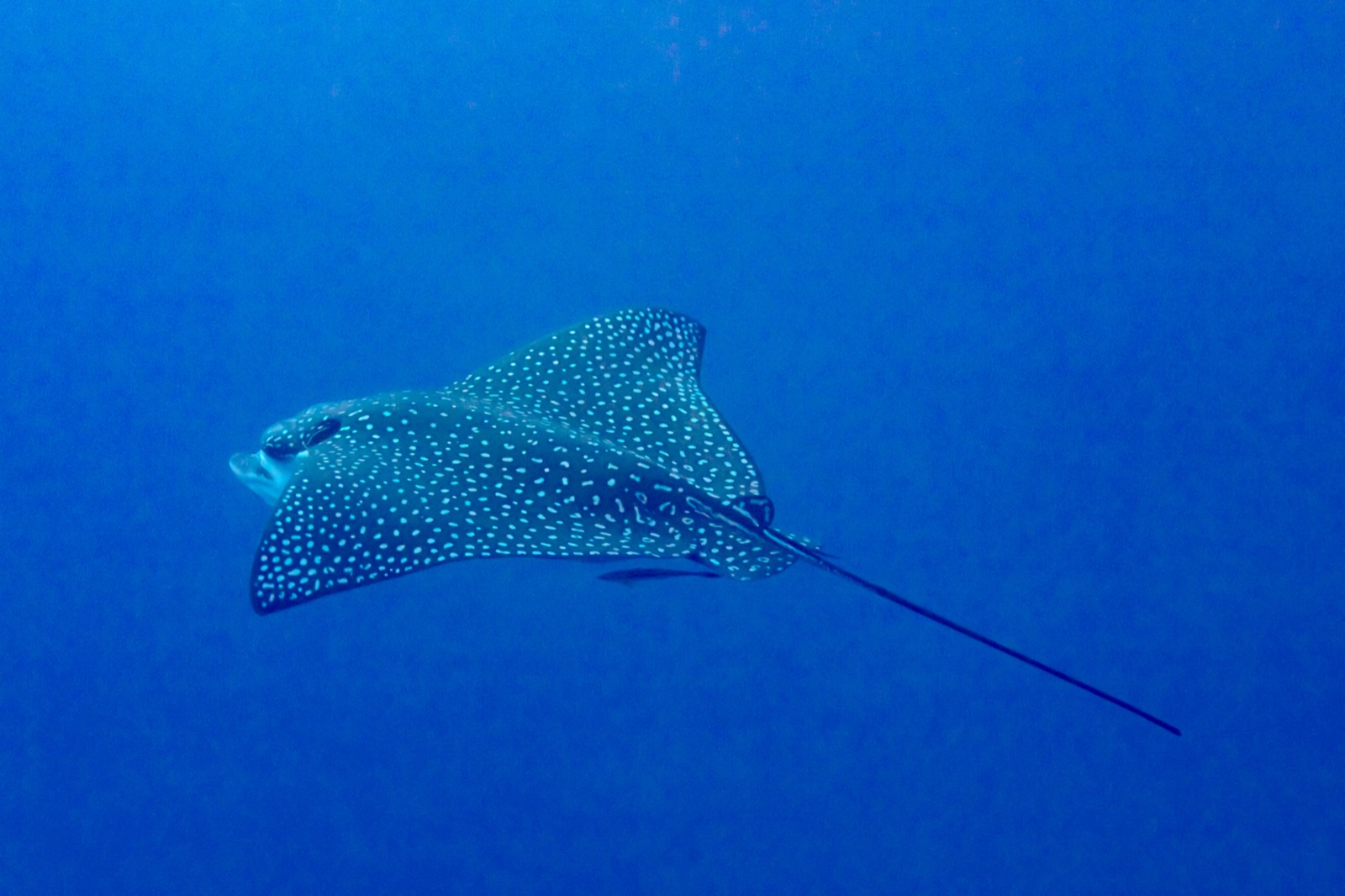
Pacific eagle ray (Aetobatus laticeps)
Key facts
- Scientific name
- Aetobatus laticeps
- Common name
- Pacific eagle ray
- Category
- Fish
- Family
- Aetobatidae
- Genus
- Aetobatus
- Size
- 150–330 cm
- Depth
- 1–80 m
- IUCN status
- Near threatened (NT)
- Danger level
- Harmless
- Habitats
- open-water, sand
- Behaviours
- solitary, schooling
- Ocean zones
- Caribbean, Eastern Pacific
Description
Aetobatus laticeps reaches 330 cm wingspan and 230 kg. Large Eastern Pacific eagle ray (Gulf of California to Peru, Galapagos). Blue-black back covered with characteristic small circular white spots, white belly, long caudal whip that can exceed body length. Very recently separated from A. narinari (Atlantic/Caribbean, already in base batch 4). Listed NT by IUCN. Lives in open water or on sand from 1 to 80 m. Predator of bivalve mollusks and crustaceans with plate teeth. Spectacular schooling encounters over sands of Sea of Cortez, Cabo Pulmo.
Frequently asked questions
- How big is the Pacific eagle ray?
- Pacific eagle ray (Aetobatus laticeps) reaches 150–330 cm in length.
- At what depth can you find the Pacific eagle ray?
- Pacific eagle ray is found between 1–80 m deep.
- Is the Pacific eagle ray dangerous to divers?
- Danger level: Harmless.
- What is the conservation status of the Pacific eagle ray?
- IUCN status: Near threatened (NT).
- Where can you find the Pacific eagle ray?
- Found in: Caribbean, Eastern Pacific.
Other species in the genus Aetobatus
Sources
- Taxonomy: WoRMS (AphiaID 712980)
- Photos: iNaturalist (CC BY-NC)
- Distribution: GBIF (taxonKey 10806963)
- Conservation: IUCN Red List
- Encyclopedia: Wikipedia