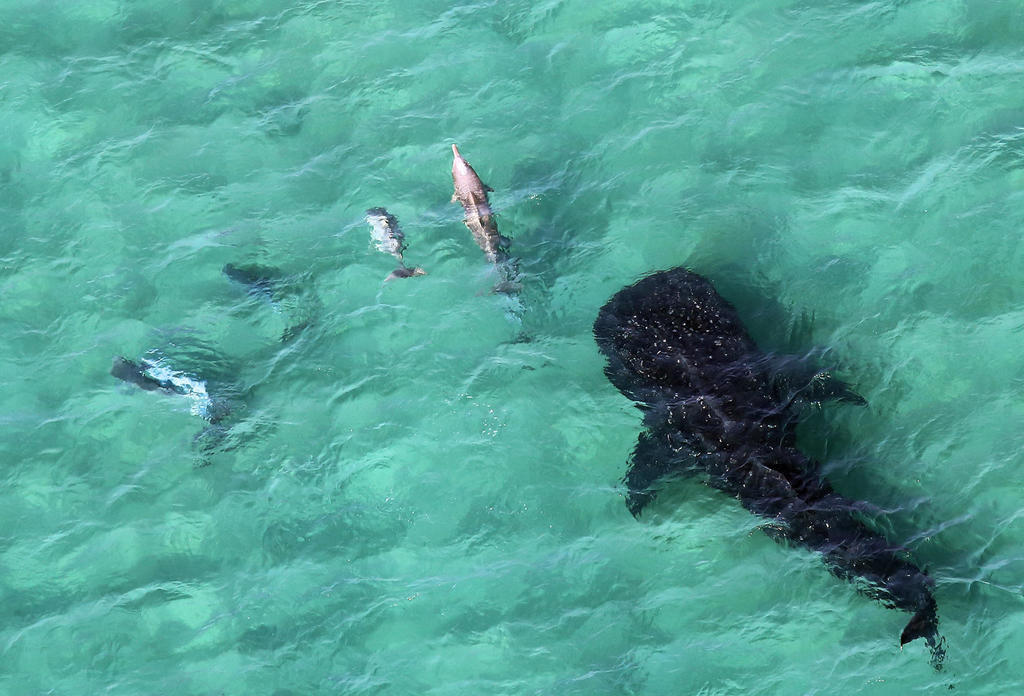
Indo-Pacific Bottlenose Dolphin (Tursiops aduncus)
Key facts
- Scientific name
- Tursiops aduncus
- Common name
- Indo-Pacific Bottlenose Dolphin
- Category
- Marine mammals
- Family
- Delphinidae
- Genus
- Tursiops
- Size
- 200–300 cm
- Depth
- 0–100 m
- IUCN status
- Least concern (LC)
- Danger level
- Harmless
- Habitats
- coral-reef, sandy-bottom, open-water
- Behaviours
- pelagic, fast-swimmer, schooling
- Ocean zones
- Asian Pacific, Indian Ocean & Red Sea, Mediterranean
Description
Robust cetacean (200-300 cm) light grey with characteristic rounded forehead. Shallow Indo-Pacific coastal (0-100 m). Gregarious, intelligent, approachable. Energetic fast swimmer. Conservation: least concern. Diving: popular, interactive, educational.
Frequently asked questions
- How big is the Indo-Pacific Bottlenose Dolphin?
- Indo-Pacific Bottlenose Dolphin (Tursiops aduncus) reaches 200–300 cm in length.
- At what depth can you find the Indo-Pacific Bottlenose Dolphin?
- Indo-Pacific Bottlenose Dolphin is found between 0–100 m deep.
- Is the Indo-Pacific Bottlenose Dolphin dangerous to divers?
- Danger level: Harmless.
- What is the conservation status of the Indo-Pacific Bottlenose Dolphin?
- IUCN status: Least concern (LC).
- Where can you find the Indo-Pacific Bottlenose Dolphin?
- Found in: Asian Pacific, Indian Ocean & Red Sea, Mediterranean.
Other species in the genus Tursiops
Other species in the family Delphinidae
- Globicephala macrorhynchus - Short-finned pilot whale
- Delphinus delphis - Common dolphin
- Stenella frontalis - Atlantic spotted dolphin
- Orcinus orca - Killer whale
- Globicephala melas - Long-finned pilot whale
- Grampus griseus - Risso's Dolphin
Sources
- Taxonomy: WoRMS (AphiaID 254983)
- Photos: iNaturalist (CC BY-NC)
- Distribution: GBIF (taxonKey 2440455)
- Conservation: IUCN Red List
- Encyclopedia: Wikipedia