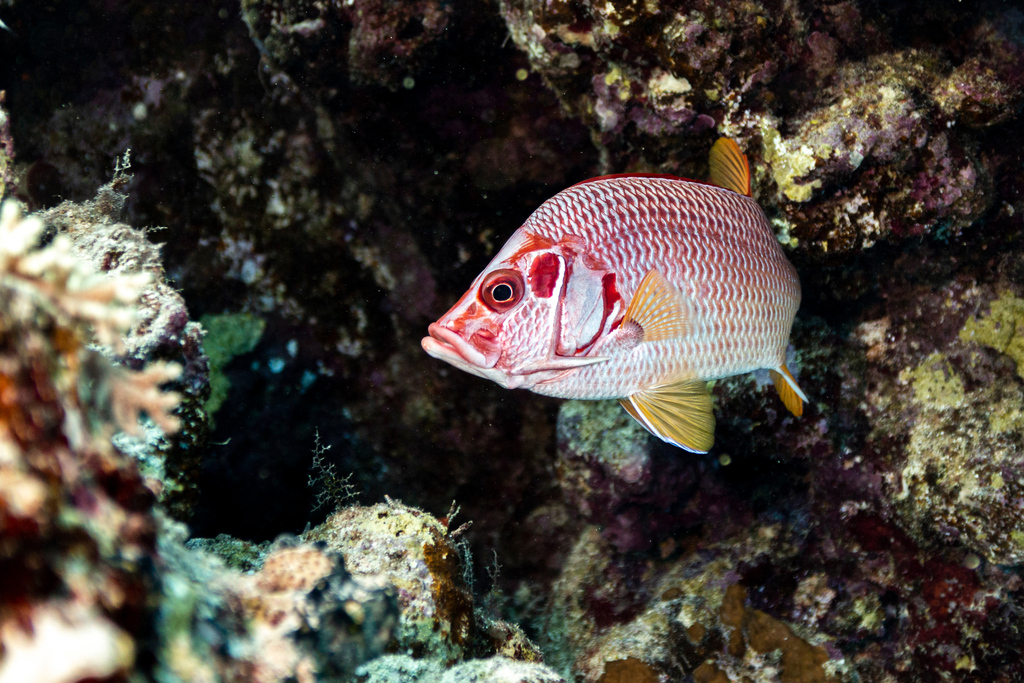
Sabre squirrelfish (Sargocentron spiniferum)
Key facts
- Scientific name
- Sargocentron spiniferum
- Common name
- Sabre squirrelfish
- Category
- Fish
- Family
- Holocentridae
- Genus
- Sargocentron
- Size
- 30–51 cm
- Depth
- 1–122 m
- IUCN status
- Least concern (LC)
- Danger level
- Harmless
- Habitats
- coral-reef
- Behaviours
- solitary, nocturnal
- Ocean zones
- Asian Pacific, Indian Ocean & Red Sea
Description
Sargocentron spiniferum reaches 51 cm, the largest holocentrid. Uniform bright red body with prominent yellow operculum spot, long sharp potentially venomous pre-opercular spines (care when handling). Large black eyes adapted to nocturnal vision. Lives from 1 to 122 m on coral reefs of Indo-Pacific. Nocturnal, comes out to hunt small invertebrates and fish at night. Rests during day under table corals. Appreciated photo subject for warm colors and respectable size.
Frequently asked questions
- How big is the Sabre squirrelfish?
- Sabre squirrelfish (Sargocentron spiniferum) reaches 30–51 cm in length.
- At what depth can you find the Sabre squirrelfish?
- Sabre squirrelfish is found between 1–122 m deep.
- Is the Sabre squirrelfish dangerous to divers?
- Danger level: Harmless.
- What is the conservation status of the Sabre squirrelfish?
- IUCN status: Least concern (LC).
- Where can you find the Sabre squirrelfish?
- Found in: Asian Pacific, Indian Ocean & Red Sea.
Other species in the genus Sargocentron
Other species in the family Holocentridae
- Myripristis murdjan - Blotcheye soldierfish
- Holocentrus rufus - Longspine squirrelfish
- Holocentrus adscensionis - Squirrelfish
- Myripristis jacobus - Blackbar soldierfish
- Myripristis vittata - Whitetip soldierfish
- Neoniphon marianus - Longjaw squirrelfish
Sources
- Taxonomy: WoRMS (AphiaID 217950)
- Photos: iNaturalist (CC BY-NC)
- Distribution: GBIF (taxonKey 2356873)
- Conservation: IUCN Red List
- Encyclopedia: Wikipedia