Banded sea krait (Laticauda colubrina)
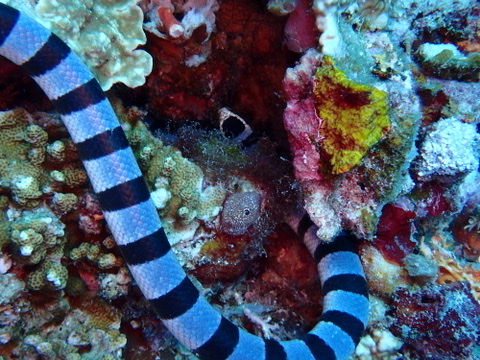
Key facts
- Scientific name
- Laticauda colubrina
- Common name
- Banded sea krait
- Category
- Marine reptiles
- Family
- Elapidae
- Genus
- Laticauda
- Size
- 100–160 cm
- Depth
- 0–50 m
- IUCN status
- Least concern (LC)
- Danger level
- Harmless
- Habitats
- coral-reef, rocky-reef
- Behaviours
- benthic, nocturnal
- Ocean zones
- Asian Pacific, Indian Ocean & Red Sea, Mediterranean
Description
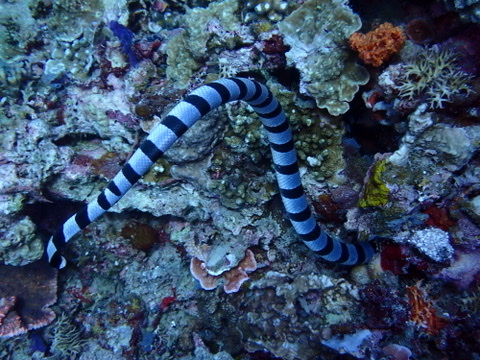
Laticauda colubrina reaches 1.6 m. Sea snake (Elapidae) tropical Indo-Pacific with cylindrical body striped with characteristic alternating black and blue-white to blue-gray bands (hence banded), flattened black head with yellow upper lip, vertically flattened tail for swimming. Lives from 0 to 50 m on coral and rocky reefs. Semi-aquatic, regularly returns to land to rest, mate and lay eggs. Nocturnal, predator of eels and small fish in crevices. Extremely powerful venom (10x more toxic than king cobra) but non-aggressive behavior, bites rare if not handled. Iconic Indo-Pacific dive photo subject Fiji, New Caledonia, Philippines.
Photo of Banded sea krait
Frequently asked questions
- How big is the Banded sea krait?
- Banded sea krait (Laticauda colubrina) reaches 100–160 cm in length.
- At what depth can you find the Banded sea krait?
- Banded sea krait is found between 0–50 m deep.
- Is the Banded sea krait dangerous to divers?
- Danger level: Harmless.
- What is the conservation status of the Banded sea krait?
- IUCN status: Least concern (LC).
- Where can you find the Banded sea krait?
- Found in: Asian Pacific, Indian Ocean & Red Sea, Mediterranean.
Other species in the family Elapidae
Sources
- Taxonomy: WoRMS (AphiaID 344083)
- Photos: iNaturalist (CC BY-NC)
- Distribution: GBIF (taxonKey 8374394)
- Conservation: IUCN Red List
- Encyclopedia: Wikipedia