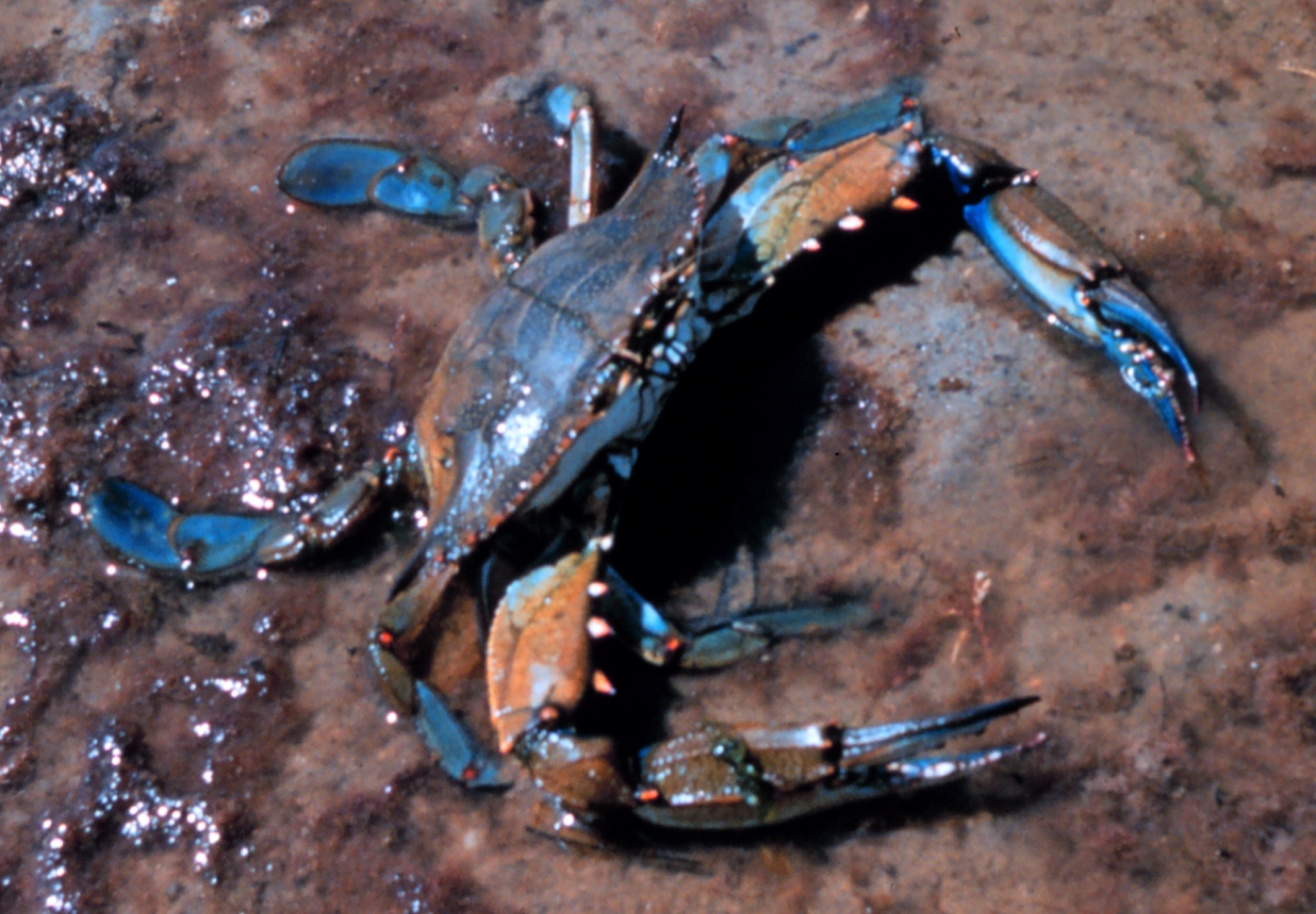
Atlantic blue crab (Callinectes sapidus)
Key facts
- Scientific name
- Callinectes sapidus
- Common name
- Atlantic blue crab
- Category
- Crustaceans
- Family
- Portunidae
- Genus
- Callinectes
- Size
- 10–23 cm
- Depth
- 0–35 m
- IUCN status
- Least concern (LC)
- Danger level
- Harmless
- Habitats
- sand, estuarine
- Behaviours
- aggressive, swimming
- Ocean zones
- Caribbean, East Atlantic, Mediterranean, Eastern Pacific
Description
Callinectes sapidus, the Atlantic blue crab, is an invasive species in the Mediterranean since the 2000s, introduced via ballast water from the US East Coast. Carapace up to 23 cm, electric-blue claws in males. A fast swimmer thanks to its rearmost pair of paddle-shaped legs. Major population increase in recent years, with significant ecological and commercial impact.
Frequently asked questions
- How big is the Atlantic blue crab?
- Atlantic blue crab (Callinectes sapidus) reaches 10–23 cm in length.
- At what depth can you find the Atlantic blue crab?
- Atlantic blue crab is found between 0–35 m deep.
- Is the Atlantic blue crab dangerous to divers?
- Danger level: Harmless.
- What is the conservation status of the Atlantic blue crab?
- IUCN status: Least concern (LC).
- Where can you find the Atlantic blue crab?
- Found in: Caribbean, East Atlantic, Mediterranean, Eastern Pacific.
Similar species
- Palinurus elephas - European spiny lobster
- Homarus gammarus - European lobster
- Maja crispata - Lesser spider crab
- Palaemon elegans - Rockpool prawn
- Ligia italica - Sea slater
- Clibanarius erythropus - Red-legged hermit crab
Sources
- Taxonomy: WoRMS (AphiaID 107379)
- Photos: iNaturalist (CC BY-NC)
- Distribution: GBIF (taxonKey 2225646)
- Conservation: IUCN Red List
- Encyclopedia: Wikipedia