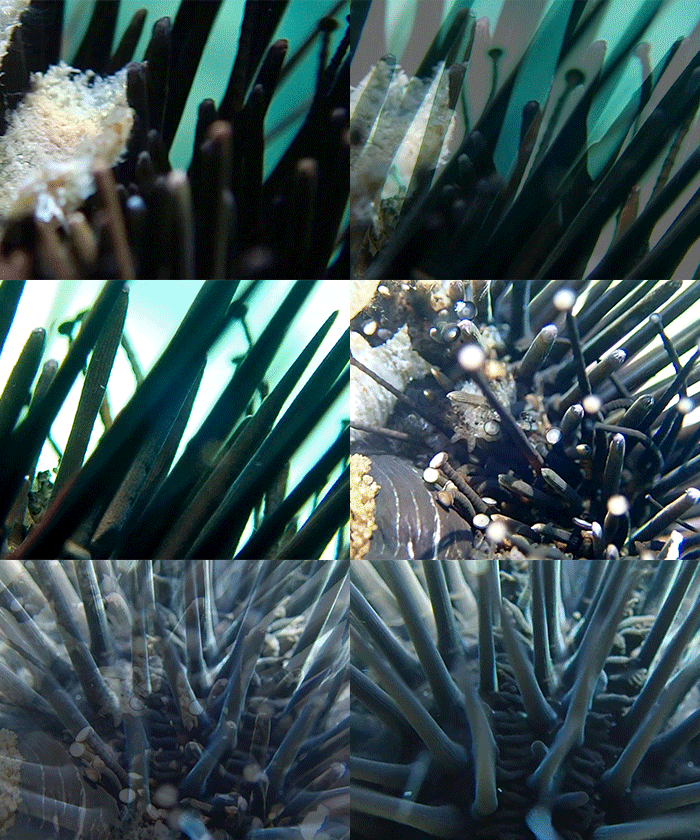
Black sea urchin (Arbacia lixula)
Key facts
- Scientific name
- Arbacia lixula
- Common name
- Black sea urchin
- Category
- Echinoderms
- Family
- Arbaciidae
- Genus
- Arbacia
- Size
- 4–6 cm
- Depth
- 0–40 m
- IUCN status
- Least concern (LC)
- Danger level
- Harmless
- Habitats
- rocky
- Behaviours
- herbivorous, nocturnal
- Ocean zones
- East Atlantic, Macaronesia, Mediterranean
Description
Arbacia lixula is a sea urchin of 4 to 6 cm test diameter with uniformly black sharp spines and a black test. Prefers wave-exposed rocks, higher in the water column than its neighbor Paracentrotus lividus. Grazes coralline algae and helps maintain bare-rock areas. Spines are not venomous but very painful to step on: watch out when barefoot.
Frequently asked questions
- How big is the Black sea urchin?
- Black sea urchin (Arbacia lixula) reaches 4–6 cm in length.
- At what depth can you find the Black sea urchin?
- Black sea urchin is found between 0–40 m deep.
- Is the Black sea urchin dangerous to divers?
- Danger level: Harmless.
- What is the conservation status of the Black sea urchin?
- IUCN status: Least concern (LC).
- Where can you find the Black sea urchin?
- Found in: East Atlantic, Macaronesia, Mediterranean.
Similar species
- Paracentrotus lividus - Purple sea urchin
- Coscinasterias tenuispina - Blue spiny starfish
- Sphaerechinus granularis - Violet sea urchin
- Marthasterias glacialis - Spiny sea star
- Echinaster sepositus - Red sea star
- Diadema antillarum - Long-spined sea urchin
Sources
- Taxonomy: WoRMS (AphiaID 124249)
- Photos: iNaturalist (CC BY-NC)
- Distribution: GBIF (taxonKey 2278772)
- Conservation: IUCN Red List
- Encyclopedia: Wikipedia