Bigeye Thresher Shark (Alopias superciliosus)
Key facts
- Scientific name
- Alopias superciliosus
- Common name
- Bigeye Thresher Shark
- Category
- Fish
- Family
- Alopiidae
- Genus
- Alopias
- Size
- 180–500 cm
- Depth
- 0–250 m
- IUCN status
- Vulnerable (VU)
- Danger level
- Harmless
- Habitats
- open-water, pelagic-zone
- Behaviours
- pelagic, migratory
- Ocean zones
- Asian Pacific, Caribbean, Eastern Pacific, Indian Ocean & Red Sea, Macaronesia, Mediterranean
Description
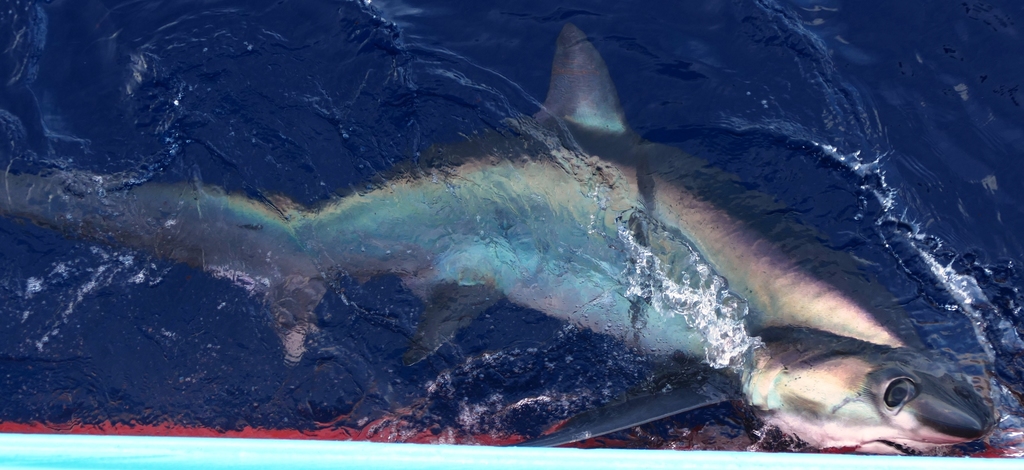
Alopias superciliosus reaches 5 m. Bigeye thresher, mesopelagic. Extraordinarily large eyes (25 mm), adaptation to dim deep light. Dark gray, extremely long tail (>= 50% body). Patchy distribution: East Pacific, Indo-Pacific. Open-water-to-benthic hunter. Overfishing and bycatch = VU (IUCN). Rarely known even to deep-sea divers.
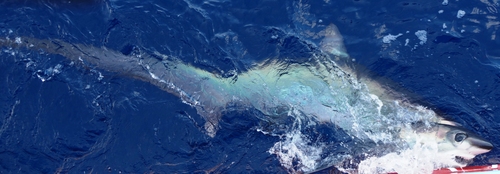
Photo of Bigeye Thresher Shark
Frequently asked questions
- How big is the Bigeye Thresher Shark?
- Bigeye Thresher Shark (Alopias superciliosus) reaches 180–500 cm in length.
- At what depth can you find the Bigeye Thresher Shark?
- Bigeye Thresher Shark is found between 0–250 m deep.
- Is the Bigeye Thresher Shark dangerous to divers?
- Danger level: Harmless.
- What is the conservation status of the Bigeye Thresher Shark?
- IUCN status: Vulnerable (VU).
- Where can you find the Bigeye Thresher Shark?
- Found in: Asian Pacific, Caribbean, Eastern Pacific, Indian Ocean & Red Sea, Macaronesia, Mediterranean.
Other species in the genus Alopias
Sources
- Taxonomy: WoRMS (AphiaID 105835)
- Photos: iNaturalist (CC BY-NC)
- Distribution: GBIF (taxonKey 2420813)
- Conservation: IUCN Red List
- Encyclopedia: Wikipedia